Postponement of Joining After Final Acceptance Due to COVID-19
Some Cases of De Facto Acceptance Cancellation Reported
41% of Job Seekers Experienced Hiring Postponement or Cancellation Notice
Violates Dismissal Restriction Rules but Exceptions Exist, Leading to Disputes
Many Forced into Part-Time Jobs for Immediate Livelihood
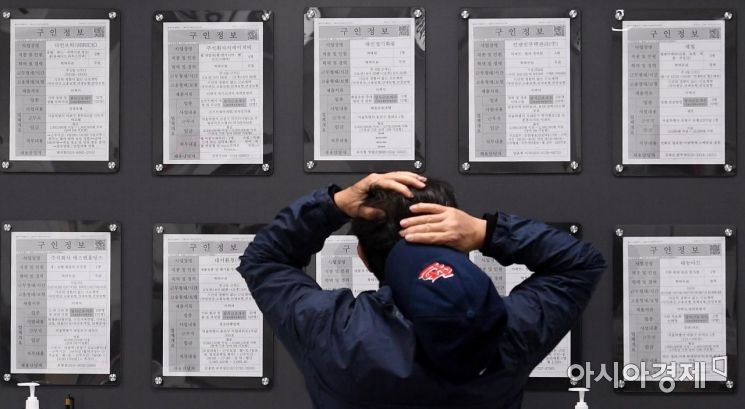 On the 16th, a job seeker visiting an Employment Welfare Plus Center in Seoul is looking at the job information bulletin board. According to the 'September Employment Trends' announced by Statistics Korea on the same day, the number of employed people last month was 27,012,000, a decrease of 392,000 compared to one year ago. This is the largest decline in four months since May (392,000). Photo by Kim Hyun-min kimhyun81@
[Asia Economy Reporter Donghoon Jeong, Intern Reporter Geunhwi Jeon] Job seeker Kim Sun-young (28, pseudonym) received the final acceptance notice for a full-time position at a youth training facility in January this year. It was a joy that came after more than a year of preparation and obtaining certifications. However, she was held back by the novel coronavirus disease (COVID-19). The company postponed the hiring schedule, saying, "We cannot conduct employee training due to COVID-19," and in May sent a message stating, "Please do not wait and pursue other opportunities if you have them," effectively canceling the hiring. The joy of acceptance was brief, and Kim is now making a living by working part-time as a server at a Japanese restaurant. She said, "After receiving the acceptance notice, I stopped preparing for employment for several months and only made rosy plans, but now I feel despair."
Due to the impact of COVID-19, job seekers who succeeded in getting hired are unable to actually start work, causing them double distress. Usually, companies notify an "indefinite postponement of hiring" citing COVID-19, which is practically no different from canceling the hiring. Such cases are numerous not only in industries hit hard like travel, aviation, and sports but also in companies struggling due to poor performance. Job seekers, who find it awkward to prepare for employment again, are wandering the unstable hourly wage labor market for immediate livelihood. However, there are no proper legal systems to protect or assist them.
This issue is not limited to job seekers. Seo Ihyun (30, pseudonym), who has been in the travel industry for three years, quit her job six months ago after successfully transferring to a foreign company. She decided to change jobs quickly as the travel industry was hit hard by COVID-19. Seo said, "I planned to switch to accounting, obtained two accounting certifications and improved my foreign language skills. However, the new company has been postponing hiring for six months due to COVID-19, so I am looking for another job."
A survey conducted by Saramin in April this year targeting 2,052 job seekers about their experience of being notified of hiring cancellation or postponement due to COVID-19 showed that 40.7% answered "yes." The top reason given by companies was "deterioration of business conditions due to COVID-19 impact (59.1%, multiple responses allowed)." Next were "indefinite postponement of schedule (46.3%)," "planned reduction of existing staff (11.4%)," and "discontinuation of the relevant business or work (6.4%)."
Despite unilateral notifications of hiring postponement or cancellation, it is not easy for job seekers, who are in a weaker position, to respond actively. Unlike workers, there is no clear way to protect them. According to the Supreme Court ruling, "when a company notifies a hiring decision, an employment contract relationship is established." Even under the Labor Standards Act, a company’s cancellation or indefinite postponement of a hiring decision violates dismissal restriction regulations. However, there is room for employers to justify this due to urgent business reasons, so disputes may arise case by case. While there are options like filing for relief with the Labor Relations Commission or civil lawsuits, these are not practical alternatives for job seekers.
Park Jeom-gyu, an operating committee member of Workplace Bullying 119, pointed out, "There are laws restricting hiring postponement or cancellation, but cases where employers have been punished are rare. Moreover, these laws do not even apply to businesses with fewer than 30 employees, and it is difficult for job seekers to respond through lawsuits or similar methods, which is a loophole."
© The Asia Business Daily(www.asiae.co.kr). All rights reserved.

















