At the OECD Ministerial Council Video Conference on the 29th
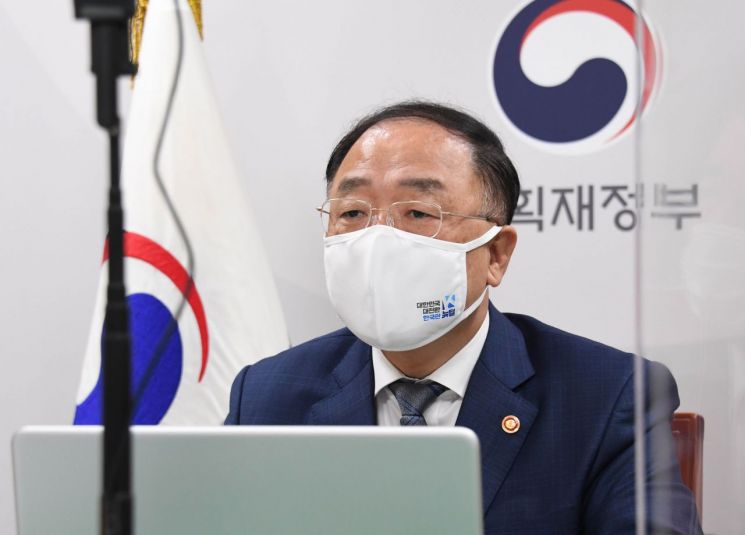 Deputy Prime Minister and Minister of Economy and Finance Hong Nam-ki is attending the 'OECD Ministerial Council Meeting' held via video conference on the 29th at the Government Seoul Office in Gwanghwamun, Seoul.
[Asia Economy Reporter Joo Sang-don] Hong Nam-ki, Deputy Prime Minister and Minister of Economy and Finance, stated on the 29th, "An active role of the public sector and strong economic stimulus policies are more important than anything else for the swift overcoming of the crisis caused by the novel coronavirus infection (COVID-19)."
On this day, Deputy Prime Minister Hong participated via video conference in the OECD's highest decision-making meeting, the annual Ministerial Council Meeting attended by ministers from all member countries (currently 37 countries), and made these remarks.
At this meeting, Deputy Prime Minister Hong proposed to the member countries strong economic stimulus measures along with ▲support for vulnerable groups ▲economic and social structural transformation ▲policy coordination and cooperation among countries.
First, Hong introduced that Korea is implementing a policy package worth a total of 310 trillion won this year, including four supplementary budgets, and mentioned that as a result, the economy grew by 1.9% (compared to the previous quarter) in the third quarter of this year.
Deputy Prime Minister Hong also emphasized, "Support is needed for vulnerable groups and developing countries that have been severely affected by COVID-19," and urged, "Let us overcome this crisis together by promoting the spirit of multilateralism based on solidarity and cooperation, and by facilitating trade and movement of people between countries."
At this Ministerial Council Meeting held amid the COVID-19 crisis, member countries adopted a ministerial statement by consensus for the first time in four years since 2016, addressing key issues such as trade, investment, and climate change, reaffirming their commitment to restoring multilateralism and coordinating policies for economic recovery. Korea actively negotiated to reflect the importance of cross-border movement of personnel necessary for core economic activities such as business operations in the ministerial statement.
This ministerial statement presented COVID-19 recovery measures including ▲sustaining economic stimulus policies within sustainable limits ▲utilizing opportunities and responding to challenges of digital transformation ▲promoting employment-friendly recovery policies ▲pursuing an integrated approach to economic, social, and environmental aspects and considering environmental factors ▲maintaining free, fair, and predictable trade and investment ▲strengthening international cooperation in taxation, including digital taxation.
© The Asia Business Daily(www.asiae.co.kr). All rights reserved.