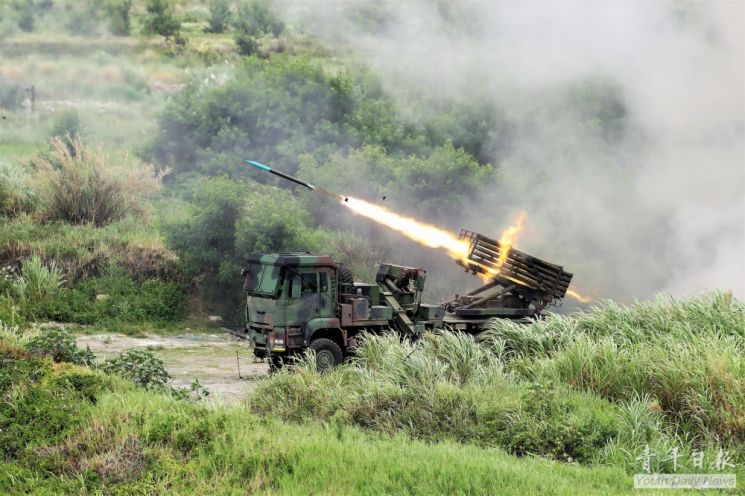
[Military Analyst Kim Daeyoung] The Rayting (雷霆) 2000, developed by Taiwan’s National Chung-Shan Institute of Science and Technology, is a multiple launch rocket system used to repel amphibious forces in the event of a Chinese invasion of Taiwan. Similar to the U.S.-made large-caliber MLRS that fires rockets equipped with submunitions, it has earned the nickname "Steel Rain" in Taiwan. It boasts the most powerful firepower among the artillery possessed by the Taiwanese Army and, like South Korea’s Chunmoo, uses a wheeled chassis.
The development of the Rayting 2000 began in 1997. Prior to this, the Taiwanese Army used the domestically developed Kung Feng (Gong Feng) Type 6 multiple launch rocket system. Deployed since 1982, the Kung Feng Type 6 fired 117mm rockets with a maximum range of 15 km. Equivalent to South Korea’s Kuryong system, the Kung Feng Type 6 operated manually, and rocket loading was done by hand, resulting in lengthy preparation times before firing. In the 1990s, as the Chinese military’s amphibious assault capabilities improved, there arose a need for a next-generation multiple launch rocket system that could quickly and effectively suppress enemy landing forces from a greater distance.
The Rayting 2000, developed as a wheeled multiple launch rocket system, was initially planned to use the U.S.-made HEMTT heavy military truck by Oshkosh as its chassis. Although the prototype vehicle used the HEMTT, negotiations over vehicle pricing between the U.S. and Taiwan stalled before mass production, leading to a shift toward military vehicles from other countries. Negotiations with German manufacturer Mercedes-Benz were pursued but ultimately failed due to export license issues. Finally, in 2009, South Korea’s specialized vehicle manufacturer Kwanglim supplied the German MAN TGS 8x8 high-mobility commercial truck to the Taiwanese government, which became the chassis for the Rayting 2000. Incidentally, Kwanglim had previously exported garbage trucks to Taiwan in 1991. After various challenges, mass production of the Rayting 2000 began at the end of 2010. Taiwan independently developed the fire control system, launcher, and ammunition, while three types of rockets are reportedly used.
First, the MK-15 rocket module carries 20 rounds of 117mm rockets previously used in the Kung Feng Type 6 multiple launch rocket system. These rockets are equipped with high-explosive warheads containing steel balls to maximize fragmentation effects. With a maximum range of 15 km, the Rayting 2000 can mount up to three MK-15 rocket modules, enabling it to fire 60 rockets in rapid succession. The MK-30 rocket module holds nine 182mm rockets loaded with 267 M77 submunitions (dual-purpose high-explosive anti-tank warheads) designed to destroy tanks and armored vehicles. Its maximum range reaches 30 km. The MK-45 rocket pod contains six 230mm rockets loaded with 518 M77 submunitions and has a maximum range of 45 km. The Rayting 2000 has been fielded with about 50 launchers and 50 ammunition and loading vehicles in the Taiwanese Army, and plans are underway to significantly extend its range through future upgrades.
© The Asia Business Daily(www.asiae.co.kr). All rights reserved.

















