Gyeongbuk Province and 6 Organizations Participate... MOU to Expand Regional Win-Win Renewable Energy Distribution
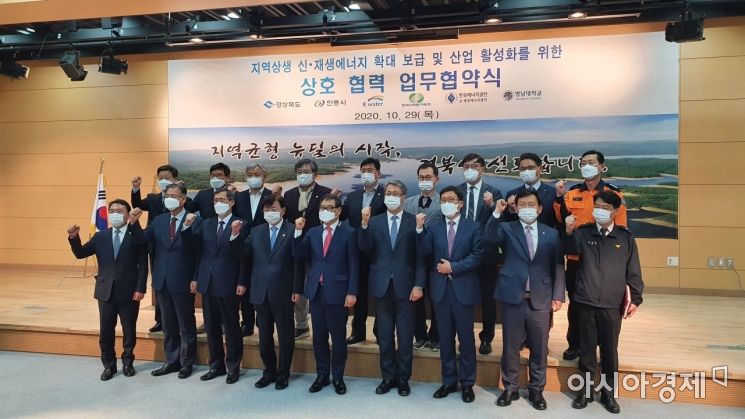
[Asia Economy Yeongnam Reporting Headquarters Reporter Park Dong-wook] Gyeongsangbuk-do signed a memorandum of understanding (MOU) for mutual cooperation to expand the distribution of renewable energy for regional coexistence and to revitalize the industry at the Andong World Water Forum Center on the 29th.
Attendees at the event included Ha Dae-seong, Deputy Governor for Economy of Gyeongsangbuk-do, Kwon Young-se, Mayor of Andong, Park Jae-hyun, President of Korea Water Resources Corporation, Jeong Jae-hoon, President of Korea Hydro & Nuclear Power Co., Ltd., Lee Sang-hoon, Director of the Korea Energy Agency Renewable Energy Center, Seo Gil-soo, President of Yeungnam University, Kim Hyung-dong, Member of the National Assembly, and local provincial council members.
Through this agreement, they plan to invest 117.9 billion KRW in the Imha Dam in Andong to promote the construction of the largest floating solar power plant in Korea with a capacity of 56 MW. In the future, Gyeongsangbuk-do intends to expand floating solar power plants with a total capacity of 648 MW and an investment scale of 1.3643 trillion KRW across eight dams in the province, including Andong Dam, Gunwi Dam, and Gimcheon Buhang Dam.
Gyeongsangbuk-do, Andong City, and Korea Water Resources Corporation plan to pre-assess environmental impacts and establish resident participation plans through the formation of a public-private consultative body to apply for Korea’s first renewable energy cluster complex.
A renewable energy cluster complex is a designated area for installing and operating environmentally friendly renewable energy power generation facilities (40 MW or more) under relevant laws. By securing suitable renewable energy resources, resident acceptance, sites, and infrastructure, the designated local government will receive benefits in local tax revenue through an additional 0.1 Renewable Energy Certificate (REC) allocation upon cluster designation.
Floating solar power generates electricity by installing solar panels on buoyant structures on the water surface. Using buoyant bodies and solar cell modules that do not affect water quality, it has no impact on aquatic ecosystems or surrounding environments and also provides spawning grounds for aquatic organisms, thereby revitalizing the fish ecosystem.
Ha Dae-seong, Deputy Governor for Economy of Gyeongsangbuk-do, stated, "We are developing a Gyeongsangbuk-do-type Green New Deal business model that coexists with local residents and communities." He added, "Through this agreement, we will strengthen cooperation among local governments, public enterprises, and regional universities and promote the Imha Dam floating solar pilot project as a signal fire of the Gyeongsangbuk-do-type Green New Deal that local residents can feel."
Meanwhile, Gyeongsangbuk-do plans to create 32,000 jobs through the promotion of 46 Green New Deal projects worth 7.3013 trillion KRW, including the designation of an energy industry convergence complex (2021?2025, 1.0312 trillion KRW) and the establishment of a hydrogen fuel cell power generation cluster (2022?2026, 234 billion KRW).
© The Asia Business Daily(www.asiae.co.kr). All rights reserved.

















