Concerns Over European Consumer Contraction Amid US Election Uncertainty
Volatility Index Hits Highest Since April COVID-19 Pandemic
"Investor Sentiment Likely to Recover Only If Stimulus Expectations Increase After US Election"
[Asia Economy Reporter Hyunwoo Lee] As the spread of the novel coronavirus infection (COVID-19) has reached a level uncontrollable by countries, fear has weighed heavily on global stock markets. Major European countries such as France and Germany have announced the resumption of lockdown measures one after another, raising concerns about consumption contraction. Coupled with political uncertainties in the U.S. due to the presidential election and delays in stimulus packages, investor sentiment has become extremely subdued. Wall Street experts foresee that even if the COVID-19 situation continues to worsen, optimism will resume after the U.S. presidential election as the new government’s stimulus measures begin, potentially restoring the weakened investor sentiment.
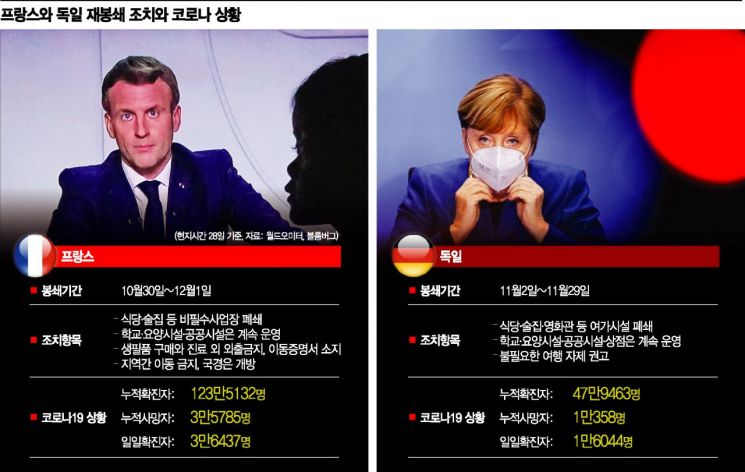
The stock market decline is largely influenced by the rapid intensification of COVID-19 spread in France and Germany as winter approaches. According to the global statistics site Worldometer’s COVID-19 tally, France recorded 36,437 new daily cases on the day, with cumulative cases rising to 1,235,132, making it the country with the highest number of confirmed cases in Europe except for Russia (1,533,976). Germany also recorded a record high of 16,044 new daily cases, increasing COVID-19 concerns. Italy (24,991), the United Kingdom (22,884), and Spain (18,418) are also seeing daily cases around 20,000, prompting calls for nationwide lockdowns to resume. Notably, Italy’s daily confirmed cases surpassed the previous record of 21,994 set the day before, marking a new all-time high in just one day.
The situation in the United States is also becoming severe. According to The Washington Post (WP), the U.S. health authorities reported 501,930 new COVID-19 cases over the past week, with the daily average stubbornly remaining in the 70,000 range.
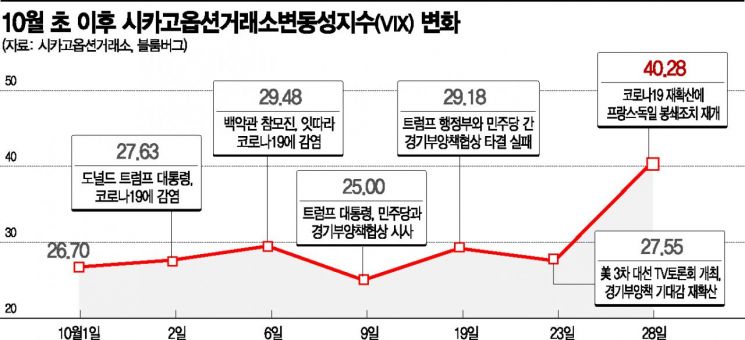
The news of nationwide lockdowns resuming in France and Germany, along with nighttime business restrictions in some U.S. regions, has heightened fears of consumption contraction in the market. The Chicago Board Options Exchange (CBOE) Volatility Index (VIX), known as the "fear index," surged 20.78% from the previous day to 40.28. This is significantly higher than the VIX levels recorded on October 2 when U.S. President Donald Trump was infected with COVID-19 (27.63) and on October 19 when stimulus package negotiations failed (29.18). The VIX surpassing 40 is the first time since April 9, when the U.S. was in the midst of a COVID-19 pandemic surge, recording 41.67.
Consumer sentiment is expected to contract sharply due to Europe’s lockdown measures. In France, from October 30 to December 1, all non-essential businesses such as restaurants and bars will be closed, excluding schools, nursing homes, and public institutions. Movement of residents is prohibited except for purchasing essentials and medical visits. The German government, unlike France, did not announce a full ban on residents’ movement but closed all leisure facilities including restaurants, bars, and cinemas.
A greater concern is the lack of effective methods to stop the spread of COVID-19. Anthony Fauci, director of the U.S. National Institute of Allergy and Infectious Diseases (NIAID), stated at an online discussion hosted by the Journal of the American Medical Association (JAMA) that "the increasing trend of confirmed cases in the U.S. is at record levels, raising concerns about hospital bed shortages," and "the likelihood of a vaccine receiving U.S. Food and Drug Administration (FDA) approval within this year is very low, with the earliest possible approval in January next year or even later." There is growing concern that if the 'twindemic' situation?simultaneous outbreaks of COVID-19 and influenza?occurs during the winter flu season, the situation could become uncontrollable.
Political uncertainties ahead of the U.S. presidential election and concerns over delays in stimulus packages are also perceived as negative factors overlapping with the COVID-19 situation. According to The Wall Street Journal (WSJ), David Bailin, Chief Investment Officer at Citi Private Bank, analyzed, "In the midst of the COVID-19 issue, strong government stimulus is urgently needed, but with the U.S. presidential and Senate elections coinciding, uncertainty remains whether a new government with strong administrative power will emerge, leading investors to sell."
However, given that the U.S. economy remains robust, even considering the COVID-19 situation, it is expected that investor sentiment will recover after the presidential election with hopes for stimulus measures from the new government. According to CNBC, Ed Yardeni, CEO of Yardeni Research, stated, "Key economic indicators are still healthy enough to start a new crisis, and expectations for a V-shaped recovery are high," adding, "A stock market recovery after election day is quite possible."
© The Asia Business Daily(www.asiae.co.kr). All rights reserved.
![Clutching a Stolen Dior Bag, Saying "I Hate Being Poor but Real"... The Grotesque Con of a "Human Knockoff" [Slate]](https://cwcontent.asiae.co.kr/asiaresize/183/2026021902243444107_1771435474.jpg)

















