President Moon's Order to 'Create High-Quality Lifetime Housing'
Utilizing Government-Invested Housing and Urban Fund
LH and HUG Debt Increasing Annually
"Limits Remain in Solving Supply Issues"
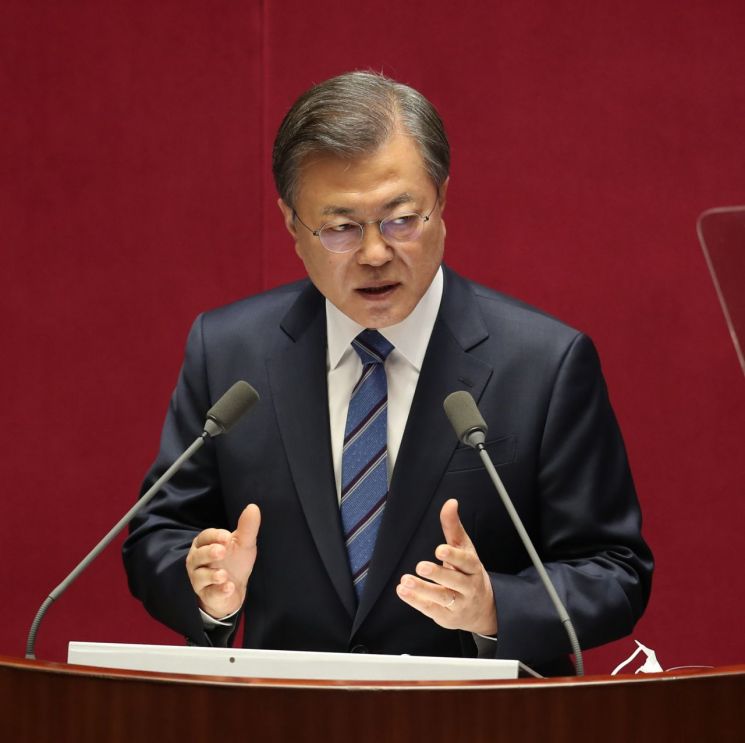
[Asia Economy Reporter Jang Sehee] President Moon Jae-in has instructed to devise a plan to make public rental housing a 'high-quality lifelong home' that anyone, including the middle class, would want to live in. The funding is planned to be secured through government investment and the Housing and Urban Fund. However, some critics argue that this approach involves borrowing with taxes to curb the side effects of the real estate market.
According to related ministries such as the Ministry of Land, Infrastructure and Transport and the Ministry of Economy and Finance on the 29th, the government is reportedly considering increasing the area up to 85㎡ to allow middle-class residents and raising the median income standard beyond 130%. A government official stated, "The Ministry of Land and the Ministry of Economy and Finance are discussing the introduction of high-quality lifelong housing," adding, "Increasing the size inevitably requires more funding." Essentially, this means expanding lifelong housing through additional financial input.
Public rental housing funding is procured through investments from the Korea Land and Housing Corporation (LH) and the Housing and Urban Fund or by guarantees provided by the Housing and Urban Guarantee Corporation (HUG). HUG plays a subrogation role by reimbursing the deposit to tenants if the landlord fails to return the jeonse deposit on time due to a guarantee accident. The rest is covered by receiving rental deposits from tenants.
With the expansion of the government's housing stability support measures, the burdens on LH, the Housing and Urban Fund, and HUG are increasing annually. LH's debt in the first half of this year reached 131.9 trillion won, increasing every year since 2018. Meanwhile, net income, which was 2.2 trillion won in 2016, sharply dropped to 1.4 trillion won in the first half of this year.
HUG is also in poor financial condition. HUG's debt in the first half of this year was 1.9652 trillion won, with a debt ratio reaching 34%. In 2018 and 2019, the debt ratios were 30.6% and 32.6%, respectively. The Housing and Urban Fund's debt in 2018 was 150.5044 trillion won, nearly 50 trillion won more than four years earlier (102.3117 trillion won). Previously, the Ministry of Economy and Finance expressed its position during consultations with the Ministry of Land that supporting investments for medium-sized housing for the middle class is not feasible given the fund's limited capacity.
Academics point out that expanding the size of public rental housing has limitations in solving supply issues in the market. Professor Kim Sangbong of Hansung University’s Department of Economics said, "With total funding limited, increasing the size inevitably reduces the number of units supplied," adding, "Without effective supply policies and only demand-side regulations, housing prices inevitably rise."
Professor Shim Gyo-eon of Konkuk University’s Department of Real Estate advised, "The Moon administration’s housing welfare policy has invested heavily in public rental housing," emphasizing, "It is important to see whether the public rental policy is functioning properly in the market." He added, "In some local areas, rental housing remains vacant," and said, "It would be more effective to supply housing in locations where tenants actually want to live."
© The Asia Business Daily(www.asiae.co.kr). All rights reserved.

















