"From Just a Fine to Now Facing Actual Imprisonment"
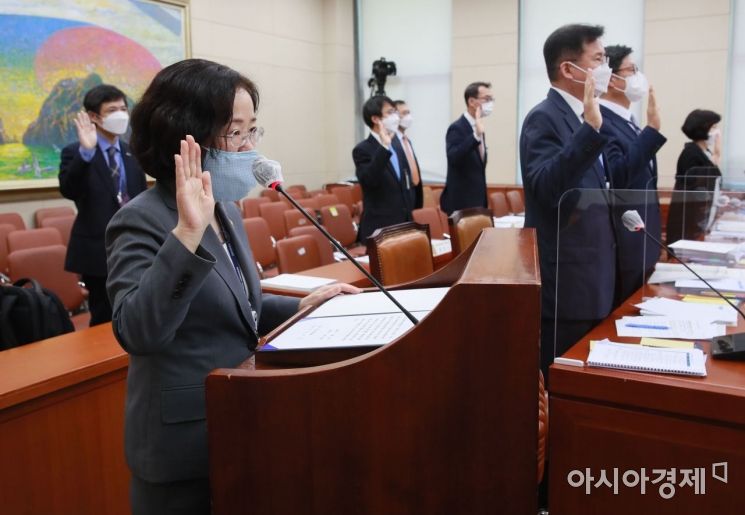 Chairman Jo Sung-wook of the Korea Fair Trade Commission appeared at the National Assembly's Political Affairs Committee hearing on the 8th and took the witness oath.
 [Photo by Yoon Dong-joo]
[Asia Economy Reporter Kim Jong-hwa] "If the Fair Trade Commission investigates, it would end with a fine, but if the prosecution gets involved, one could face imprisonment."
A small and medium-sized enterprise (SME) executive made this remark regarding the government's and ruling party's push to fully revise the Fair Trade Act centered on abolishing the exclusive right to file complaints.
The exclusive right to file complaints is a system that allows only the Fair Trade Commission (FTC) to file complaints with the prosecution regarding violations of unfair practices such as collusion. In the current amendment, the exclusive right to file complaints will be abolished only for 'hardcore cartel.' Hardcore cartel refers to collusion aimed at strengthening corporate monopolies, including price and quantity collusion, market division collusion, and bid rigging, which cause significant harm to the market.
Since over 90% of collusion cases detected by the FTC are hardcore cartels, this can be considered a de facto complete abolition of the exclusive right to file complaints. This means that the prosecution will investigate collusion cases detected by the FTC. Therefore, once the amended law is enforced, anyone can file a complaint with the prosecution regarding cases judged as hardcore cartel, and the prosecution can initiate investigations at its discretion.
Legal Vulnerability in Case of Abuse of Complaint Rights
The problem lies in the contraction of business activities of SMEs due to abuse of complaint rights by ordinary citizens or competitors. Compared to large corporations, SMEs often lack technology or capital and frequently collaborate in joint technology development, joint production of products, and enter the market under a joint brand at the same price. If other competing companies that are not part of the joint brand obtain such information and file complaints or accusations with the FTC or prosecution alleging collusion, the act of 'price collusion' is clear, thus violating the Fair Trade Act as a 'hardcore cartel.'
Although the Small and Medium Enterprise Cooperative Act includes a clause that joint production through joint meetings is not considered collusion, if leniency is applied or competitors file complaints, the FTC's investigation cannot be avoided. Until now, with the exclusive right to file complaints, administrative sanctions such as fines by the FTC were the end, but if the prosecution investigates, it becomes subject to criminal punishment and imprisonment may be sought.
A lawyer specializing in Fair Trade Act cases at a major law firm said, "Malicious collusion cases require additional criminal punishment beyond administrative sanctions, but most collusion cases involving SMEs are sufficiently addressed by light administrative sanctions," adding, "However, if the prosecution investigates, minor violations during business operations are likely to be expanded into separate investigations, which will be a significant burden for companies."
Kim Hee-jung, head of the Win-Win Cooperation Department at the Korea Federation of SMEs, lamented, "Even if it is not actual collusion, if a third party perceives it as collusion and files complaints, prosecution investigations are inevitable," and added, "In reality, SMEs lack legal response capabilities. Most SMEs find it difficult to conduct normal business operations even if only one case is filed against them."
Prosecution Says No 'Separate Investigations'... "Lack of Trust"
A more serious issue is the prosecution's 'separate investigations.' A key official from an SME-related organization, who has experienced prosecution investigations following FTC investigations for collusion, said, "If the exclusive right to file complaints is abolished and the prosecution directly investigates companies, companies become very vulnerable," and continued, "We prepared answers regarding reasons for collusion, but the actual investigation was about embezzlement. We struggled immensely to clear the charges." He also raised his voice, saying, "While investigating the reported case, unrelated matters are uncovered, eventually turning into separate investigations. Who is there that won't be targeted when they try to dig? This is a malicious legal amendment aimed at turning business people into criminals."
Since leniency can still lead to criminal punishment, companies may be reluctant to apply for it. At the National Assembly's Fair Trade Commission audit on the 8th, Kang Min-gu, a member of the People Power Party, pointed out, "Out of about 50 collusion cases detected by the FTC in 2019, over 30 were resolved through leniency," and added, "In such a situation, abolishing the exclusive right to file complaints may reduce voluntary reporting due to fear of separate investigations by the prosecution."
Seemingly aware of such public opinion, the prosecution is actively considering creating internal regulations or enforcement decrees to prevent separate investigations. This means expressing an intention not to additionally investigate other charges such as embezzlement or breach of trust while investigating collusion-related cases.
Despite this opposition, as the government and National Assembly push forward with abolishing the exclusive right to file complaints, the Korea Federation of SMEs proposed a phased implementation starting with large corporations. A representative from the Federation said, "Since institutional supplementation is necessary, it is better to first implement the amended law for large corporations that have well-established legal response capabilities such as legal teams," and added, "It may be appropriate to apply it to SMEs later while monitoring market conditions."
An official from the National Assembly Research Service emphasized, "It depends on the decision of the National Assembly, but since the scope of application can be determined flexibly, it is possible to have an intermediate stage as a buffer," and stressed, "Since overlapping investigations by the FTC and prosecution can increase the burden on companies, institutional measures to supplement this and adjustments to criminal punishment targets should be discussed together."
© The Asia Business Daily(www.asiae.co.kr). All rights reserved.

















