Road Traffic Authority Demonstration Test
Signal Controller→Authority Center→Autonomous Vehicle Information Transmission
Expecting to Minimize Infrastructure Construction Costs Using LTE
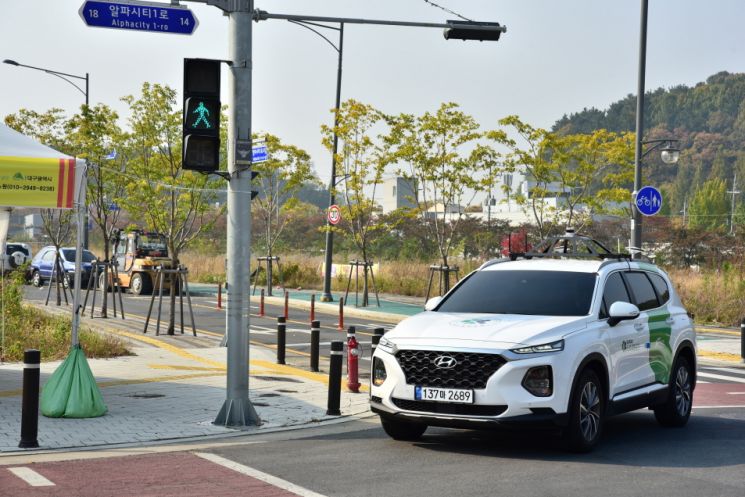 An autonomous vehicle receiving a signal waiting at a pedestrian signal while making a right turn at an intersection. / Provided by the Road Traffic Authority
[Asia Economy Reporter Lee Gwan-joo] An autonomous vehicle that received real-time traffic light status via LTE communication successfully navigated an intersection without the aid of cameras. This is expected to pave the way for overcoming the limitations of camera-based autonomous driving systems.
The Korea Road Traffic Authority announced on the 29th that, for the first time in Korea, it provided real-time traffic signal information to autonomous vehicles and successfully verified that these vehicles could safely drive straight, make unprotected left turns, U-turns, and right turns at intersections using this information.
This demonstration was conducted with the cooperation of Daegu City, with the Korea Road Traffic Authority building and testing an autonomous cooperative driving environment infrastructure. The real-time traffic signal information was transmitted from traffic signal controllers installed at intersections via LTE modems to the Authority’s Signal Hub Center, and then forwarded to the autonomous vehicles.
As a result, the maximum error in traffic signal information transmission was within 0.1 seconds, and it was confirmed that autonomous vehicles could safely navigate all travel paths at intersections based on the provided signal information.
Through this demonstration, the Authority confirmed that autonomous vehicles can utilize signal information without delay in an LTE environment and that delivering traffic light information as digital data enables more perfect driving capabilities compared to the limited video recognition method.
In particular, it is expected to overcome the limitations of autonomous vehicles that have relied on camera recognition. Camera recognition has faced difficulties such as recognizing pedestrian signals during right turns and lacking information on unprotected left turns and U-turns, but these can be covered by delivering signal information. Since Korea’s nationwide LTE network is already commercialized, the infrastructure construction does not require significant costs, which is another advantage.
Yoon Jong-gi, Chairman of the Korea Road Traffic Authority, said, "We expect this demonstration to accelerate the commercialization of autonomous vehicles," adding, "In the future, both general drivers and autonomous vehicles will be able to receive services utilizing real-time traffic signal information."
© The Asia Business Daily(www.asiae.co.kr). All rights reserved.

















