USTR Supports Head Yu
EU Still Holds the Casting Vote
'US-China Proxy War' Dynamics... Final Impact
Government Chooses Final Competition Over Resignation
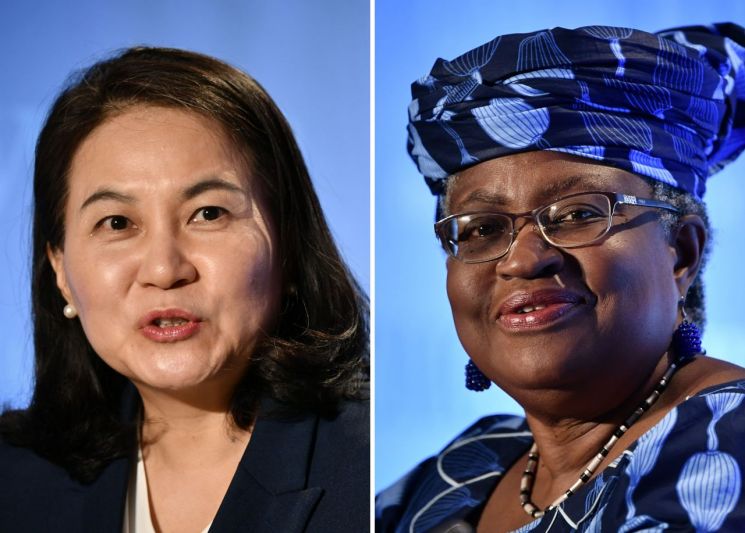 In the final runoff of the World Trade Organization (WTO) Director-General election, Korea's Yoo Myung-hee, Minister for Trade at the Ministry of Trade, Industry and Energy (left), competes against Ngozi Okonjo-Iweala, former Nigerian Minister of Finance and Foreign Affairs. (Image source=AFP Yonhap News)
[Asia Economy Reporter Moon Chaeseok] The U.S. Trade Representative has publicly endorsed Yoo Myung-hee, the Chief Negotiator of the Ministry of Trade, Industry and Energy, for the position of Director-General of the World Trade Organization (WTO), emerging as the final variable in the election. Considering the WTO's traditions and stance, the atmosphere was expected to favor the nomination of Nigeria's Ngozi Okonjo-Iweala, Yoo's competitor, before the U.S. presidential election on the 3rd of next month (local time). However, a major variable has suddenly appeared. Director-General Yoo is the first Korean and first woman to challenge for the WTO Director-General position.
WTO Election is a Matter of Politics and Power... U.S. Support a Major Variable
At 12:05 a.m. on the 29th, the Ministry of Trade, Industry and Energy stated in a press release, "At a WTO ambassador-level meeting convened in Geneva at 3 p.m. local time (11 p.m. Korean time), David Walker, Chair of the WTO General Council, announced that candidate Okonjo-Iweala received more votes in the final round." This means that the WTO summoned the ambassadors of Korea and Nigeria to convey the message that "member countries have decided to support the Nigerian candidate and nominate her as the final winner."
Typically, all member countries agree to the WTO's proposal and then officially nominate the candidate as the next Director-General. Moreover, the WTO was eager to fill the vacant Director-General position as soon as possible and aimed to nominate the Director-General before the U.S. presidential election on the 3rd, rather than the initially announced 7th.
The U.S. throwing its support behind Director-General Yoo has created a major variable. As the WTO Director-General election progresses to higher rounds, political judgments by governments have a greater influence on voting than the individual qualities of candidates. This has given Director-General Yoo a clear justification to seek even one more vote from the U.S., as well as from U.S. allies in South America, Oceania's developed countries, the Caribbean, and developing countries in Eastern Europe.
Since June, African Momentum... Last Chance for a Comeback
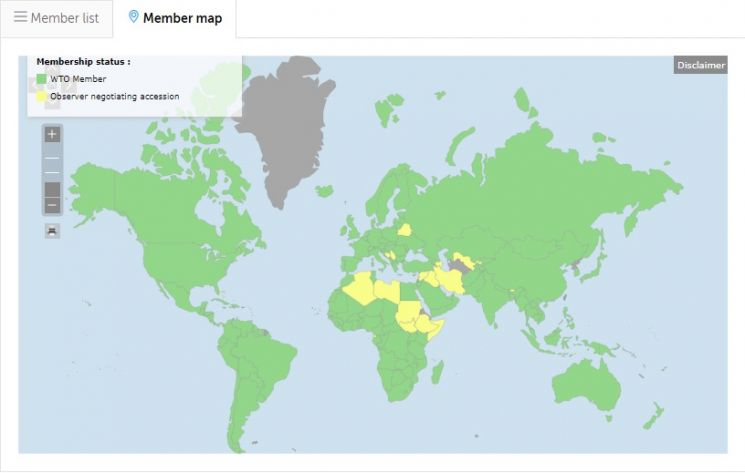 Countries in green are members of the World Trade Organization (WTO). (Photo by WTO website capture)
During the four months of the election, many analyses emerged such as "The election has turned into a proxy war between the U.S. (supporting Korea) and China (supporting Nigeria)," "Japan, involved in WTO disputes, has covertly influenced European votes to lean toward Nigeria," and "Japan and China’s early declarations of African support reflect pre-existing uncertainties and thus will not significantly affect the momentum."
The clear fact is that the U.S.'s public support for Director-General Yoo is the last chance to revive the election, which was practically concluded with the EU's support for candidate Okonjo-Iweala. Ultimately, dispersing European votes is necessary for a comeback victory, and whether U.S. support for Korea can lead to a shift in European backing is key. The critical question is whether U.S. support can break the traditional "EU-Africa bond" relationship.
Interpretations of U.S. support lean toward "advantageous for Director-General Yoo if Donald Trump is re-elected, disadvantageous if Joe Biden wins." The U.S. presidential election results are expected to play a significant role in WTO decision-making, as the Trump administration’s Trade Representative has come out in support of Director-General Yoo. There is also pessimism questioning whether U.S. support will be beneficial to the candidate given that the U.S. has paralyzed WTO functions.
Government Deliberating Whether to Hold On... "Cannot Ignore U.S. Position"
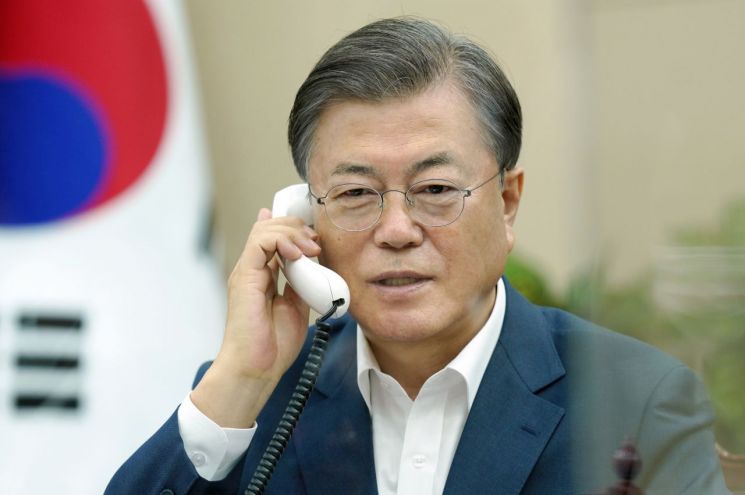
For Director-General Yoo, she must choose between withdrawing her candidacy as proposed by the WTO or attempting a comeback in the final member consultations. According to WTO regulations, receiving lower support in the preference survey does not mean immediate withdrawal from the race.
It is widely expected that Director-General Yoo will not withdraw immediately despite trailing in the preference survey. The Blue House and government maintain the stance of "no voluntary withdrawal; we will do our best until the end." The Ministry of Trade, Industry and Energy has not commented on voluntary withdrawal, only stating, "The candidate agreed upon through a consensus process involving all member countries will be recommended as the next WTO Director-General at the special General Council meeting scheduled for the 9th of next month."
The WTO Director-General election operates under a unique system where the candidate who wins the preference survey must also absorb opposing votes to receive "unanimous support" for the election to conclude. In the 1999 Director-General election, former New Zealand Prime Minister Mike Moore, supported by developed countries, and former Thai Deputy Prime Minister Supachai Panitchpakdi, backed by developing countries, competed until the end. Failing to reach consensus, the Director-General term was extended to six years, with Mike Moore serving from 1999 to 2002 and Supachai from 2002 to 2005, each serving three years. Neither candidate passed the consensus process.
The reason the U.S. supports Director-General Yoo is clear: she is the competitor to Okonjo-Iweala, who is backed by China. According to the U.S. political media Politico, the U.S. State Department sent a memo on the 25th instructing its overseas missions to ascertain whether host governments support Director-General Yoo and, if no preferred candidate exists, to encourage support for her. If the U.S. refuses to accept the Nigerian candidate, it implies that other countries might change their stance to support Director-General Yoo.
Meanwhile, President Moon Jae-in, Prime Minister Chung Sye-kyun, the Ministry of Foreign Affairs, and related departments have provided full support throughout Director-General Yoo’s election process. At least, there is widespread evaluation that the Korean government "did everything it could."
President Moon requested support for Director-General Yoo from 13 countries including New Zealand, Australia, Russia, Germany, Brazil, Malaysia, Italy, Denmark, India, Kazakhstan, and Chile. Prime Minister Chung appealed for support from 27 countries including Colombia, Sri Lanka, Guatemala, and Croatia. This strategy of "targeted support fire" focusing on key regions such as the New Northern and New Southern policies, Asia, and Latin America?covering both developed and developing countries?has been generally regarded as the right direction.
© The Asia Business Daily(www.asiae.co.kr). All rights reserved.



















