Junggyeonryeon Holds Policy Meeting with the Democratic Party on the 28th
Conveys Mid-sized Companies' Opinions on Amendments to the Commercial Act and the Fair Trade Act
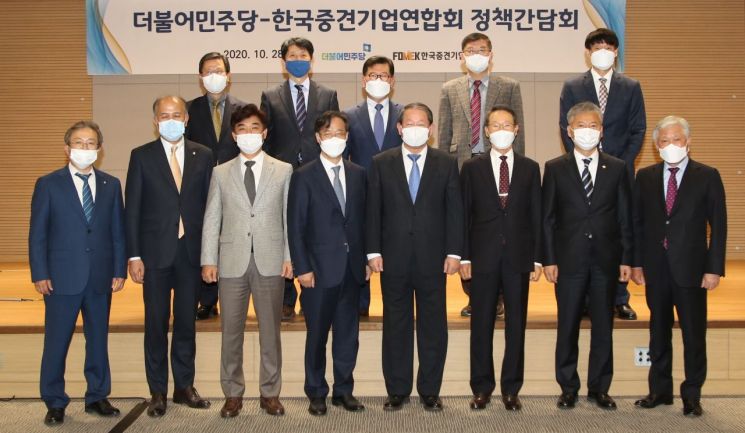 Kang Ho-gap, Chairman of the Federation of Medium and Small Businesses (fourth from the right in the first row), and others are taking a commemorative photo at a policy meeting with the Democratic Party of Korea on the 28th.
[Asia Economy Reporter Kim Cheol-hyun] The Korea Federation of Medium-sized Enterprises (KMFME) announced on the 28th that it held a policy meeting with the Democratic Party of Korea at the Seoul Mapo Listed Companies Association Hall and conveyed the "Opinions of the Medium-sized Enterprises Sector on the Amendments to the Commercial Act and the Fair Trade Act."
According to KMFME, on that day, medium-sized business leaders, including Chairman Kang Ho-gap, pointed out the problems of the amendments to the Commercial Act and the Fair Trade Act that would impose significant burdens on corporate management. The attendees emphasized that the business sentiment index for medium-sized enterprises in the third quarter recorded an all-time low, indicating a severe perceived crisis, and requested that the government and the National Assembly respond proactively to ensure that the concerns from the business field are reflected in the so-called 'three corporate regulation laws' amendments.
The meeting was attended by Yoo Dong-su, Chairman of the Fair Economy 3 Laws Task Force; Kim Byung-wook, Secretary of the Political Affairs Committee; Baek Hye-ryun, Secretary of the Legislation and Judiciary Committee; Assemblymen Oh Ki-hyung, Hong Sung-guk, Lee Yong-woo, and Song Ki-heon. From the medium-sized enterprise sector, Chairman Kang Ho-gap, Chairman Jung Gu-yong of Inzi Controls, Chairman Kim Hyung-jin of Sejong Telecom, Executive Director Kim Yong-su of Nepes, Vice Chairman Ban Won-ik of KMFME, Director Cho Byung-sun of the Medium-sized Enterprise Research Institute, and Executive Director Choi Hee-moon of KMFME participated.
The medium-sized business leaders raised their voices that the amendments to the Commercial Act, which would seriously affect small and medium-sized enterprises accounting for 88.1% of listed companies, are not only inconsistent with global standards but also severely infringe on corporate autonomy under the pretext of 'rationality' in governance structures arbitrarily set, thereby reducing overall economic vitality. They particularly pointed out that overlooking the possibility of management rights threats by speculative capital in the absence of sufficient defense measures such as dual-class voting rights is problematic.
Additionally, the industry warned that the comprehensive amendments to the Fair Trade Act, which emphasize fair economy and innovative growth, including strengthening shareholding requirements for holding companies, tightening internal transaction regulations, and abolishing exclusive prosecution rights, could only increase damage to small and medium-sized enterprises unrelated to economic power concentration. They urged a full reconsideration in a direction that can restore corporate dynamism to overcome the COVID-19 pandemic and achieve economic re-acceleration. Regarding the strengthening of shareholding requirements for holding companies, KMFME explained that it would block the establishment or conversion of holding companies for small and medium-sized enterprises, which account for 77.3% of general holding companies, and result in reduced job creation and investment expansion due to increased additional share purchase costs.
The attendees also emphasized that internal transactions have value as a strategic measure to reduce transaction costs and improve management efficiency. They argued that abolishing exclusive prosecution rights is one of the representative measures that would increase corporate management burdens, causing inefficiency due to overlapping investigations by the prosecution and the Fair Trade Commission, and unnecessarily increasing the human and material costs for corporate responses.
Kang Ho-gap, Chairman of KMFME, stated, "In a situation where the majority of companies and the entire Korean community stand at a crossroads of life and death due to COVID-19, there should be no deepening of legislative regulations that strangle the foundation of economic recovery, which is the enterprise." He added, "We ask the National Assembly to carefully examine the corporate situation, break the chain of regulations disconnected from reality, and open the way for establishing an institutional foundation that leads creative management activities and improves the industrial ecosystem's constitution."
© The Asia Business Daily(www.asiae.co.kr). All rights reserved.

















