The 9th Real Estate Market Inspection Meeting of Relevant Ministers
Move in with 20% equity… Acquire an additional 10-15% every 4 years
Industry: "Key to success is location and total supply volume"
No measures for Jeonse yet
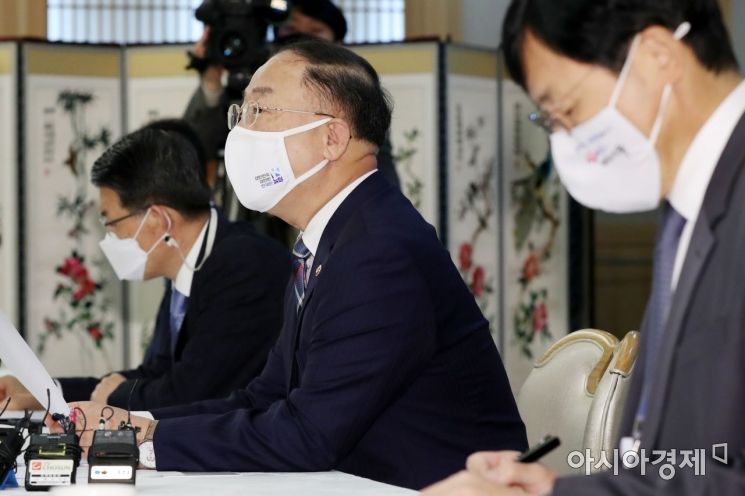 Hong Nam-ki, Deputy Prime Minister and Minister of Economy and Finance, is delivering opening remarks at the '9th Real Estate Market Inspection Meeting of Related Ministers' held on the 28th at the Government Seoul Office in Jongno-gu, Seoul. Photo by Kang Jin-hyung aymsdream@
[Asia Economy reporters Joo Sang-don (Sejong) and Jang Se-hee] The government has decided to supply 'equity accumulation type sale housing' from 2023, allowing people to secure a 'home' with a minimum of 20% equity. The government expects this to ease the initial burden on low-income citizens lacking capital, but concerns have arisen in the market. Sufficient supply to curb panic buying must be provided in locations that satisfy actual demand, but the location and total supply volume have not yet been determined. Clear measures for the recent Jeonse crisis have also not been presented.
On the 28th, Hong Nam-ki, Deputy Prime Minister and Minister of Economy and Finance, chaired the 'Real Estate Market Inspection Meeting of Related Ministers' at the Government Seoul Office and announced the 'Key contents and future plans for equity accumulation type sale housing.'
According to the announcement, buyers can initially acquire only 20-25% of the land and building equity at the time of sale to move in. The rent for the public equity portion after moving in will be set at a level lower than market prices. Subsequently, buyers will acquire additional equity evenly every 4 years by 10-15%, eventually owning 100% of the house after 20-30 years. Minister Hong said, "Equity accumulation type housing will be gradually applied starting with highly preferred urban sites such as publicly owned land and public redevelopment project contributions among newly supplied houses, and sales are expected to begin from 2023." He added, "We expect equity accumulation type sale housing to become a new supply model that actively supports home ownership for future non-homeowners with actual demand."
The government plans to support asset formation through long-term residence while sufficiently securing public interest through equity acquisition periods and residence obligations. Representative measures include applying resale restrictions and actual residence requirements, though specific levels have not yet been decided.
Ham Young-jin, head of Zigbang Big Data Lab, pointed to location and total volume as the keys to the success of equity accumulation type housing. He said, "Since resale is restricted and full ownership is only achieved after up to 30 years, if house prices fall in the future, there could be many mid-term dropouts, so locations where asset value does not decline in the long term are important." He added, "Also, the key is whether enough supply can be provided to satisfy demand and suppress panic buying."
Regarding the recent Jeonse crisis, Minister Hong said on the same day, "We will carefully analyze the Jeonse market and consider various measures to harmoniously stabilize both the sales and Jeonse markets." This indicates that finding a solution is not easy. A senior government official said, "There is no sharp solution for the Jeonse issue," and added, "The government will create policies that signal that house prices will rise but not sharply, and that waiting a little is acceptable."
As opinions differ on whether the current Jeonse shortage is a side effect of real estate policies or a temporary transitional rise, premature Jeonse measures could inadvertently fuel sales price increases. If sales prices are declining, the government can expand Jeonse deposit return guarantees or increase Jeonse loan amounts, but if the opposite is true, Jeonse and sales prices may rise together. Also, since most Jeonse tenants are actual demanders, it is difficult to impose penalties as with sales. In fact, the government views that the upward trend in sales prices tends to raise Jeonse prices more strongly than the other way around.
© The Asia Business Daily(www.asiae.co.kr). All rights reserved.
![Clutching a Stolen Dior Bag, Saying "I Hate Being Poor but Real"... The Grotesque Con of a "Human Knockoff" [Slate]](https://cwcontent.asiae.co.kr/asiaresize/183/2026021902243444107_1771435474.jpg)
















