Complete Confirmation of All Adornments on the Mummy's Body
"Similar Set of Ornaments Unearthed from Silla Tomb in Gyeongju Hwangnam-dong"
Important Clue for Understanding the Nature of Bihagaya Culture
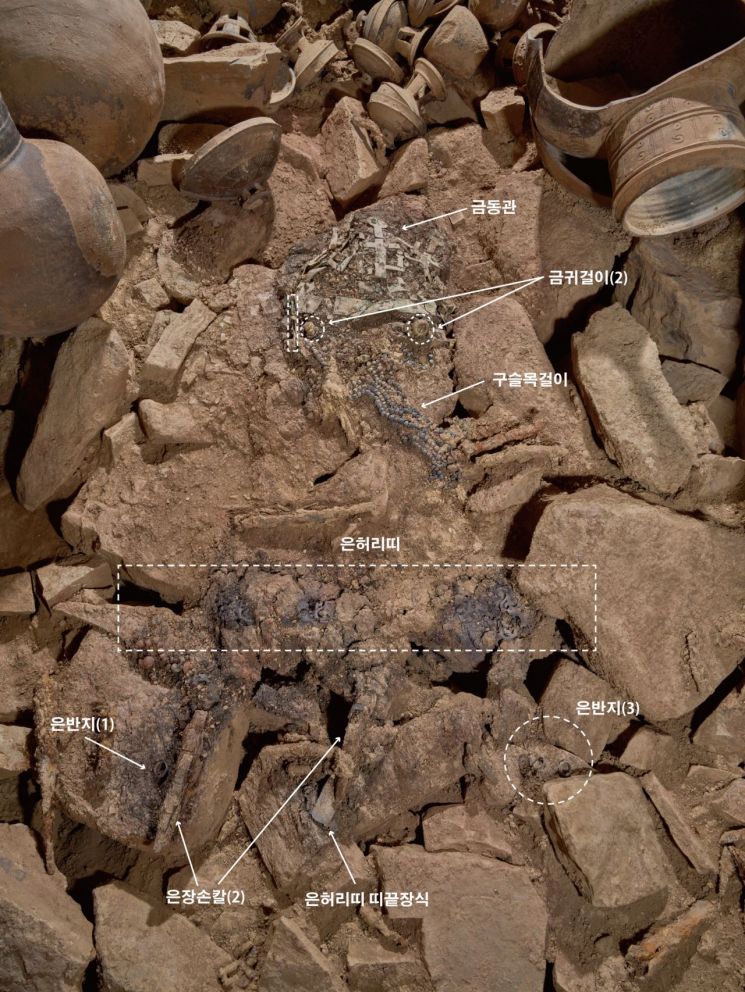
The National Gaya Cultural Heritage Research Institute announced on the 28th that it has excavated and investigated Tomb No. 63 of the Gyodong II group in the Changnyeong Gyodong and Songhyeon-dong Tumuli Cluster (Historic Site No. 514), confirming the ornaments of the ruler of Bihwa Gaya. These include a gilt-bronze crown approximately 21.5 cm in height, gilt-bronze pendants, gilt-bronze rod decorations, a pair of thick ring earrings (Taehwan style), a navy blue glass bead necklace, a silver ring, and a silver belt. An official stated, “For the first time, all the decorative artifacts (wearing items) adorning the body of the interred individual were fully confirmed in a tomb of the highest ruling class of Bihwa Gaya,” adding, “Except for the absence of shoes, the set of ornaments is similar in composition to those excavated from the Silla tomb in Hwangnam-dong, Gyeongju, last September.”
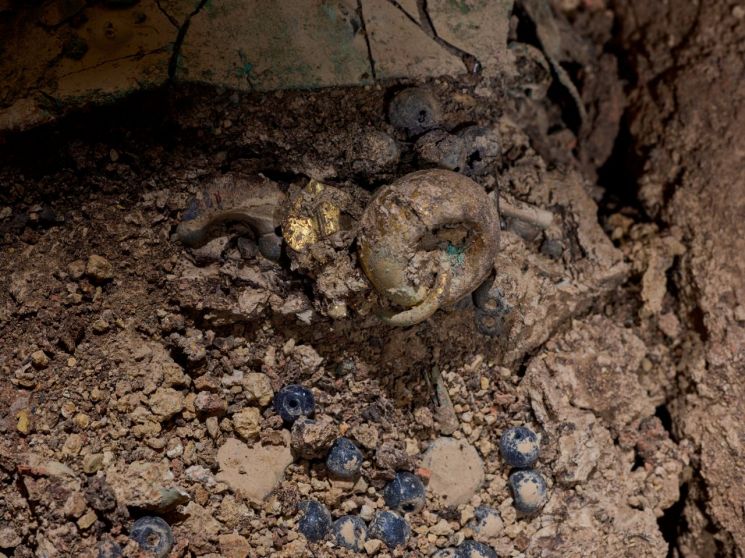
The gilt-bronze crown has a crown band about 3 cm wide at the bottom, designed as a rounded band to fit on the head. Above it stands a three-tiered branch-shaped ornament. Below the crown band are gilt-bronze pendants composed of curved jade (Gok-ok) and gilt-bronze beads on both sides. Cylindrical gilt-bronze rod decorations hang on both lateral sides. An official noted, “There were textile traces presumed to be a crown cap on the underside of the standing ornament.” The silver belt, with a total width of 45 cm, is adorned with two silver decorated hand knives and belt-end ornaments attached as pendants. On both hands, one silver ring (right hand) and three rings (left hand) were confirmed. On the right forearm of the interred individual, curved jade and orange beads connected to a circular gold plate, presumed to be a bracelet or hand knife decoration, were also identified.
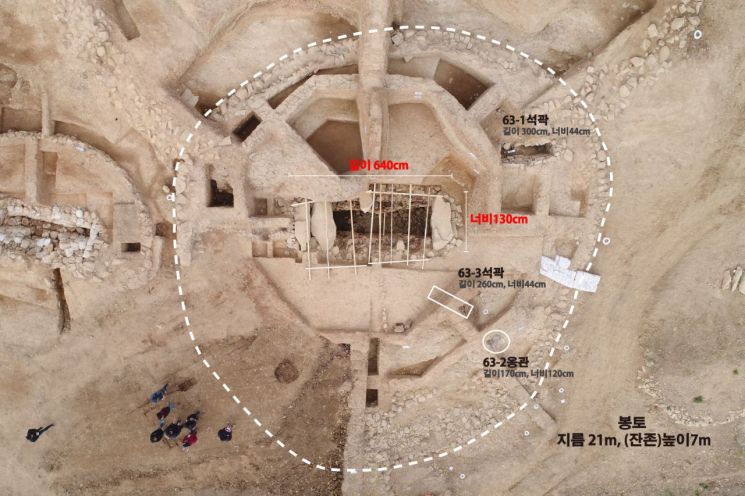
The stone chamber of Tomb No. 63, where the artifacts were excavated, measures 640 cm in length, 130 cm in width, and 190 cm in depth. Wooden traces and brackets were found around the interred individual, suggesting the use of a box-shaped wooden coffin. Above the head of the interred individual is a burial goods space (190 cm long and 130 cm wide) containing pottery and iron artifacts. Below the feet is a lowered-floor space for accompanying burials (220 cm long and 130 cm wide), lowered by about 40 cm. An official stated, “It is presumed that two individuals were interred in the accompanying burial space.” They added, “Some teeth and leg bones of the accompanying burials, one gilt-bronze thin ring (Sehwan), two jars, two iron cauldrons, and one iron sickle were excavated,” and “A large number of brackets were also found throughout the accompanying burial space, suggesting that the accompanying burials were also placed in wooden coffins.”
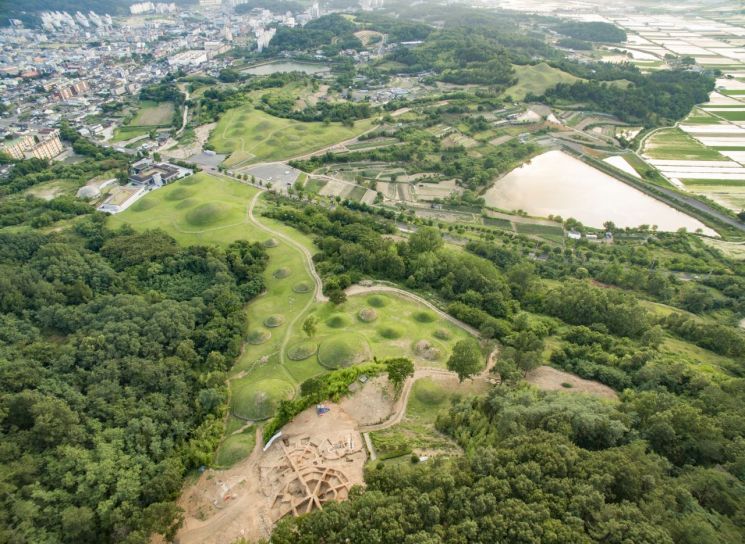
The National Gaya Cultural Heritage Research Institute has been conducting excavations and investigations at the Changnyeong Gyodong and Songhyeon-dong Tumuli Cluster, the highest ruling class cemetery of Bihwa Gaya, since 2014. In November last year, they opened the main burial chamber of Tomb No. 63, which had been protected from looting by the mound of Tomb No. 39, and recently confirmed the entire set of decorative artifacts, including the gilt-bronze crown, that adorned the body of the interred individual at the time of burial. Until now, only parts of gilt-bronze crowns and ornaments had been identified in the Bihwa Gaya region due to plundering and looting during the Japanese colonial period, so the full picture was unknown. An official said, “This investigation will provide important clues for understanding the construction techniques of Bihwa Gaya tombs, funeral rites, and the complex and diverse culture that characterizes Bihwa Gaya.”
© The Asia Business Daily(www.asiae.co.kr). All rights reserved.
![Clutching a Stolen Dior Bag, Saying "I Hate Being Poor but Real"... The Grotesque Con of a "Human Knockoff" [Slate]](https://cwcontent.asiae.co.kr/asiaresize/183/2026021902243444107_1771435474.jpg)


















