Bank of Korea 'Weighted Average Interest Rate of Financial Institutions in September'
[Asia Economy Reporter Kim Eunbyeol] Last month, household loan interest rates rebounded for the first time in five months as commercial banks reduced preferential loan interest rates to curb the surge in household loans, and banks’ funding costs increased. Deposit interest rates also rose as banks competed to attract funds.
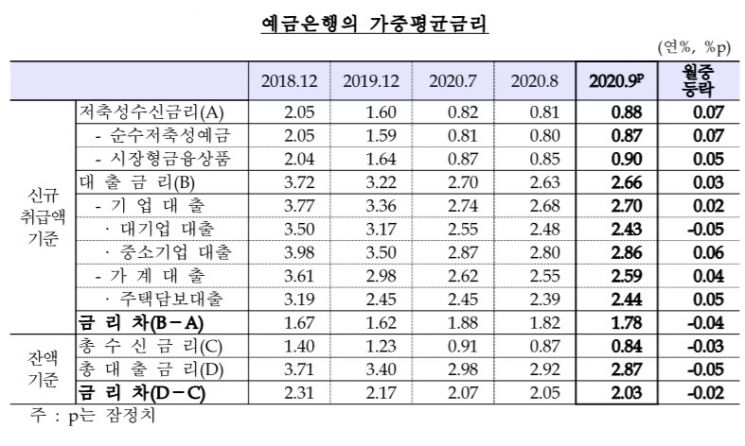
According to the "Weighted Average Interest Rates of Financial Institutions in September" announced by the Bank of Korea on the 28th, the household loan interest rate of deposit banks last month was 2.59%, up 4 basis points (1bp=0.04 percentage points) from 2.55% in August.
The mortgage loan interest rate rose 5bp from 2.39% to 2.44%, while general credit loans (2.89%) and guaranteed loans (2.52%) each increased by 3bp. Group loan interest rates increased by 1bp from 2.40% to 2.41%.
Song Jaechang, head of the Financial Statistics Team at the Bank of Korea’s Economic Statistics Bureau, explained, "Loan interest rates rose across the board compared to the previous month due to rising market interest rates and spread expansion to secure profitability." It is also interpreted that recent measures by banks to reduce preferential interest rates to curb the surge in household loans contributed to the overall interest rate increase.
Regarding corporate loan interest rates, they rose 2bp from 2.68% to 2.70%. For large corporations, banks increased the proportion of high-credit borrowers, resulting in a 5bp decrease, whereas for small and medium-sized enterprises, influenced by rising financial bond interest rates, the rate increased 6bp from 2.80% to 2.86%.
The CD (91-day) rate, which serves as the benchmark for loan interest rates, fell from 0.68% in August to 0.63% in September, but the bank bond (AAA, 1-year) rate jumped 11bp from 0.80% to 0.91% during the same period. Among corporate loans, short-term loans have a high proportion of CD-linked loans, while loans with a term of one year or more are often linked to bank bonds.
The average loan interest rate combining both household and corporate loans rose 3bp from 2.63% to 2.66%.
The weighted average interest rate on savings deposits (based on new contracts) at deposit banks rose 7bp to 0.88% per annum. Pure savings deposits increased 7bp, centered on time deposits, and market-type financial products rose 5bp, centered on CDs. Among savings deposit interest rates, the time deposit rate, which has the highest weight, rose 7bp (from 0.80% to 0.87%) due to banks’ strengthened efforts to attract funds for LCR and loan-to-deposit ratio management.
The difference between loan interest rates and savings deposit interest rates at deposit banks, i.e., the loan-deposit spread, narrowed by 4bp to 1.78 percentage points compared to 1.88 percentage points in August. On a balance basis, both deposit (-3bp) and loan (-5bp) interest rates fell. The difference between total loan interest rates and total deposit interest rates narrowed by 2bp to 2.03 percentage points compared to the previous month.
Deposit interest rates (based on new contracts for 1-year fixed-term deposits) at mutual savings banks, credit cooperatives, mutual finance, and Saemaeul Geumgo, excluding mutual savings banks, fell by 1?3bp. Loan interest rates fell except for credit cooperatives.
© The Asia Business Daily(www.asiae.co.kr). All rights reserved.

















