"Solutions Must Be Proposed by the 28th... No Formation of Medical-Government Consultative Body Without National Medical Exam Resolution"
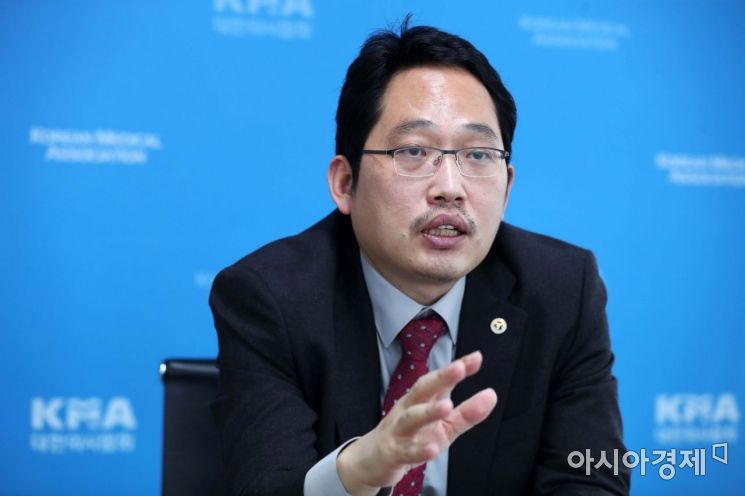
[Asia Economy Reporters Seo So-jeong and Cho Hyun-ui] "If the government does not resolve the medical licensing examination (Kuksi) issue, we will consider a strike as a last resort."
On the 28th, Choi Dae-jip, president of the Korea Medical Association (KMA), stated in an interview with Asia Economy, "If the government does not present a clear solution regarding the medical students' licensing exam by today, we will consider it as a lack of willingness to resolve the issue and seek future responses."
The KMA's Special Committee for Medical Sector Struggle (KMA Special Committee) held a working-level meeting with the Ministry of Health and Welfare the previous afternoon. During the meeting, they discussed the formation of a medical-government consultative body and the medical licensing exam issue, but only reaffirmed the differences in positions between the two sides.
President Choi said, "The issue of medical students taking the licensing exam is entirely a problem the government must solve," and added, "The government should clearly state the conditions for resuming the medical students' licensing exam, and once those conditions are met, the exam should resume immediately."
However, President Choi drew a line by saying that they are not immediately planning to initiate collective actions such as strikes. He said, "In principle, I believe it is undesirable for doctors to express their opinions through collective actions," and explained, "Because when doctors go on strike, patients inevitably suffer various degrees of harm."
Since there are differing views on strikes within the KMA, unifying internal voices is also a task for the association. President Choi said, "Within the KMA, there are diverse opinions depending on the professional groups such as private practitioners and residents, so multiple voices are inevitable, and it is true that there are limits to garnering everyone's participation," and emphasized, "The government must create a mechanism for discussion so that doctors do not have to resort to the last measure of 'strike.'"
Regarding Medical Students' Licensing Exam, Medical Students and KMA "No Plans to Apologize"
Most Medical Students Who Did Not Take the Practical Exam Are Taking the Written Exam
President Choi also stated that there are "no plans or need" for a public apology related to the medical students' licensing exam issue.
He emphasized, "If medical students do not take the licensing exam, they themselves suffer the consequences," adding, "It disrupts their own career and life plans, and since it does not cause harm to others, there is no reason to apologize." He defended, "The KMA did not advise medical students not to take the exam; it was a decision made by the students themselves, so the KMA has no reason to apologize."
President Choi raised his voice about the serious shortage of medical personnel expected next year due to medical students not taking the licensing exam. He said, "The government said it would reallocate personnel for the insufficient military doctors and public health doctors, and solve the shortage of interns and residents by utilizing specialized nurses and hospitalist specialists, but that is nonsense," adding, "If about 3,000 new doctors are not produced, not only will there be a shortage of interns and residents immediately, but nurses and professors who would replace their work will also have to adjust their duties one after another, leading to a situation hospitals cannot handle."
President Choi said that at this point, with the medical students' licensing exam issue unresolved, the formation of a medical-government consultative body is impossible. Prime Minister Chung Sye-kyun instructed Minister of Health and Welfare Park Neung-hoo on the 15th to promptly form a consultative body for public healthcare policy discussions.
President Choi said, "What we are trying to form now is a consultative body between the Ministry of Health and Welfare and the KMA," and emphasized, "We will also need to form a separate consultative body with the National Assembly in the future, but if the licensing exam issue is not resolved, we cannot form any consultative body."
Currently, the practical part of the medical licensing exam is ongoing amid a large-scale non-participation by medical students, and 3,196 candidates have submitted applications for the written exam scheduled for January 7 next year. The medical licensing exam is divided into practical and written parts, and passing both is required to obtain a medical license.
President Choi said, "The licensing exam issue must be resolved within this week due to scheduling," and added, "Most candidates have already submitted applications for the written exam, so I hope the government makes a prompt decision."
© The Asia Business Daily(www.asiae.co.kr). All rights reserved.

















