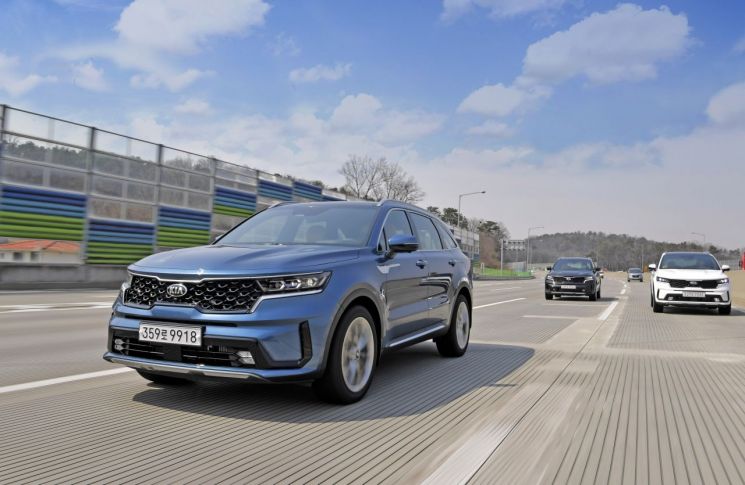
[Asia Economy Reporter Eunmo Koo] Kia Motors has posted better-than-expected earnings despite the adverse event of incurring over 1 trillion KRW in quality costs in the third quarter, leading to a sharp rise in its stock price, which hit its highest level in 1 year and 10 months.
According to the Korea Exchange on the 28th, Kia's stock price closed at 52,900 KRW, up 10.32% (4,950 KRW) from the previous trading day. This not only set a new 52-week high but also marked the highest closing price in 4 years and 10 months since December 29, 2015 (53,100 KRW). On the previous day, institutional and foreign investors were the largest buyers of Kia shares, recording net purchases of 116.3 billion KRW and 54.2 billion KRW respectively in just one day on the 27th.
The better-than-expected third-quarter earnings appear to have stimulated the market. On the 26th, Kia disclosed that its consolidated operating profit for the third quarter of this year was 195.2 billion KRW, a 33.0% decrease compared to the same period last year. However, this operating profit exceeded market expectations by more than 80%.
Initially, Kia had planned to reflect 1.2592 trillion KRW in quality costs related to the Theta 2 GDI engine in its third-quarter results, leading the market to forecast operating profit at 107.5 billion KRW. However, some of the quality costs were reversed, and the actual provision reflected in the results was 1.0131 trillion KRW. Excluding the one-time engine-related costs, operating profit would be around 1.2 trillion KRW, marking the highest quarterly performance. Kia's previous quarterly record was 1.2191 trillion KRW in the second quarter of 2012.
The increase in domestic sales and expansion of vehicle models, which raised the average selling price, are analyzed as factors contributing to the outstanding third-quarter performance. Kia's average domestic selling price in the third quarter was 27.7 million KRW, and the average export price was 18,400 USD, up 9.9% and 14.1% respectively from the same period last year. Jaeil Lee, a researcher at Eugene Investment & Securities, explained, “Not only did the share of recreational vehicles (RVs) and large cars increase in terms of vehicle class, but the option adoption rate also rose significantly. Comparing the option adoption rate of Kia's flagship sport utility vehicle (SUV), the Sorento, the driving assistance system increased from 58% to 83%, and navigation systems rose from 73% to 96%.”
The earnings improvement trend is expected to continue beyond the third quarter. Woong Yoo, a researcher at Ebest Investment & Securities, forecasted, “The full-scale launch of Sorento sales in the U.S., the production increase effect of Telluride, and the rapid rise in operating rate of the India plant producing over 25,000 units per month will accelerate Kia's clear competitive advantage mainly in overseas markets.” According to financial information provider FnGuide, Kia's operating profit for the fourth quarter is estimated to grow 67.4% year-on-year to 988.3 billion KRW.
However, exchange rates and the resurgence of COVID-19 in Europe are variables to watch in the fourth quarter. Yongkwon Moon, a researcher at Shin Young Securities, pointed out, “The exchange rate, which contributed to profit increases of 97 billion KRW in the first quarter and 62 billion KRW in the second quarter, is turning unfavorable ahead of the export recovery period, which is regrettable. Signs of COVID-19 resurgence in Europe, which accounts for 22.9% of sales, the 'No Deal Brexit' risk in the UK, Kia's largest European market, and the domestic labor union's application for dispute mediation are variables to monitor.”
© The Asia Business Daily(www.asiae.co.kr). All rights reserved.

















