Recommendation by Public Interest Committee Member of Health and Medical Committee under Tripartite Commission
Medical and Government Sides Withdraw Amid Strike Just Before Final Agreement After One Year of Discussions
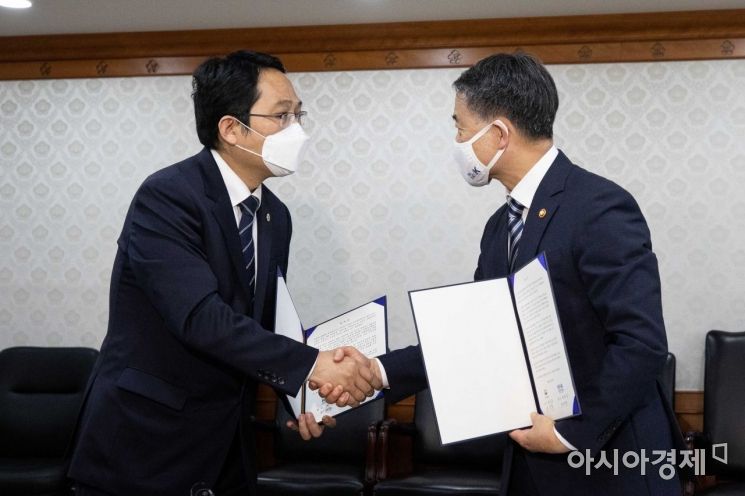 Minister of Health and Welfare Park Neung-hoo (right) and Chairman Choi Dae-jip of the Korean Medical Association are greeting each other after signing an agreement on the 4th of last month at the Government Seoul Office in Jongno-gu, Seoul, to form a medical consultation body to discuss stopping the collective strike and expanding medical school quotas./Photo by Kang Jin-hyung aymsdream@
[Asia Economy Reporter Choi Dae-yeol] The shortage of doctors and nurses and the burden of heavy workloads have been longstanding issues. It has also been well known that there are severe regional disparities in healthcare and that the health insurance (fee) system designed to address these issues does not function properly in reality. The Presidential Commission on Economic, Social and Labor Affairs decided to overhaul the entire healthcare system and formed a separate consultative body in October last year. The Healthcare Committee under this commission was initially set up with a one-year term.
The Healthcare Committee’s term ends at the end of this month, and it has been decided to dissolve it without extending the period. This is not because the domestic healthcare system was successfully reformed or problems were solved within the year. It is difficult to expect improvements in just one year, and the COVID-19 pandemic has starkly exposed the structural problems of the domestic healthcare system. The frontline workers, who have conflicting interests, met several times to reach consensus on solutions, but the doctors’ strike that broke out in August wiped out all the progress made.
The labor-management-government agreement in the healthcare sector, which was almost buried, was made public on the 27th. The chair of the Healthcare Committee, Professor Kim Yoon of Seoul National University (Healthcare Management), who led the discussions, along with public interest members, released it in the form of a recommendation. Strictly speaking, it is not an agreement. Although workers, employers, government, and public interest members largely agreed on the framework and roughly aligned on detailed points, the final document was not signed. The draft agreement was ready and about to be approved, but the government and employer organizations withdrew at the last minute, resulting in no formal agreement.
Government and Employer Organizations Reverse Position at Final Stage of Agreement Approval
Reason Cited: Discuss in 'Party-Government-Medical Agreement Body' After Handling General Strike
"To Increase Doctors and Nurses, Medical and Nursing School Quotas Must Be Expanded"
The backbone of the 'recommendation' produced after dozens of official and unofficial consultations over the past year is the need to increase healthcare personnel. The plan proposed increasing the quotas of medical and nursing schools to nurture and deploy healthcare workers. It also included creating a labor-friendly work environment by improving long working hours and establishing an appropriate compensation system. The regional doctor system (tentative name), which the government proposed but faced severe criticism from the medical community, was also discussed in this committee.
In particular, all members of the consultative body agreed on the need to increase university quotas starting as early as the year after next to raise the number of clinical doctors to the OECD average level by 2040 and nurses by 2030, according to Chair Kim. This indicates that, unlike other industries or sectors, the majority of healthcare workers currently share a similar awareness of the problem?that there is a shortage of medical personnel. This consensus is shared by workers, employers, government, and academia alike.
The Economic, Social and Labor Council (ESLC) brings together stakeholders with conflicting interests to find alternatives through dialogue and consultation, followed by a final approval process. It is democratic in that it involves dialogue and coordination rather than simply relying on laws and regulations, but it is often difficult to reach consensus. However, it is rare for a committee to dissolve abruptly as happened with this Healthcare Committee when members collectively withdrew at the last minute. Their withdrawal was due to the party-government-medical agreement reached last month.
On the 4th of last month, the ruling party, government, and medical community agreed to re-examine the healthcare policies that the government had been pursuing. After conflicts over healthcare policies led to a doctors’ general strike, the agreement brought things back to square one. It was a difficult decision to discard nearly a year’s worth of discussions and achievements, but the problem is that there has been little progress since the party-government-medical agreement. For over a month and a half, only formal letters proposing to form a consultative body have been exchanged, with no substantive dialogue taking place.
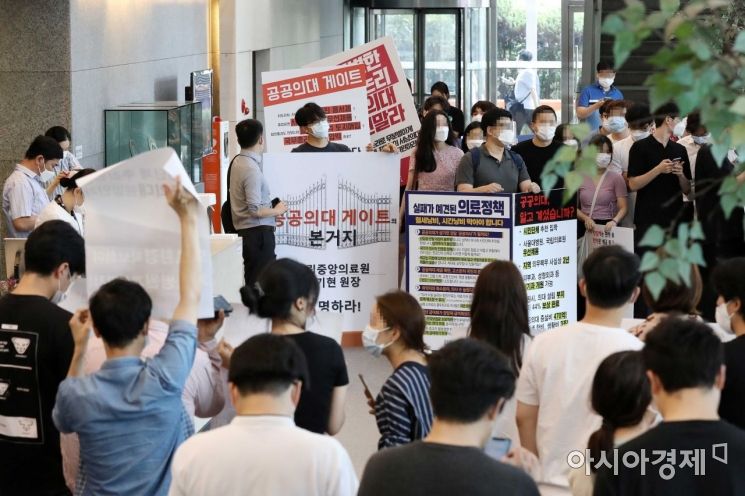 Residents opposing the agreement between the government and the Korean Medical Association held a sit-in protest on the afternoon of the 4th of last month in the lobby on the first floor of the Namsan Square Building in Jung-gu, Seoul, where the Korea Health Promotion Institute is located.
The residents are strongly opposing the agreement in which the Ministry of Health and Welfare and the Medical Association drafted a memorandum to stop the collective strike and form a medical-government consultative body to discuss medical policies such as the expansion of medical school quotas. Photo by Jinhyung Kang aymsdream@
There are circumstances. The agreement last month included the condition that discussions would resume "when the spread of COVID-19 stabilizes," but since then, cluster outbreaks have occurred nationwide, and the number of new confirmed cases has not subsided. Conflicts surrounding the national medical licensing exam for medical students continue to be a stumbling block. The government has clearly stated that, citing fairness with other exams and public opinion, medical students who refused to take the exam cannot retake it. On the other hand, the Korean Medical Association (KMA), a party to the agreement, insists that "the government is fully responsible for the consequences of its flawed policies" and demands that the government provide a way for medical students to take the exam. The government and KMA met to discuss this issue but failed to find common ground.
According to Professor Kim Yoon, only the public interest members, mainly professors, and labor representatives were positive about producing a final agreement or extending the committee’s term until the end. Employer organizations, composed mainly of doctors such as the director of the National Medical Center, the director of Seoul National University Hospital, and the vice president of the Hospital Association, withdrew citing the party-government-medical agreement as an excuse. The government also showed a negative stance, saying it would participate only if some issues were excluded, and eventually withdrew entirely.
Within the healthcare sector, there is a strong sentiment that the upcoming party-government-medical consultative body should not be a one-on-one negotiation between the KMA and the government. Since healthcare policies affect the majority of the public, it is argued that a wider range of stakeholders beyond just the medical associations should participate in the consultation process.
© The Asia Business Daily(www.asiae.co.kr). All rights reserved.


















