Hankyung Research Institute Report on 'Diagnosis and Implications of Public Job Policies'
[Asia Economy Reporter Dongwoo Lee] A study has found that although the government expanded public job policies by investing budget, the earned income of low-income groups actually decreased. There is an argument that public job policies should be converted into private sector job creation support projects, considering sustainability and effectiveness.
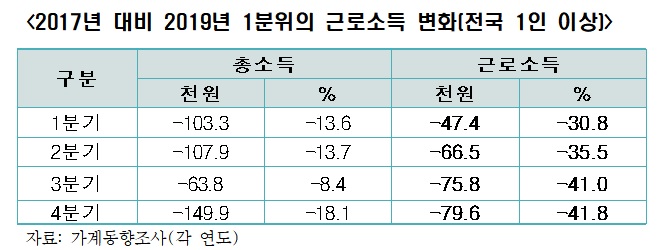
The Korea Economic Research Institute announced on the 28th through its report titled "Diagnosis and Implications of Public Job Policies" that as of 2019, the earned income of low-income groups decreased by 30-40% compared to 2017, and the quintile ratio increased, indicating a deepening of income inequality.
Public job projects are a type of government-supported job program that provides temporary jobs or experience aimed at helping vulnerable groups such as the long-term unemployed to find employment in the private sector. Most of the wages are directly supported by the government.
The report stated that the public job budget in 2018 recorded about 2 trillion won, a 17.6% increase from the previous year. In 2019, a budget of 2.3 trillion won was allocated, a 15.0% increase. In 2021, the public job budget also increased by 257.7 billion won (9%) from the previous year to 3.1 trillion won, and the scale is expected to increase by 83,000 people (8.8%) to 1,028,000 people compared to the previous year.
On the other hand, the income of households with one or more persons nationwide, specifically the low-income group (1st income quintile), decreased. Compared to the first quarter of 2017 when the Moon Jae-in administration took office, the earned income of the 1st quintile group in the first quarter of 2019 decreased by 47,000 won. Earned income also decreased in the 2nd quarter (67,000 won), 3rd quarter (76,000 won), and 4th quarter (80,000 won), with quarterly decline rates ranging from 30% to 42%.
The report diagnosed that despite the continuous expansion of public jobs promoted by the government, the decrease in earned income among low-income groups reveals the limitations of public job policies. During this period, the equivalized disposable income of low-income groups showed little increase or even decreased, while that of high-income groups increased, exacerbating income inequality. Equivalized disposable income is an income indicator calculated by considering the number of household members, representing the total amount of actual "available money" after adding pension and welfare income and subtracting taxes.
The Korea Economic Research Institute analyzed households with one or more persons nationwide based on equivalized disposable income in 2019 and found that the disposable income of the 1st quintile (lowest 20%) decreased compared to 2017 except for the 3rd quarter. Meanwhile, the equivalized disposable income of high-income groups increased, and the quintile ratio also rose. The quintile ratio is the value obtained by dividing the equivalized disposable income of the 5th quintile group (highest 20%) by that of the 1st quintile group (lowest 20%), with a higher value indicating greater income inequality.
Specifically, the quarterly quintile ratios last year were 6.91 in the 1st quarter (an increase of 0.65 from 2017), 6.29 in the 2nd quarter (0.83 increase), 6.46 in the 3rd quarter (0.43 increase), and 6.30 in the 4th quarter (1.02 increase). Meanwhile, during this period, increases in public transfer income such as public pensions and basic pensions compensated for the decrease in earned income among low-income groups.
The report diagnosed that if the government's public job policy is carried out continuously, it would require a huge budget and could weaken participants' motivation to work in the private sector.
Cho Kyung-yeop, head of the Economic Research Office at the Korea Economic Research Institute, said, "Considering sustainability and competitiveness, future government job policies should focus on creating an environment where the private sector can create jobs rather than the government directly providing jobs," adding, "For low-income groups, it is desirable to expand opportunities for jobs and vocational training to increase their chances of employment in the labor market."
© The Asia Business Daily(www.asiae.co.kr). All rights reserved.
![Clutching a Stolen Dior Bag, Saying "I Hate Being Poor but Real"... The Grotesque Con of a "Human Knockoff" [Slate]](https://cwcontent.asiae.co.kr/asiaresize/183/2026021902243444107_1771435474.jpg)
















