Some Clinics "Finished Vaccinations This Year"... Pediatric Supply Quantity Less Than Usual
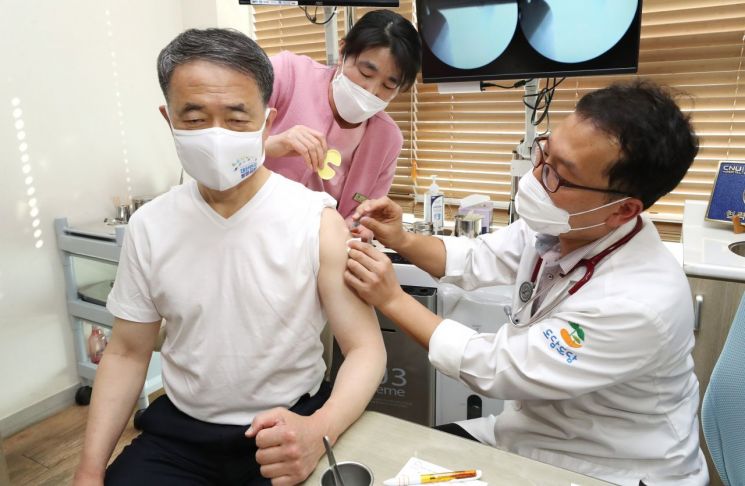
[Asia Economy Reporter Seo So-jeong] "The free influenza (flu) vaccines have run out, and although I want to get a paid vaccine, all local clinics say they are sold out."
As the Korea Disease Control and Prevention Agency (KDCA) stated that the link between deaths after flu vaccination is very low and decided to proceed with the national vaccination support program as scheduled, the free vaccines for children under 12 years old continue to be out of stock. Some medical institutions have exhausted both free and paid vaccines, effectively declaring the end of children's vaccinations for this year.
According to the KDCA, the vaccination rate for children under 12 years old (first-time recipients) was 71.1% as of midnight on the 27th, similar to the previous day’s 70.8%. Since free vaccinations began last month for children under 12 (first-time recipients), there are 4,780,820 eligible for free vaccination this year, and 2,298,813 have been vaccinated as of this date, completing about 71%. Considering that the vaccination rate in previous years exceeded 80%, more than 800,000 remain as latent demand, but the field is reporting vaccine shortages.
At a pediatric clinic in Seodaemun-gu, Seoul, it was said, "Regardless of recent concerns about flu vaccination, vaccines for children under 12 continue to be sold out," adding, "We receive a certain amount allocated from public health centers, but the quantity is not large and runs out quickly." An otolaryngology clinic in Gangnam-gu, Seoul, said, "The free vaccines ran out last week, and we switched to paid vaccines, but due to insufficient supply, vaccinations for children under 12 are no longer possible this year."
The reason why only vaccines for children under 12 are particularly scarce is that even among free vaccination recipients, the supply methods differ by age group. For this year's free vaccination, vaccines for adolescents aged 13 to 18 and the elderly are procured by the government through contracts and supplied to frontline medical institutions via public health centers. In contrast, vaccines for children under 12 are supplied directly to frontline hospitals from pharmaceutical companies.
Pediatric clinics and others use general paid vaccines for vaccination and then claim costs from the government. However, since the government sets a low price for national free vaccination vaccines, pharmaceutical companies and hospitals tend to avoid free vaccines and prefer paid vaccinations with higher margins, causing a shortage of free vaccines for children.
Increase in Flu Vaccinations Compared to Previous Years Due to COVID-19 Impact
Some Vaccines Recalled Due to Room Temperature Exposure and White Particles
The smaller supply to pediatric clinics this year compared to previous years is also a reason for the shortage of children's vaccines. A pediatric clinic in Mapo-gu, Seoul, said, "This year, parents brought their children to hospitals from the early stages of the free flu vaccination program due to concerns about the simultaneous outbreak (twindemic) of COVID-19 and flu," adding, "People who did not get vaccinated in previous years are getting vaccinated this year, causing a sudden depletion of supply early on."
During the national vaccination support program, some vaccines were recalled due to 'room temperature exposure' and 'white particle' issues, which also became a variable. According to the KDCA, a total of 30.04 million doses (one dose per vaccination) of vaccines will be supplied domestically this year, and shipment approval has been completed for 29.59 million doses. However, 1.06 million doses were recalled due to improper temperature management or white particles, reducing the actual market supply to 28.98 million doses.
Producing vaccines at this point due to the shortage is impossible due to scheduling. Pharmaceutical companies such as GC Green Cross said, "Most of the vaccines to be supplied this year have already been delivered to entrusted medical institutions and frontline clinics," adding, "It is structurally difficult to supply more even if clinics request additional doses."
As the shortage of children's vaccines continues, the KDCA is reviewing related countermeasures. Shin Hye-kyung, head of the Vaccine Supply Division at the KDCA, said, "We are monitoring vaccine supply volume, vaccination registration performance, and vaccination rates by target group," adding, "Vaccinations for seniors aged 62 to 69 began on the 26th, and we will observe the trend and establish a redistribution plan."
© The Asia Business Daily(www.asiae.co.kr). All rights reserved.

















