KOSDAQ Plunges 3.7%... Breaks Below 800
KOSPI Ends Down 0.7%
Rising External Uncertainty Shrinks Investor Sentiment
Profit-Overvalued Bio Sector Faces Selling Pressure
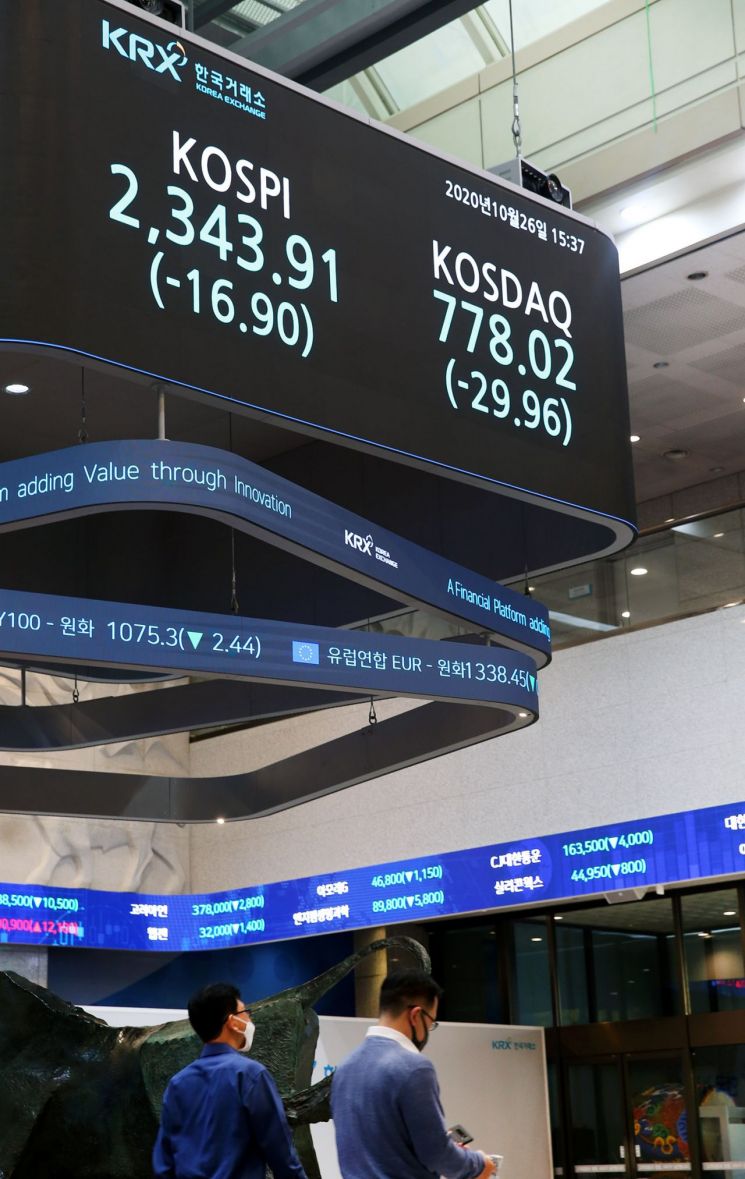
[Asia Economy Reporter Minwoo Lee] The KOSDAQ index fell more than 3.7%, breaking below the 800-point mark. This decline is attributed to the global resurgence of COVID-19 and increased external uncertainties ahead of the U.S. presidential election, which dampened investor sentiment.
On the 26th, the KOSDAQ closed at 778.02, down 3.71% (29.96 points) from the previous session. It opened slightly higher at 808.06, up 0.01% from the previous close, but then sharply declined. The KOSDAQ falling into the 770s is the first occurrence since July 20. This marks the largest drop since it closed down 4.33% on September 24. In contrast, the KOSPI, which also opened slightly higher, closed down 0.72% (16.90 points) at 2343.91.
Experts analyzed that various external uncertainties, including the global resurgence of COVID-19, negatively impacted the domestic stock market. According to the World Health Organization (WHO), the number of new COVID-19 cases worldwide reached approximately 465,000 on the 24th (local time). This is a record high for three consecutive days, following 437,247 cases on the 22nd and 449,720 cases on the 23rd. About half of these cases occurred in Europe (221,898), and the United States also saw a record increase in new COVID-19 cases over the past two days.
Sangyoung Seo, a researcher at Kiwoom Securities, explained, "While large-scale COVID-19 resurgences are occurring in the U.S. and Europe, the U.S. presidential election is just a week away, increasing various uncertainties and unsettling investor sentiment. Particularly, the continued poor performance of some newly listed stocks triggered sell-offs in the bio sector, which had been burdened by high valuations." He added that as valuation pressures mounted, a liquidity-driven market emerged, leading to a reversal of earlier gains regardless of corporate earnings.
However, opinions diverged regarding the government's plan to lower the major shareholder threshold for capital gains tax from 1 billion KRW to 300 million KRW. Daehun Han, a researcher at SK Securities, said, "The burden of capital gains tax on major shareholders seems to have affected investor sentiment. Since major shareholders as of the end of this year will be subject to capital gains tax on profits realized after April next year, there is inevitably increased pressure to realize gains, especially in stocks that have risen in price." On the other hand, researcher Seo stated, "Although the strengthened major shareholder criteria have been controversial, since they will be implemented after December, it is hard to say they have already influenced this recent sharp decline."
Meanwhile, institutional investors were strong sellers in the KOSDAQ market, net selling 164.5 billion KRW, while foreigners and individuals were net buyers of 33.5 billion KRW and 145 billion KRW, respectively.
All sectors declined. The technology growth enterprise sector saw the largest drop at -5.60%. This was followed by pharmaceuticals (-4.94%), paper and wood (-4.57%), other services (-4.53%), general electric and electronics (-4.44%), and semiconductors (-4.29%), with many sectors falling more than 4%.
Among the top 10 market capitalization stocks, only Celltrion Pharm rose by 1.3%. The rest all declined, with Genexine experiencing the largest drop at -9.5%, followed by Alteogen (-7.5%), Seegene (-7.4%), CJ ENM (-4.8%), and KMW (-3.5%).
In contrast, on the KOSPI, foreigners and individuals were prominent sellers, net selling 118.8 billion KRW and 110.7 billion KRW, respectively. Institutions were net buyers of 244.7 billion KRW.
Most sectors also declined. The textile and apparel sector had the largest drop at -3.35%. Other sectors falling more than 2% included securities (-2.93%), machinery (-2.82%), paper and wood (-2.74%), electric and gas utilities (-2.63%), food and beverages (-2.47%), non-metallic minerals (-2.30%), and banking (-2.28%). Meanwhile, retail (2.82%), transportation equipment (2.33%), medical precision (0.72%), and insurance (0.70%) sectors rose.
The top 10 market capitalization stocks also struggled. Kakao had the largest drop at -3.0%, followed by NAVER (-1.7%), Samsung SDI (-1.6%), LG Household & Health Care (-1.5%), and Samsung Biologics (-0.9%). Meanwhile, Hyundai Motor and Samsung Electronics rose by 2.6% and 0.3%, respectively. Celltrion remained flat.
© The Asia Business Daily(www.asiae.co.kr). All rights reserved.
![Clutching a Stolen Dior Bag, Saying "I Hate Being Poor but Real"... The Grotesque Con of a "Human Knockoff" [Slate]](https://cwcontent.asiae.co.kr/asiaresize/183/2026021902243444107_1771435474.jpg)
















