Average Interest Rates on Credit Loans and Mortgage Loans Raised Simultaneously by 5 Major Banks
Household Loan Surge Significantly Curbed Amid Limit Reductions

[Asia Economy Reporter Kim Hyo-jin] The household loan interest rates of major commercial banks, which had been repeatedly lowered, have all risen this month. Measures such as reducing preferential interest rates to curb the surge in household loans caused by the craze for 'Yeongkkeul' (borrowing to the limit) and 'Bittu' (investing with loans) have resulted in an overall increase in interest rates. At the same time, the tightening of management through loan limit reductions and the impact of decreased real estate transactions have significantly slowed the growth of household loans.
According to the financial sector on the 26th, the average interest rate on personal credit loans at the five major commercial banks?KB Kookmin, Shinhan, Hana, Woori, and NH Nonghyup?was 2.58% this month. The average interest rate, which had been continuously falling due to the base rate cuts, rebounded starting last month (2.51%). The interest rate on mortgage loans (installment repayment type) also steadily decreased, recording 2.51% last month, but increased by 0.11 percentage points to 2.62% this month.
The financial authorities ordered banks to manage the total loan volume as household loans, especially credit loans, repeatedly increased to record monthly highs, raising concerns about delinquencies and defaults. Banks began implementing loan suppression measures in earnest from last month.
A representative measure was the reduction in the scope of preferential interest rates applied when handling major loan products. For example, the 0.3% preferential interest rate offered on the condition of salary transfers was lowered by 0.1 percentage points. In some cases, preferential interest rate items were completely removed. The average household loan interest rates compiled monthly by banks are based on the interest rates of loans actually handled in the previous month. This means that banks have become more conservative in lending since last month.
Additionally, banks worked to suppress total loan volume by significantly reducing loan limits for high-income and high-credit customers, sometimes by as much as half. This was intended to somewhat curb the trend of borrowing more than twice their annual salary based on high income and credit to invest in real estate, stocks, and other areas rather than for living expenses.
'Loan Tightening' to Continue for the Time Being
"Modest Increase Expected in Q4"
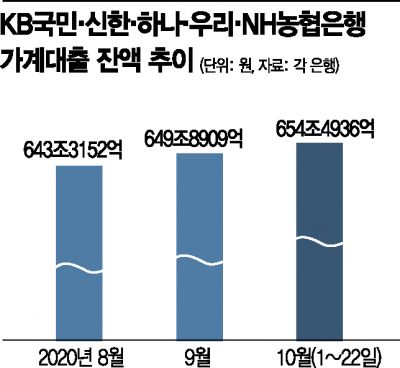
Based on these moves by banks, the growth rate of household loans has noticeably slowed. As of the 22nd of this month, the household loan balance at the five major banks was 654.4936 trillion won, an increase of 4.6027 trillion won from the end of September (649.8909 trillion won). Although there are still business days left this month, the increase is 30% less than last month (6.5757 trillion won) and 45% less than August (8.4098 trillion won), when the increase was at a record high, indicating a clear downward trend.
In particular, mortgage loans, which increased by 4.4419 trillion won last month, rose by only 2.7582 trillion won this month. It is analyzed that the decrease in apartment transactions due to measures such as the June 17 real estate policy has led to a decline in loan demand.
According to the Seoul Real Estate Information Plaza's real estate sales statistics, apartment transactions in Seoul have decreased as follows: ▲June 15,604 cases ▲July 10,647 cases ▲August 4,985 cases ▲September 3,677 cases ▲October 1,118 cases.
The increase in credit loans this month (1.6401 trillion won) also sharply decreased compared to last month (2.1121 trillion won) and August (4.0705 trillion won).
The tightening of loans by banks is expected to continue for the time being. Kim Ki-hwan, Vice President (CFO) of KB Financial Group, said during the earnings conference call on the 22nd, "This year, credit loans and large corporate loans have increased significantly, and with policy loans and financial support, loan growth exceeded plans. However, from the third quarter, we have begun to actively manage profitability and soundness, and loans in the fourth quarter are expected to increase only slightly compared to the end of September."
© The Asia Business Daily(www.asiae.co.kr). All rights reserved.


















