Unexpected Q3 Earnings Boost Shareholders' Expectations for Dividend Increase
Financial Authorities Recommend Dividend Restraint
[Asia Economy Reporter Park Sun-mi] As the banking sector enters the third-quarter earnings announcement season, shareholders' expectations are growing that the 'surprise' earnings, which exceeded expectations, could lead to an expansion of dividends.
Banks are reaching a consensus that dividend expansion is necessary to enhance the undervalued stock value and return profits to shareholders. However, reflecting the uncertain economic situation caused by the novel coronavirus disease (COVID-19), they feel it is burdensome to realize this immediately.
Financial Holding Companies Considering Quarterly Dividends but Not Immediate Implementation
According to the financial sector on the 26th, KB Financial Group and Hana Financial Group, which disclosed solid third-quarter earnings contrary to concerns, stated in their conference calls that they are considering dividend expansion but not at this moment. KB Financial, aware of shareholders' increasing demands for dividend expansion following a record quarterly net profit exceeding 1 trillion won, emphasized maintaining the dividend payout ratio at least at last year's level, reminding of the COVID-19 situation.
Kim Ki-hwan, CFO of KB Financial, said, "Implementing quarterly dividends is a matter worth considering to enhance shareholder value," but added, "However, due to COVID-19, aggressive dividend expansion may be difficult this year, and it is expected to be similar to last year." Last year, KB Financial paid a dividend of 2,210 won per share, with a payout ratio of about 26%.
Hana Financial, which announced third-quarter net profit more than 10% higher than the second quarter, is also exploring various shareholder return policies, including quarterly dividends, but believes it will be difficult to implement quarterly dividends in the short term. Lee Hu-seung, CFO of Hana Financial, stated, "Considering the low stock price, quarterly dividends have value," and added, "Quarterly dividends are also good for shareholders' cash flow." He continued, "However, various external economic variables remain, so it will not be easy to realize quarterly dividends soon," and said, "We will discuss it thoroughly after the end of COVID-19."
Shinhan Financial, which is scheduled to announce third-quarter earnings on the 27th, is also pushing to enable quarterly dividends through amendments to its articles of incorporation at the shareholders' meeting in March next year, but this too is premised on realization after COVID-19. Shinhan Financial has already informed financial authorities of its intention to implement quarterly dividends once the COVID-19 situation ends. Currently, under its articles of incorporation, interim dividends can only be paid once a year, but if the articles are amended at the March shareholders' meeting, interim dividends can be paid up to four times a year.
Financial Holding Companies' Stock Prices Rising on Dividend Expectations
The banking sector's consideration of dividend expansion reflects the growing shareholder demands for returns amid recent earnings improvements and undervalued stock prices. In fact, during the third-quarter earnings announcement season, the stock prices of financial holding companies, which had lagged behind the KOSPI's gains, have been rising continuously on expectations of dividend expansion.
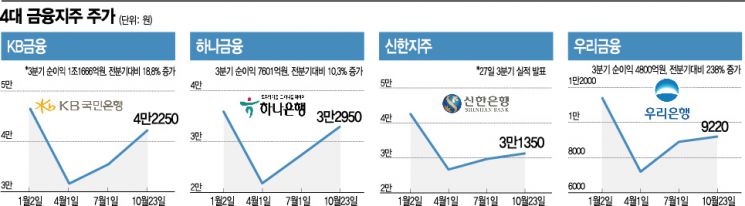
According to financial information provider FnGuide, the KOSPI banking sector recorded a recent one-month increase of 10.23%, about 9% higher than the KOSPI's 1.18% rise.
On the 23rd, Hana Financial Group's stock closed at 32,950 won, up 2.49% from the previous day. This is about a 13.2% increase from the closing price of 29,100 won on the 16th. The five consecutive trading day rise is the first since early June. KB Financial's stock is also on the rise, increasing for five consecutive trading days since the 16th and closing at 42,250 won on the 23rd. It even reached 43,000 won intraday. This is the highest price since February 17, before the global stock market crash caused by the spread of COVID-19. Shinhan Financial and Woori Financial Group also rose 12.2% and 9.6%, respectively, compared to their closing prices on the 16th. Bank stocks, which had been sluggish, have all shown an upward trend simultaneously.
Financial Authorities Recommend Dividend Restraint
Korea Institute of Finance: "Potential Increase in Loan Loss Costs Should Be Actively Reflected in Dividend Decisions"
However, financial authorities are recommending restraint on dividends in the banking sector. Yoon Seok-heon, Governor of the Financial Supervisory Service, recommended banks to refrain from paying dividends during the COVID-19 outbreak in April, and the authorities still maintain the position that a conservative dividend policy is necessary considering banks' capital adequacy.
Kwon Heung-jin, a research fellow at the Korea Institute of Finance, also advised in a recent report that banks should consider the possibility of increased loan loss costs due to COVID-19 when deciding dividends. Kwon said, "Domestic banks should prepare for the possibility that potential non-performing loans may materialize significantly as the economic downturn caused by COVID-19 prolongs or as the loan maturity extension and interest payment deferral measures expire in March next year." He also added, "It is necessary to actively reflect the potential increase in medium- to long-term loan loss costs after COVID-19 in dividend decisions to secure sufficient capital buffers."
© The Asia Business Daily(www.asiae.co.kr). All rights reserved.
![Clutching a Stolen Dior Bag, Saying "I Hate Being Poor but Real"... The Grotesque Con of a "Human Knockoff" [Slate]](https://cwcontent.asiae.co.kr/asiaresize/183/2026021902243444107_1771435474.jpg)
















