"South Korea is very important," yet regarding compensation liability, it ended with the 1965 Claims Agreement
Emphasizing North Korea-Japan summit... escaping isolation from neighboring countries
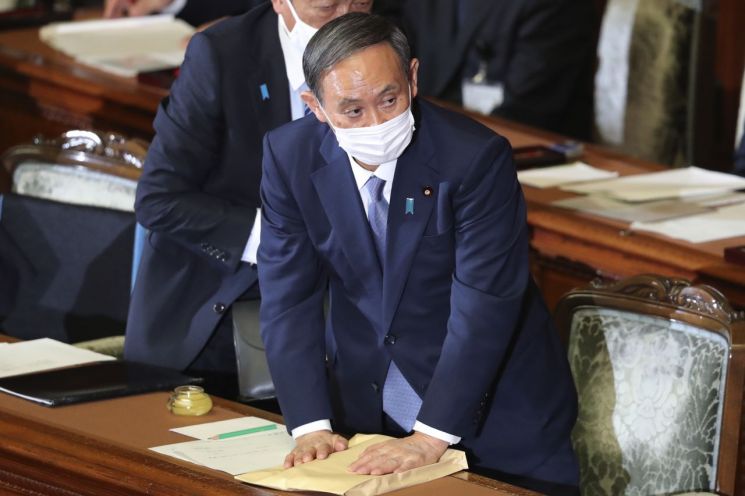
[Asia Economy Reporter Kwon Jae-hee] Japanese Prime Minister Yoshihide Suga repeatedly emphasized South Korea's responsibility regarding compensation for forced labor victims during Japan's colonial rule. In contrast, he expressed a willingness for active dialogue on North Korea issues, creating a clear contrast.
In a policy statement speech at the extraordinary Diet session opened on the 26th, Prime Minister Suga said, "South Korea is a very important neighboring country," but added, "To return to a healthy Japan-Korea relationship, we will strongly demand appropriate responses in line with Japan's consistent position."
The policy statement speech is delivered by the Japanese Prime Minister at the plenary session when the extraordinary Diet begins, outlining the basic stance on current national issues. This was Prime Minister Suga's first such speech since his inauguration on the 16th of last month.
The position expressed by Prime Minister Suga this time follows the diplomatic line of former Prime Minister Shinzo Abe, reiterating the Japanese government's long-standing claim that the South Korean government must take responsibility and propose a solution regarding the biggest issue between Japan and South Korea?the compensation for forced labor victims.
Kyodo News analyzed that Prime Minister Suga urged the South Korean side to resolve the issue.
Having served for a long time as Chief Cabinet Secretary, the government spokesperson during the Abe administration, Suga has argued that the South Korean Supreme Court's final ruling in October 2018 ordering compensation to forced labor victims in lawsuits against Nippon Steel (formerly Shin Nippon Steel & Sumitomo Metal) violates the 1965 Japan-Korea Claims Agreement, and that the South Korean government should propose a solution.
The plaintiffs in this lawsuit, after Nippon Steel refused to comply with the ruling following the Japanese government's policy, have applied to the court to seize shares of PNR Co., a non-listed Korean corporation affiliated with Nippon Steel and POSCO, to secure compensation claims and are proceeding with the process of converting these into cash.
Regarding this, Prime Minister Suga warned at a press conference held during his visit to Indonesia on the 21st, "If the seizure assets are liquidated and Japanese companies suffer actual damage, it will cause a very serious situation in Japan-Korea relations."
On the other hand, he expressed a willingness for active dialogue with North Korea.
In his speech, Prime Minister Suga said that the issue of Japanese abductees by North Korea "remains the most important task of the administration," and stated, "We will do our utmost so that all abductees can return home as soon as possible."
He continued, "I am determined to meet directly with Chairman Kim Jong-un without any preconditions," and reiterated, "Based on the 2002 Japan-North Korea Pyongyang Declaration, we aim to comprehensively resolve issues such as abductions, nuclear weapons, and missiles, to clear the unfortunate past and normalize diplomatic relations with North Korea."
He also emphasized the goal of normalizing diplomatic relations with North Korea.
This reiterates the intention to follow the Abe administration's line on North Korea issues. It also appears related to a strategy to avoid the impression of Japan's diplomatic isolation among neighboring countries.
Former Prime Minister Abe maintained the view that improving Japan-North Korea relations, including normalization of diplomatic ties, is difficult without resolving the issue of Japanese abductees by North Korea. Since May last year, he has proposed a no-conditions Japan-North Korea summit, and through his policy statement speech at the extraordinary Diet session in October last year, he has presented this as a solution to the abduction issue.
However, North Korea maintains the position that all abduction issues have been resolved.
In his speech, Prime Minister Suga once again emphasized that the cornerstone of Japan's diplomatic security is the Japan-U.S. alliance.
Prime Minister Suga stated, "The Japan-U.S. alliance is the foundation of peace, prosperity, and freedom in the Indo-Pacific region and the international community," and added, "We will maintain deterrence based on the Japan-U.S. alliance."
He also added that Japan aims to realize a "free and open Indo-Pacific" under the rule of law by cooperating with countries sharing fundamental values such as the Association of Southeast Asian Nations (ASEAN), Australia, India, and Europe.
Regarding China, he said, "A stable relationship is very important not only for both countries but also for the region and the international community," and added, "We will firmly assert our points during high-level contacts while cooperating on common challenges."
On the issue of sovereignty over the four Kuril Islands (called the Northern Territories in Japan) with Russia, he stated, "We must put an end to this without passing it on to the next generation," and said, "Through frank exchanges of opinions between leaders, we aim to develop the overall Japan-Russia relationship, including the conclusion of a peace treaty."
© The Asia Business Daily(www.asiae.co.kr). All rights reserved.
![Clutching a Stolen Dior Bag, Saying "I Hate Being Poor but Real"... The Grotesque Con of a "Human Knockoff" [Slate]](https://cwcontent.asiae.co.kr/asiaresize/183/2026021902243444107_1771435474.jpg)
















