China Government Duty-Free Expansion Effect
Hainan Duty-Free Quota Tripled in July
Golden Week Visitors Up 44%
Q3 Korea-China Gap Likely to Widen
Domestic Industry Appeals for Active Government Support
[Asia Economy Reporter Cha Min-young] "If the trend of China's duty-free rise continues, the Korean duty-free industry, which has held the world No.1 position for the past several years, will soon have to relinquish that crown."
While Korean duty-free shops have been hampered by the COVID-19 pandemic, the Chinese government's policy of promoting duty-free sales to solidify its dominance in the global duty-free market is proving effective. Chinese duty-free shops, which surged to first place in the first half of the year, are expected to widen the sales gap over domestic duty-free shops even further in the third quarter.
Sales Gap Between Korea and China Expected to Widen in Q3
According to the Shanghai Stock Exchange (SSE) and the duty-free industry on the 26th, China Duty Free Group (CDFG) recorded an operating profit of 15.83 billion yuan (approximately 2.6935 trillion KRW) in the third quarter (July to September) of this year, a 38.9% increase compared to the same period last year. Net profit for the same period surged 141.9% to 2.234 billion yuan (approximately 378 billion KRW). CDFG ranked first among global duty-free shops in the first half of the year, jumping up four places from before.
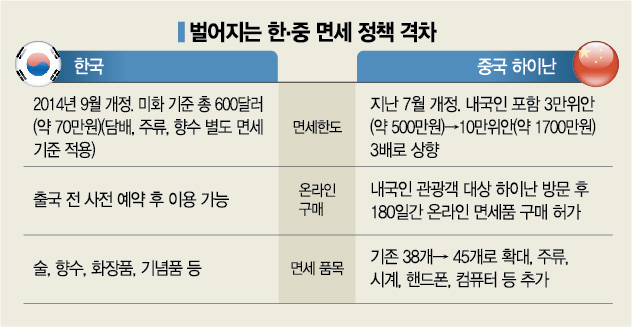
This is thanks to the Chinese government's policy, implemented since July, to expand the duty-free quota on Hainan Island. The Chinese government has positioned Hainan Island as a global forward base and increased the duty-free limit from the previous 30,000 yuan (about 5 million KRW) to 100,000 yuan (about 17 million KRW), roughly tripling it. As a result, during China's Golden Week, the number of visitors to Hainan surged by 44% year-on-year to 146,800 over eight days. Chinese consumers swept up high-margin products such as luxury goods, watches, and jewelry.
Due to these effects, the sales gap between Korean and Chinese duty-free shops in the third quarter is expected to be much larger than in the first half. The number of international passengers at Incheon International Airport from July to September dropped by more than 97%, from 23 million in the same period last year to 650,000. According to FnGuide estimates, Hotel Shilla is expected to record an operating loss of 31.3 billion KRW on a consolidated basis in the third quarter, marking a deficit compared to the previous year. Sales are expected to fall 47% to 782.1 billion KRW. Duty-free sales account for about 90% of Hotel Shilla's revenue.
Government Needs to Actively Support Duty-Free Policies
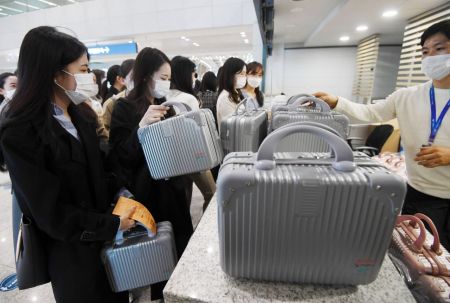 As the management difficulties in the duty-free industry deepen on the 26th, since domestic non-purpose flights (sightseeing flights) have been approved, the prompt approval of international sightseeing flights has emerged as one of the solutions to enable free purchase of duty-free goods. The photo shows Jeju Air 'Incheon to Incheon' sightseeing flight passengers receiving boarding gifts after issuing their tickets at Terminal 1 of Incheon International Airport on the 23rd. Photo by Moon Honam munonam@
Although the Korean government introduced measures such as reducing fees at Incheon International Airport and 'good landlord policies' to support domestic duty-free companies struggling due to COVID-19 this year, these efforts are considered insufficient to save the duty-free industry.
Accordingly, the domestic duty-free industry is appealing for the government's active support of duty-free policies. First, to encourage sales to domestic consumers, it is urgently necessary to extend the period for domestic sales of inventory duty-free goods, which was originally fixed until October 29. There is also a call to extend the support period for third-party returns to attract Chinese corporate-type daigou (overseas purchasing agents). According to the office of Jeong Il-young of the Democratic Party, sales generated from third-party overseas returns by duty-free shops reached 465.94 million USD (about 534 billion KRW) as of September 25.
In particular, since domestic non-purpose flights (tourism flights) have been permitted, the prompt approval of overseas tourism flights to freely enable duty-free purchases has emerged as one solution. Taiwan's Tigerair circled over Jeju without landing and returned. Taiwanese tourists were able to enjoy views of Hallasan Mountain from the plane and then shop at duty-free stores. There are also 12-hour round-trip Antarctic sightseeing flights by Australia's Qantas and tourism flight products from Japan. All of these allow duty-free shopping options. In contrast, in Korea, although tourism flight products by Asiana and Busan Air have appeared, they are all limited to 'domestic tourism' and have not been expanded to overseas airspace. Regarding quarantine issues, it has been suggested that online duty-free shops could be an alternative.
Similar to China's online purchase support policy in Hainan, allowing duty-free purchases after visiting places like Jeju could be another method. Professor Byun Jung-woo of Kyung Hee University's College of Hotel and Tourism Management emphasized, "Korean duty-free shops also need more proactive non-face-to-face policies that allow online purchase of duty-free items like Hainan in the post-COVID era," adding, "It is time for new duty-free policies from a long-term perspective, rather than slight adjustments to duty-free limits or temporary conditional support policies."
© The Asia Business Daily(www.asiae.co.kr). All rights reserved.
![Clutching a Stolen Dior Bag, Saying "I Hate Being Poor but Real"... The Grotesque Con of a "Human Knockoff" [Slate]](https://cwcontent.asiae.co.kr/asiaresize/183/2026021902243444107_1771435474.jpg)

















