Securing 3D Mini Alveoli Culture Technology
Investigating Early COVID-19 Infection Mechanism
Elucidating Lung Cell Destruction Process
Significant Aid in Therapeutic Development
[Asia Economy Reporter Junho Hwang] A study has revealed that infection can occur even if a single particle of the novel coronavirus (COVID-19) enters the lungs. In particular, COVID-19 can begin to replicate in less than 6 hours after infection, and the immune response of the cells to this is confirmed to occur actively only after 2 to 3 days, once replication is well underway.
Professor Youngseok Joo's research team at the Graduate School of Medical Science and Engineering, Korea Advanced Institute of Science and Technology (KAIST), in collaboration with the University of Cambridge in the UK and Seoul National University Hospital, developed a '3D mini-organ technology' that cultures human alveolar (lung sac) cells in the laboratory. Using this technology, they precisely elucidated the process by which the COVID-19 virus destroys human lung cells. The related research paper was published in 'Stem Cell,' an international journal in the field of stem cells.
Three-Dimensional Culture of Human Lung Cells
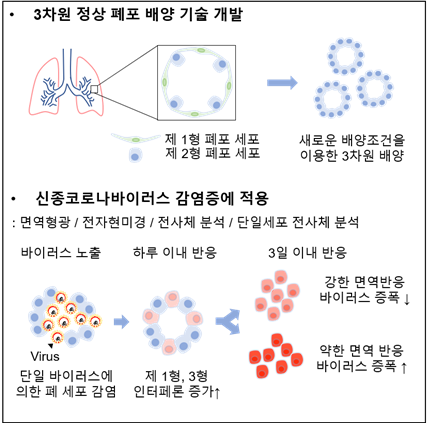
First, the research team succeeded in culturing human alveoli (lung sacs) three-dimensionally in the laboratory. They identified conditions that allow stable long-term 3D culture of lung tissue. Using this technology, alveolar stem cells can be cultured for over six months. The team demonstrated through immunofluorescence staining, electron microscopy imaging, and transcriptome analysis that the cultured cells are structurally and functionally similar to human cells.
By utilizing the cultured cells, the research team can understand the precise mechanism of COVID-19. This means they can observe how COVID-19 infects lung cells cultured in the laboratory. Understanding the disease mechanism is a prerequisite for developing treatments. However, in the case of COVID-19, it is difficult to infect animal models such as mice, and there was no human cell model available for laboratory use, which limited research.
Infection Possible with a Single Virus Particle
 Professor Ju Young-seok of Korea Advanced Institute of Science and Technology (from left), Dr. Lee Joo-hyun of University of Cambridge, Section Chief Choi Byung-sun of National Institute of Health, Director Ko Kyu-young of Institute for Basic Science Vascular Research Center, Professor Kim Young-tae of Seoul National University College of Medicine
The research team exposed the cultured cells to the COVID-19 virus and examined the results using virus plaque assays, immunofluorescence staining, electron microscopy, and other analytical methods. They also checked immune responses through transcriptome analysis. The results showed that the cultured cells exposed to COVID-19 experienced rapid viral replication within just 6 hours, leading to infection. The immune response of the cells to block this took more than 3 days to activate. Furthermore, the team discovered that even a single virus particle is sufficient to infect one cell. They also confirmed that after 3 days post-infection, some cells rapidly lose their inherent functions.
Co-corresponding author Professor Youngseok Joo emphasized, "If the scale of the developed 3D human lung culture model is expanded, it will be useful for infection studies of various respiratory viruses, including COVID-19." He added, "By directly applying human lung cells?the target cells of respiratory viruses?to disease research, rather than cells derived from animals or other organs, it is possible to efficiently and accurately elucidate mechanisms and also utilize this for therapeutic development."
© The Asia Business Daily(www.asiae.co.kr). All rights reserved.
![Clutching a Stolen Dior Bag, Saying "I Hate Being Poor but Real"... The Grotesque Con of a "Human Knockoff" [Slate]](https://cwcontent.asiae.co.kr/asiaresize/183/2026021902243444107_1771435474.jpg)


















