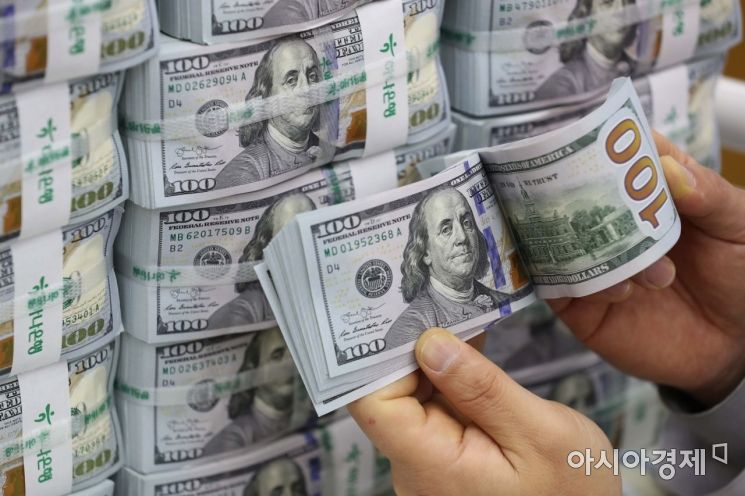
 South Korea's foreign exchange reserves surpassed 420 billion dollars, marking a record high for four consecutive months. According to the "Foreign Exchange Reserves at the End of September 2020" announced by the Bank of Korea on the 7th, the foreign exchange reserves at the end of last month amounted to 420.55 billion dollars, an increase of 1.59 billion dollars compared to the previous month. The foreign exchange reserves, which had sharply declined due to the spread of the novel coronavirus disease (COVID-19), have been continuously increasing for six consecutive months since April. The photo shows an employee organizing US dollars at the Counterfeit Response Center of Hana Bank in Euljiro, Seoul, on the same day. Photo by Mun Honam munonam@
[Asia Economy Reporter Jo Gang-wook] Recently, as the exchange rate has continued to decline, the dollar deposit balances at major commercial banks have surged by more than 4 trillion won.
According to the financial sector on the 25th, the dollar deposit balances of five major banks?KB Kookmin, Shinhan, Woori, Hana, and NongHyup?stood at $55.122 billion as of the 22nd, an increase of $4.092 billion compared to the end of September. When converted to Korean won, the increase amounts to approximately 4.6 trillion won.
Since the beginning of this month, the KRW/USD exchange rate has sharply declined, continuing the trend of won appreciation. The KRW/USD exchange rate, which surged to 1,285 won per dollar in March during the global pandemic of the novel coronavirus (COVID-19), has recently continued its rapid decline, dropping to the 1,130 won level for the first time in a year and a half.
As the dollar value decreases, it is interpreted that companies are buying dollars in advance to deposit them, driving the increase in dollar deposits. Generally, foreign currency deposit balances increase when the exchange rate is low and decrease when the exchange rate is high as investors realize profits.
There is also an interpretation that export companies missing the timing to sell dollars amid the sharp drop in the KRW/USD exchange rate has influenced the recent increase in dollar deposit balances.
Additionally, the rise in individual investor demand seeking foreign exchange gains is also analyzed to have contributed to the increase in dollar deposit balances.
Dollar deposits are financial products where Korean won is exchanged into dollars and deposited, and then withdrawn or converted back to won upon maturity.
By opening a dollar deposit account, one can buy or sell dollars at a desired time through the bank’s app. Since it is easy to gain foreign exchange profits when the dollar value rises and no separate taxes are imposed, salaried workers prefer it as an investment method.
Along with this, the increase in individual investors’ overseas stock investment demand due to heightened volatility in the U.S. stock market is also cited as a recent cause of the rise in dollar deposits.
Kim Il-gu, Chief Economist at Hanwha Investment & Securities, said, "Since June, not only major advanced currencies such as the euro and yen but also the Chinese yuan have continued their strong performance against the U.S. dollar, leading to the won’s appreciation," adding, "The strength of these currencies against the dollar is not a temporary phenomenon, so the won’s strong exchange rate is expected to continue for some time."
© The Asia Business Daily(www.asiae.co.kr). All rights reserved.

















