Only Twice Has an Incumbent Lost a U.S. Presidential Election Despite Post-WWII Stock Market Gains
CNBC: "COVID-19 and Stimulus Hopes Officially Shattered"
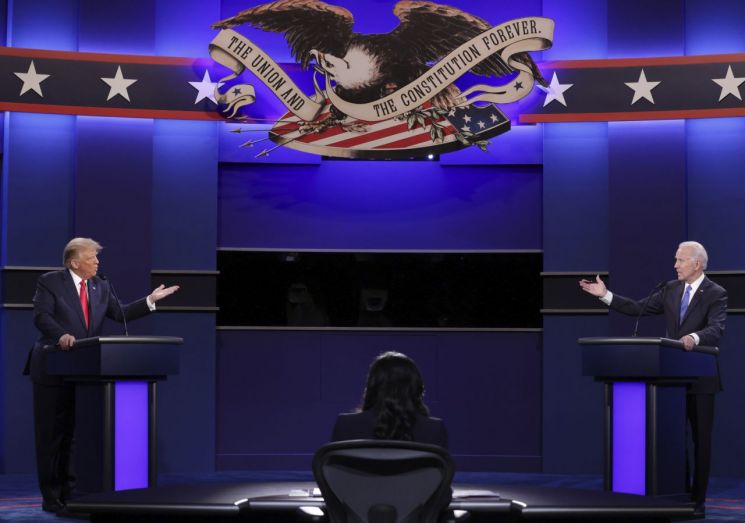 U.S. President Donald Trump (far left) and Democratic presidential candidate Joe Biden (far right) are debating on the 22nd. [Image source=AP Yonhap News]
[Asia Economy Reporter Jeong Hyunjin] With the U.S. presidential election scheduled for the 3rd of next month, President Donald Trump and Democratic presidential candidate Joe Biden are focusing on securing last-minute votes, while the U.S. stock market is making efforts to gauge the outcome. The movement of the S&P 500 index, often called the 'stock market predictor,' seemed to favor President Trump, but investors are leaning toward a Biden victory.
According to CNBC on the 24th (local time), Sam Stovall, Chief Investment Strategist at U.S. market research firm CFRA, mentioned the hypothesis that the winner is determined by the movement of the S&P 500 index during the 90 days before the election. He explained, "Since World War II, there have only been two instances where the incumbent president and ruling party lost the election despite the stock market rising between July and November."
In the U.S. stock market, there is a prediction method that if the S&P 500 index rises during the 90 days before the election, the current administration is likely to win in November, and if it declines, a regime change is probable. This prediction has mostly held true since World War II. In fact, during the 2016 U.S. presidential election, most polls overwhelmingly predicted that Democratic candidate Hillary Clinton would win, but President Trump was elected, resulting in a regime change. CNBC reported that the S&P 500 index showed a downward trend during those 90 days, calling it "the only prediction that said Trump would seize victory."
However, in the 1968 election held after the Vietnam War, Republican Richard Nixon was elected, resulting in a regime change. At that time, the S&P 500 index rose by 5.8%, so the prediction was incorrect. Also, in 1980, despite the stock market showing an upward trend, incumbent Democratic President Jimmy Carter lost to Republican candidate Ronald Reagan.
Based on this prediction method, the likelihood of President Trump's re-election is considered high. Since early August, the S&P 500 index has risen more than 5%, suggesting the current administration will remain in power.
However, CNBC stated, "Although the stock market favors President Trump, this year could be an exception." Stovall explained that the two previous elections where the prediction failed were influenced by geopolitical turmoil, and this year's election, amid the significant disruption caused by the novel coronavirus disease (COVID-19), is a similar situation. He added, "The market is moving 40% based on the expectation that the COVID-19 situation will improve and 60% leaning toward the Democratic candidate's victory, which is likely to lead to a stimulus package."
Ultimately, it is difficult to definitively declare a winner on either side. Despite various polls being conducted ahead of the election, the reason the market uses this prediction method is due to the trauma experienced during the 2016 election. Amanda Agati, Chief Investment Strategist at PNC Financial, said, "There is no perfect prediction regarding the election outcome, but we are examining various indicators to derive results and gain insights as much as possible."
© The Asia Business Daily(www.asiae.co.kr). All rights reserved.
![Clutching a Stolen Dior Bag, Saying "I Hate Being Poor but Real"... The Grotesque Con of a "Human Knockoff" [Slate]](https://cwcontent.asiae.co.kr/asiaresize/183/2026021902243444107_1771435474.jpg)
















