"Rising Interest in Sales Due to Jeonse Supply Shortage"
KB Real Estate Reports Concurrent Increase in Jeonse and Sales Prices
Government Firm on Announcing Additional Measures
Concerns Over Side Effects... Focus on Expanding Supply
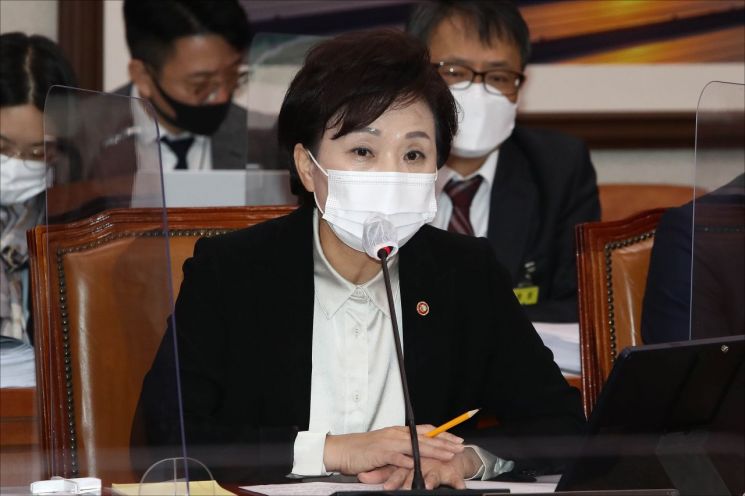 Minister of Land, Infrastructure and Transport Kim Hyun-mi is responding during the comprehensive audit of the Land, Infrastructure and Transport Committee held at the National Assembly in Yeouido, Seoul, on the morning of the 23rd. (Photo by Yonhap News)
[Asia Economy Reporter Moon Jiwon] Recently, as jeonse prices have surged mainly in the Seoul metropolitan area apartments, concerns are rising that the sales prices, which had barely stabilized, might start fluctuating again. If the gap between jeonse prices and sales prices narrows significantly due to the sharp rise in jeonse prices, the perception that 'it is better to buy a house' could spread.
The government is reportedly planning to announce additional measures as the rapid rise in jeonse prices continues. Although the 'autumn moving season' is coming to an end, it has been judged that the current 'jeonse crisis' cannot be ignored. It is analyzed that measures may include expanding the supply of rental housing and supporting monthly rent.
According to KB Real Estate Live On on the 25th, as of the 19th, the jeonse price of apartments in Seoul rose by 0.51% compared to the previous week. This is the highest increase in over nine years since September 12, 2011 (0.64%).
Gyeonggi Province (0.56%) also saw a significant rise in jeonse prices compared to the previous week, and the five major metropolitan cities?Ulsan (0.41%), Daegu (0.29%), Gwangju (0.25%), Daejeon (0.24%), and Busan (0.13%)?also showed an upward trend. The rise in jeonse prices is spreading not only in the metropolitan area but nationwide.
The problem is that as jeonse prices rise, the sales market is also showing somewhat unstable signs. The sales price in Seoul showed a 0.31% increase, a larger rise than last week's 0.22%. Gyeonggi Province saw a 0.36% increase compared to the previous week, and the five major metropolitan cities saw a 0.27% rise in sales prices.
If the gap between jeonse prices and sales prices narrows due to the rise in jeonse prices, the number of tenants who prefer to buy a house rather than rent is likely to increase, which could drive up sales prices. KB Real Estate Live On also analyzed, "due to the shortage of jeonse supply, interest in switching to buying has increased, resulting in a simultaneous rise in both jeonse and sales prices."
Such a sharp rise in sales prices can especially occur in some metropolitan areas where jeonse prices are not as high as in Seoul and regulations are weaker. Gimpo, a non-regulated area, is a representative example. In fact, apartment prices in Gimpo rose by 2.36% this week, and complexes where prices have increased by more than 100 million won in a few months are appearing one after another.
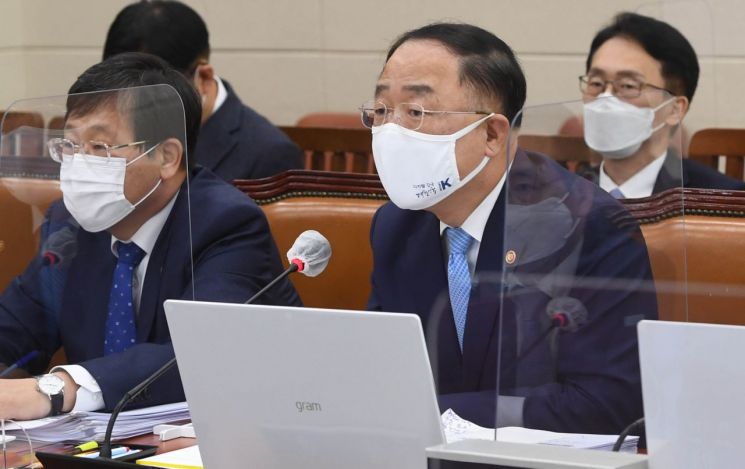 Hong Nam-ki, Deputy Prime Minister and Minister of Economy and Finance, is attending the National Assembly's Planning and Finance Committee's audit on the National Tax Service, Korea Customs Service, Public Procurement Service, and Statistics Korea held on the 22nd in Yeouido, Seoul, responding to inquiries. (Photo by Yonhap News)
As various problems have emerged due to the recent jeonse crisis, the government is reviewing additional measures to stabilize the jeonse market. Initially, some within the government believed the situation would stabilize over time, but due to public outcry and increasing political pressure, the government decided to take action.
However, there is no easy solution to resolve the jeonse crisis. On the 22nd, Deputy Prime Minister and Minister of Economy and Finance Hong Nam-ki said, "We have reviewed all the jeonse measures from the past 10 years," and added, "(Currently) there are not many sharp measures available."
From the government's perspective, since stabilizing both the jeonse and sales markets is urgent, unlike in the past, they cannot use measures that convert jeonse demand into sales to resolve the jeonse crisis. One of the most direct solutions, the standard rent system, can only be considered after sufficient data is accumulated following the introduction of the jeonse and monthly rent reporting system in June next year.
Therefore, the government is expected to focus on expanding the supply of jeonse units for now. Earlier, Deputy Prime Minister Hong said, "The best measure for the jeonse market is to supply public rental housing very sufficiently," and added, "At least one in four people will be able to rent with stability, and we will push forward with supply measures without delay."
The government is likely to expedite the schedule for supplying public rental housing or utilize methods such as converting other types of housing owned by public institutions in urban areas into rental units.
© The Asia Business Daily(www.asiae.co.kr). All rights reserved.


















