10 Securities Firms' Research Center Heads
Expect KOSPI at 2200~2500 Range
Heightened Uncertainty Ahead of US Presidential Election
Potential Selling Pressure from Individual Investors
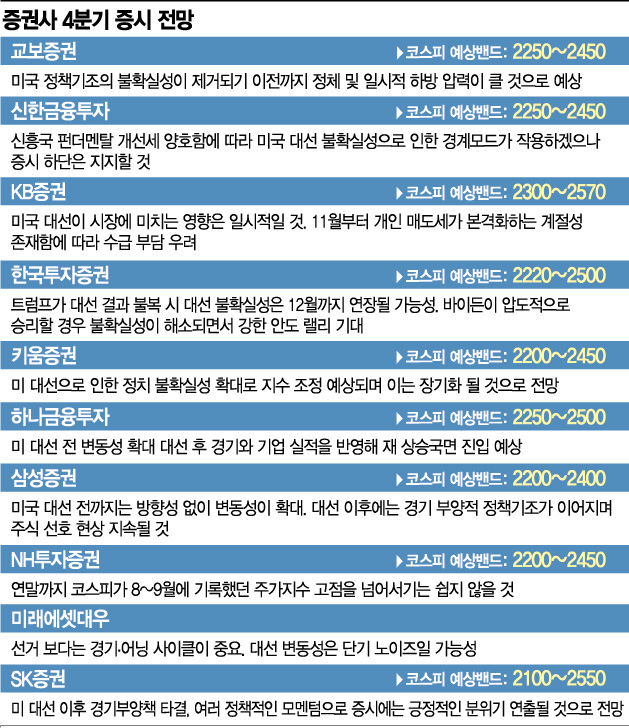
[Asia Economy Reporter Song Hwajeong] Amid ongoing market uncertainty due to the U.S. presidential election, variables such as the U.S. election, corporate earnings, and supply-demand changes are expected to influence the year-end stock market. Major securities firms forecast that the KOSPI will generally move between the 2200 and 2500 levels until the end of the year.
On the 23rd, Asia Economy surveyed the heads of research centers at 10 major domestic securities firms regarding the expected KOSPI range for the fourth quarter. The average low point was 2218 points, and the average high point was 2480 points.
With less than two weeks remaining until the U.S. presidential election, it is considered the biggest factor currently affecting the stock market. The election has increased market uncertainty, and investors are closely watching whether this uncertainty will be resolved depending on the election outcome. Yoon Heedo, head of the research center at Korea Investment & Securities, said, "The market will show a sluggish trend until the U.S. election," adding, "If Trump disputes the results after the election, the uncertainty could extend until December. On the other hand, if Democratic candidate Joe Biden wins by an overwhelming margin that leaves no room for contesting the results, the uncertainty will be resolved, leading to a strong relief rally in the market."
There are also opinions that the impact of the U.S. election will be temporary. Shin Dongjun and Yoo Seungchang, heads of the KB Securities research center, said, "Although there is noise such as the possibility of President Trump disputing the election results, the market impact will be temporary," adding, "Since this is not an issue shaking fundamentals, the decline will be limited to within 5%." Jo Yongjun, head of the Hana Financial Investment research center, also said, "Political uncertainty related to the election will disappear with the election results unless there are additional issues such as election disputes or recounts," and predicted, "Volatility will increase before the election but after the election, the market will enter a recovery phase reflecting the economy and corporate earnings."
Regardless of the election outcome, the preference for stocks is expected to continue. Oh Hyunseok, head of the Samsung Securities research center, said, "Volatility will increase without direction until the U.S. election, but after the election, regardless of who takes office, expansionary economic policies are expected to continue, so the preference for stocks will persist."
Changes in supply and demand are also cited as major variables affecting the year-end stock market. Individual investors, who have supported the domestic stock market since the COVID-19 pandemic, have turned to selling ahead of the year-end. As of this month until the day before, individuals have net sold 1 trillion won in the KOSPI market. This is the first monthly net selling by individuals in 10 months since December last year. It is interpreted that the government's decision to strengthen the major shareholder threshold for stock capital gains tax to 300 million won has influenced this. Shin Dongjun and Yoo Seungchang said, "Individual supply-demand shifted to a selling dominance since mid-October," adding, "There is seasonality where selling intensifies from November, which will lead to supply-demand pressure on the KOSDAQ, where individual investors have a high share." On the other hand, foreign inflows are expected due to a weak dollar. The won-dollar exchange rate closed at 1,131.9 won on the 21st, marking the lowest closing level in 1 year and 7 months. Lee Changmok, head of NH Investment & Securities research division, explained, "Especially if Biden wins the U.S. election, the weak dollar trend will strengthen," adding, "Tax increases and regulatory tightening policies are factors for a weak dollar, which could lead to foreign capital inflows into the domestic stock market."
Earnings are also expected to impact the stock market. As companies continue to announce third-quarter earnings, fourth-quarter earnings forecasts are also being revised upward. According to financial information provider FnGuide, the KOSPI's third-quarter operating profit consensus is 37.5051 trillion won, a 15.44% increase compared to the same period last year. This figure was revised upward by 1.7% compared to a month ago. The fourth-quarter operating profit consensus is 35.7361 trillion won, a 55.14% increase compared to the same period last year, and it was revised upward by 4.5% compared to a month ago.
© The Asia Business Daily(www.asiae.co.kr). All rights reserved.
![Clutching a Stolen Dior Bag, Saying "I Hate Being Poor but Real"... The Grotesque Con of a "Human Knockoff" [Slate]](https://cwcontent.asiae.co.kr/asiaresize/183/2026021902243444107_1771435474.jpg)











