Introduction of Convenience Facilities Integrating ICT such as Air Purifiers and UV Air Curtains
Operation through Advertising Revenue Business ... Tax Revenue Increase Effect without Budget Input
Expansion to 373 Locations by 2023 ... Also Enhancing Energy Use Efficiency
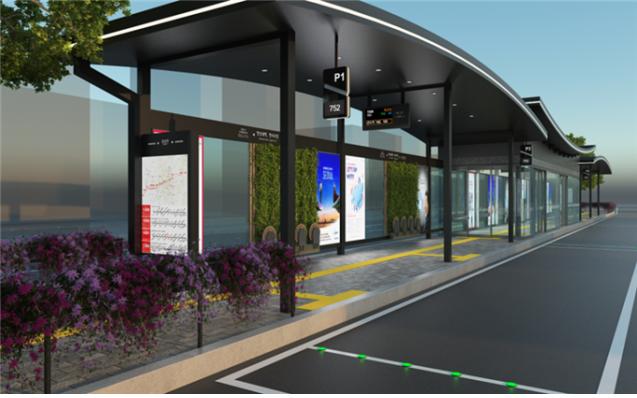 Perspective view of the smart shelter promoted by Seoul City. Starting with 10 pilot projects this year, the city plans to install and operate smart shelters, future-type bus stops, at 373 locations throughout Seoul by 2023.
[Asia Economy Reporter Jo In-kyung] The Seoul Metropolitan Government has decided to implement the 'Smart Shelter' by introducing cutting-edge ICT instead of outdated bus stops as a 'non-budget private investment project.' The private sector will operate the facilities through revenue-generating businesses such as advertising, while the city plans to increase tax revenue by receiving rental income.
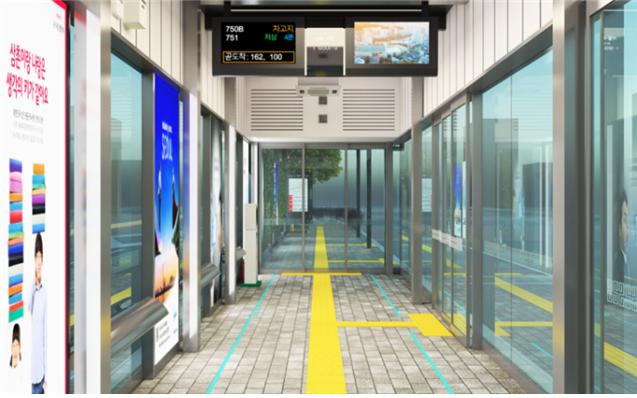
According to Seoul City on the 23rd, the newly introduced Smart Shelter aims to be a future-type bus stop integrating various convenience facilities such as air purifiers, UV air curtains, CCTV, heating and cooling systems, wireless phone charging, and Wi-Fi. The central lane bus stops, which have been installed for over 15 years, will be dismantled and replaced with shelters where citizens can avoid heatwaves, cold, exhaust fumes, and fine dust.
It costs between 250 million to 600 million KRW to build one Smart Shelter. This year, a pilot project will be promoted with the already secured budget of 5 billion KRW, and from next year, the project will be gradually expanded through private investment projects without additional budget input.
Starting next month, the city will pilot-install and operate Smart Shelters at 10 locations including Sungnyemun, Wangsimni Station, Hongdae Entrance, and Hapjeong. In the first year, 120 locations will be added, followed by 126 in the second year, and 127 in the third year, totaling 373 Smart Shelters by 2023. During the pilot operation period, installation costs, maintenance costs, and advertising revenue will be closely examined to develop a reasonable business model ensuring transparent and fair implementation in the future.
Emergency equipment such as emergency bells and automated external defibrillators, as well as facilities considerate of transportation-disadvantaged individuals like safety handrails and voice guidance, will also be installed. Solar panels will be installed to produce renewable energy directly, and energy efficiency will be enhanced through smart LEDs. Furthermore, an integrated control system for remote inspection, operation, and management of all Smart Shelters, as well as a guidance system indicating bus stopping locations, will be applied.
Through these efforts, Smart Shelters will serve as a 'testbed' for introducing future transportation systems. The city expects to solidify its position as an 'advanced public transportation city' and enhance the public nature of public transportation by providing customized services for transportation-disadvantaged groups such as people with disabilities.
While some overseas cities have introduced bus stops with specific functions such as heating and cooling or green roofs, Seoul's comprehensive approach encompassing various functions and services is considered the world's first attempt. Hwang Bo-yeon, Director of Urban Transportation at Seoul City, said, "Through Smart Shelters based on advanced IT and information, we will build a world-class public transportation system and meet the heightened expectations of citizens."
© The Asia Business Daily(www.asiae.co.kr). All rights reserved.
![User Who Sold Erroneously Deposited Bitcoins to Repay Debt and Fund Entertainment... What Did the Supreme Court Decide in 2021? [Legal Issue Check]](https://cwcontent.asiae.co.kr/asiaresize/183/2026020910431234020_1770601391.png)
















