Early-Stage Investment Decreases, Late-Stage Investment Increases in Small to Medium Scale
[Asia Economy Reporter Minji Lee] Due to the impact of the novel coronavirus infection (COVID-19), domestic venture and startup investments in the first half of this year saw a decrease in large-scale investments and an increase in small- and medium-sized investments.
According to the report "Analysis of Promising Industries and Companies through Venture and Startup Investments in the First Half of 2020" published by Samjong KPMG on the 22nd, the total number of disclosed domestic venture and startup investments under 20 billion KRW amounted to 145 cases, accounting for 90.1% of the total investment scale.
Medium to large investments ranging from 20 billion to 100 billion KRW accounted for 15 cases (9.3%), and large-scale investments exceeding 100 billion KRW were only 1 case (0.6%), which was an investment in Kurly, an e-commerce shopping mall specializing in fresh food.
According to the Ministry of SMEs and Startups, the amount of new investments in domestic venture companies in the first half of 2020 was 1.6495 trillion KRW, a 17% decrease compared to the same period last year.
By industry sector, distribution and commerce attracted the largest investment amount of 432.3 billion KRW, followed by healthcare and bio (255 billion KRW), software and solutions (174.5 billion KRW), mobility (143.2 billion KRW), and games, media, and content (126 billion KRW).
The industry with the highest average investment amount per case was also distribution and commerce (19.7 billion KRW), but excluding Kurly, it dropped to 11.1 billion KRW. Alongside this, mobility (15.9 billion KRW) and ICT manufacturing (11.8 billion KRW) recorded average investment amounts per case exceeding 10 billion KRW.
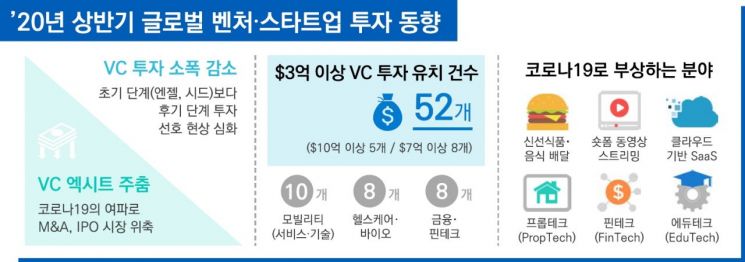
Global VC investment in the first half of this year exceeded 120 billion USD, slightly decreasing compared to the same period last year, but the number of investment cases was about 10,000, roughly one-third less than before COVID-19. In particular, early-stage investments such as angel and seed rounds sharply declined, while preference for later-stage investments intensified.
The M&A and initial public offering (IPO) markets, where global ventures and startups can exit, also contracted significantly. Cross-border M&A deals decreased due to difficulties in corporate due diligence caused by border closures, and ventures and startups are postponing IPOs while securing necessary operating funds through additional VC or PE investment rounds. It is analyzed that many VC firms are focusing on reorganizing their existing investment portfolios rather than raising new funds or sourcing new deals due to COVID-19.
Samjong KPMG analyzed 52 overseas companies that received over 300 million USD in VC investments in the first half of this year, finding that mobility sector companies were the most numerous with 10 companies. Healthcare and bio (8 companies) and finance and fintech (8 companies) followed. The companies with the largest investment amounts were Waymo, Alphabet's autonomous driving technology developer, and Gojek, an Indonesian ride-sharing company.
The report highlighted notable global VC investment trends including ▲ Edutech concentrated in China and emerging countries ▲ Food and fresh food delivery platforms boosted by COVID-19 ▲ Gene therapy and microbiome ▲ Ride-sharing services and mobility technologies ▲ Fintech unicorns ▲ Cloud-based SaaS ▲ Proptech centered in the US and China ▲ Short-form video streaming.
Kim Idong, Head of the Startup Support Center at Samjong KPMG, stated, "Although investments in ventures and startups have contracted due to the unexpected COVID-19 situation, there is also a high possibility that so-called ‘prime assets’ with promising business prospects will increase." He added, "In response to the post-COVID era, it is a crucial time for domestic companies to participate strategically in investments to find new growth models and secure new growth engines."
© The Asia Business Daily(www.asiae.co.kr). All rights reserved.

















