Mirae Asset Maps REITs and Koramco Energy REITs Rebound on Expectations of Stable Dividend Income
South Korea Shows High Investment Appeal Among Global REITs
Active Moves to Establish REIT AMC
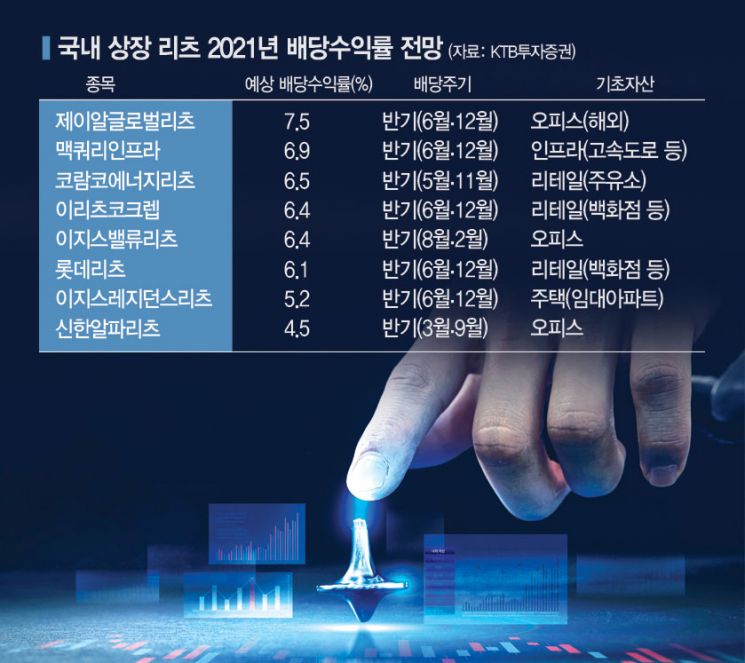
[Asia Economy Reporter Eunmo Koo] As the year-end dividend season approaches, investors' interest in REITs (Real Estate Investment Trusts), which offer stable dividend income, is increasing. Reflecting this growing market interest, the establishment of REIT asset management companies (AMCs) is also becoming active, mainly among asset management firms and trust companies.
According to the Korea Exchange on the 22nd, the stock price of Mirae Asset Maps REIT closed at 4,965 KRW, up 1.64% from the previous trading day, marking its highest price since listing. On the previous day, Koramco Energy REIT and Aegis Value REIT also hit new highs, showing a recent rebound in the stock prices of domestic listed REITs. Since the beginning of this month, Aegis Value REIT rose 8.5%, Aegis Residence REIT increased 6.3%, and Mirae Asset Maps REIT and Koramco Energy REIT rose 4.3% and 3.9%, respectively, outperforming the KOSPI index's 1.8% gain.
Since mid-last month, as stock market volatility has increased, interest in REITs, which focus on dividend income rather than capital gains, appears to be expanding. Jinseong Ra, a researcher at KTB Investment & Securities, explained, "Concerns about dividend cuts due to the COVID-19 spread and the growth stock concentration centered on non-face-to-face sectors have diminished. With social distancing easing from level 2 to level 1 and growing expectations for the full resumption of economic activities, stock prices have started to rebound."
Interest in REIT stocks is expected to continue rising. While growth stocks have been the focus in the domestic stock market, causing dividend stocks like REITs to be somewhat neglected, approaching year-end could bring renewed attention to REITs emphasizing dividends. Notably, Korea is also regarded as one of the most attractive countries for global REIT investments.
Kyungja Lee, a researcher at Samsung Securities, stated, "Domestic REITs show an average dividend yield of 5.6%, which is more than 4 percentage points higher than the KOSPI's average dividend yield of just over 2%. This is also higher compared to global REITs, which yield below 5%. Even after COVID-19, dividends have been paid as planned, alleviating concerns about dividend stability."
Increased Market Interest... Active Establishment of REIT AMCs

As interest in REITs within the stock market continues to rise, the establishment of REIT AMCs is becoming more active. To operate public REITs, it is necessary to establish a REIT AMC. Last September, the government announced the 'Plan to Revitalize Public Real Estate Indirect Investment,' expanding related tax benefits, which has served as an incentive for both investors and businesses.
Kim Daehyung, chairman of the Korea REITs Association, explained, "In a low-interest-rate environment where a 5-6% annual return meets the criteria for popular investment products, measures to revitalize listed REITs?including separate taxation on dividend income, simplification of preliminary listing reviews, and priority land supply rights?have contributed to creating the current favorable conditions."
The government's revitalization plan primarily includes applying separate taxation on dividend income up to 50 million KRW for investors in public REITs and funds, and applying separate taxation on property tax for public REITs and funds or private REITs and funds wholly invested by them. This was devised to curb household debt growth caused by liquidity concentrating in the direct real estate investment market due to the lack of suitable financial investment products.
Among these, business operators show greater interest in public REITs than public real estate funds because public REITs, especially those listed on the exchange, have an advantage in securing investors. The scale of potential investor groups differs significantly between listed and unlisted products. Listed REITs on the exchange can be easily recognized and traded by any investor with a securities account, whereas unlisted products face relatively limited investor acquisition despite active marketing by sellers.
Chairman Kim said, "From an operator's perspective, private funds might be more convenient, but public REITs are advantageous. Publicly listed products require liquidity, meaning they must be sellable when investors want to cash out. Funds have redemption restrictions, making this practically difficult." He added, "In managing assets, increasing scale by capital increases and adding new properties is necessary, but closed-end funds cannot raise additional capital mid-term, which is another reason REITs are preferred over funds recently."
Most real estate funds are closed-end, and increasing capital requires amending trust contract terms, which demands unanimous consent from all investor beneficiaries, making it a practically difficult process. In contrast, REITs as corporations can pass agendas based on quorum requirements in their articles of incorporation, making decision-making relatively easier than funds.
Recently, there has also been an increase in efforts to establish REIT AMCs for asset securitization purposes. Instead of REIT managers discovering and incorporating real estate into REITs, companies act as anchor investors to securitize their owned real estate. Lotte REIT, listed on the KOSPI market in October last year, is a representative case, with an anchor shareholding cap of 50%.
An industry insider assessed that the successful debut of Lotte REIT last year was a decisive factor that gave companies confidence in using REITs as a major method of asset securitization. The insider explained, "Companies need investment funds and have many sellable properties, but since they expect real estate values to continue rising, they are reluctant to sell. In this situation, converting real estate assets into REITs and offering part of the equity to the public is gaining attention as a way to maintain effective control while securing investment funds."
The number of companies entering the REIT business for asset securitization is expected to increase further. Kyungja Lee of Samsung Securities predicted, "Companies will raise cash by acting as anchors and incorporating real estate into REITs, then invest these funds in new businesses to prepare for crises. Next year, asset securitization through listed REITs will be actively considered."
© The Asia Business Daily(www.asiae.co.kr). All rights reserved.


















