At the Comprehensive Audit of the National Assembly’s Budget Committee: "The Jeonse Market Has Not Yet Stabilized"
Government-Level Measures Announcement Imminent
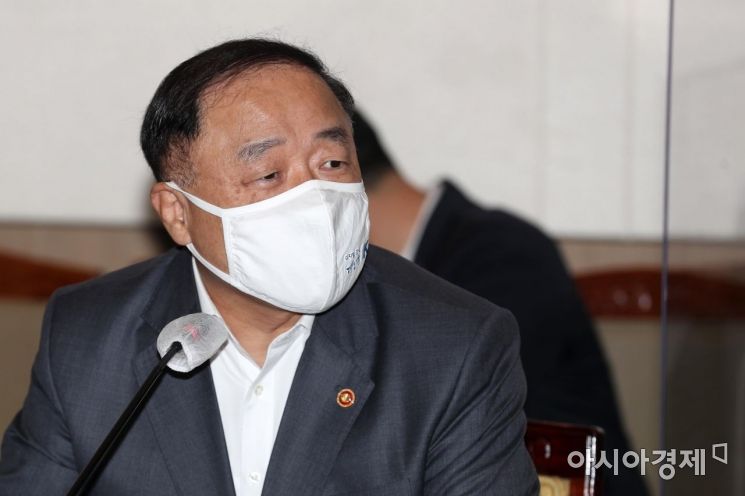
[Asia Economy Reporter Ju Sang-don] Hong Nam-ki, Deputy Prime Minister and Minister of Economy and Finance, stated on the 22nd, "We are monitoring the (Jeonse) market and considering with relevant ministries whether additional measures are necessary." This suggests that the announcement of government-level measures to resolve the recently deepening instability in the Jeonse market is imminent.
At the comprehensive audit held by the Planning and Finance Committee at the National Assembly that day, Deputy Prime Minister Hong said, "We have previously introduced and are steadily implementing measures to stabilize both the sales and Jeonse markets, but the Jeonse market has not yet stabilized."
The ruling party and government had previously announced their intention to present Jeonse measures around next week. The day before, Lee Nak-yeon, leader of the Democratic Party of Korea, Deputy Prime Minister Hong, and Kim Hyun-mi, Minister of Land, Infrastructure and Transport, discussed the Jeonse market situation in a closed-door economic situation review meeting. Immediately after the meeting, Heo Young, spokesperson for the Democratic Party of Korea, told reporters, "Through the Future Housing Promotion Task Force (TF), we are reviewing various data and considering whether related contents will be proposed as measures next week," adding, "Please watch the TF’s policy meetings." The ruling party and government’s move to prepare additional measures to stabilize the Jeonse market reflects the serious public sentiment caused by the shortage of listings and soaring prices.
In particular, the severity of the Jeonse crisis has been highlighted as even Hong Nam-ki, the economic chief, was reportedly refused renewal of his Jeonse contract for his apartment in Mapo-gu, Seoul. Moreover, the fact that the number of apartment move-ins in Seoul will nearly halve next year is likely to act as a negative factor for the Jeonse market. According to a survey by Real Estate 114, the total number of apartment move-ins nationwide next year is 265,594 units, a 26.5% (95,726 units) decrease compared to this year. Especially in Seoul, the number of move-ins next year is 26,940 units, a sharp 44.7% (21,818 units) drop from this year’s 48,758 units. The government expects that the 23,000 apartment move-ins in Seoul in the second half of this year, which is higher than the recent five-year average of 21,000 units, will contribute to stabilizing the Jeonse market. However, without a trend of increased move-ins beyond the second half of this year, it is difficult to expect stabilization of the Jeonse market.
The ruling party and government are reportedly considering expanding supply in urban areas to stabilize the Jeonse market. Measures under discussion include promoting small-scale redevelopment in urban areas to increase floor area ratios or reducing tax burdens on long-term resident single-homeowners. The intensity of the measures is likely to be determined by the government’s recognition of the severity of the Jeonse crisis. However, there is a difference in perspective between Deputy Prime Minister Hong and Minister Kim on this matter. At the review meeting, Hong evaluated that "the most important indicator to manage currently is real estate," while Minister Kim reportedly expressed a nuance of "let’s observe the market situation further and see the policy effects." On the 19th, the Ministry of Land, Infrastructure and Transport diagnosed the recent Jeonse market situation by stating, "According to reported data, the volume of Jeonse and monthly rent transactions in Seoul in August was 54,000 cases, 6.8% more than the same month last year (51,000 cases)," adding, "However, since the beginning of this year, the Bank of Korea has inevitably lowered the base interest rate to overcome the economic crisis caused by COVID-19, which has acted as a factor destabilizing Jeonse prices." This emphasized that the recent Jeonse crisis is not a side effect of the implementation of the Jeonse and monthly rent reporting system, the Jeonse and monthly rent price ceiling system, or the contract renewal request right system.
© The Asia Business Daily(www.asiae.co.kr). All rights reserved.

















