Dollar Index Hits 92.5 Intraday
Reflects Recognition of Inevitable Additional US Stimulus
US Treasury Yields Also Surpass 0.8%
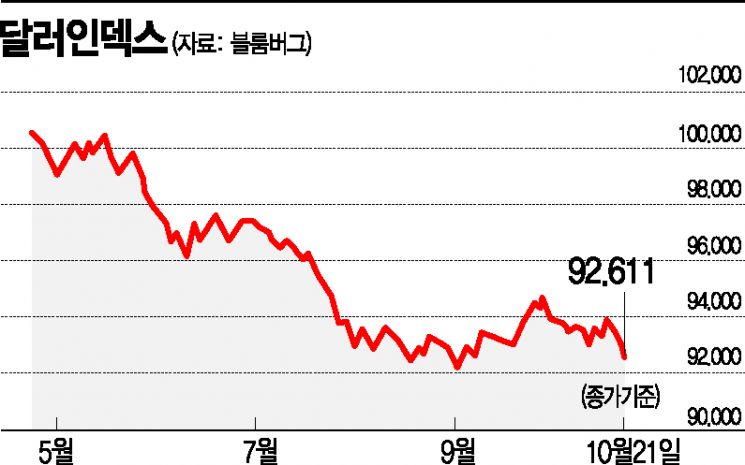
[Asia Economy New York=Correspondent Baek Jong-min] Ahead of the U.S. presidential election, the value of the dollar has been falling day by day, hitting its lowest point in seven weeks. Despite delays in negotiations over the economic stimulus bill amid the third wave of the novel coronavirus infection (COVID-19), there is a growing perception that additional stimulus is inevitable, which is being more strongly reflected in the dollar's value.
Along with the dollar, the yield on U.S. Treasury bonds, considered a representative safe asset, exceeded 0.8% for the first time in four months since June. The Chinese yuan exchange rate also showed its lowest level since July 9, 2018, amid the dollar's weakness.
On the 21st (local time) in the New York foreign exchange market, the dollar index, which shows the value of the dollar against major currencies, closed at 92.61. It fell to as low as 92.50 during the session. The dollar index has continued to weaken after breaking below the 93 level the previous day.
The dollar's weakness is also confirmed by the rise in the yen's value. The yen-dollar exchange rate fell to 104.6 yen, the level at the time of former Japanese Prime Minister Shinzo Abe's resignation.
The yuan also appreciated. On the morning of the 22nd, the People's Bank of China announced the dollar-yuan reference exchange rate at 6.6556 yuan, down 0.34% from the previous session.
The dollar index had plunged sharply in early March due to the impact of the COVID-19 crisis, then surged to the 102 level almost instantly due to a shortage of dollar liquidity, and subsequently followed a downward trend, but the recent sharp decline has not been seen before.
Wall Street interprets the recent decline in the dollar's value as looking ahead to the post-election period. Despite sluggish negotiations over large-scale fiscal spending for economic stimulus, the safe-haven dollar has not escaped weakness.
Expectations that large-scale fiscal spending will occur if Democratic presidential candidate Joe Biden is elected, including the implementation of Green New Deal policies, have had a greater impact on the dollar.
Although no agreement on the stimulus bill was reached between the White House and the Democratic Party on this day either, House Speaker Nancy Pelosi's side said they were closer to an agreement, contributing to the decline in the dollar's value. Axel Merk, president of the Merk Hard Currency Fund, diagnosed that "the dollar has entered a bear market."
U.S. Treasury yields are also stirring. The 10-year U.S. Treasury yield recorded 0.82% on this day, exceeding 0.8% for the first time since June. The yield even reached 0.86% during the session. A rise in Treasury yields means a fall in bond prices.
The U.S. economic situation also urgently requires additional stimulus. The Federal Reserve (Fed), through its Beige Book economic assessment report released on this day, evaluated that the U.S. economy grew from "weak" to "moderate," but mentioned "uncertainty" 20 times. This is interpreted as a signal that the introduction of stimulus measures is essential to maintain economic recovery.
© The Asia Business Daily(www.asiae.co.kr). All rights reserved.

















