First Introduction of Innovative Assessment Area
Average Scores of Female Students Higher Than Male Students
[Asia Economy Reporter Hyunju Lee] In the 2018 Programme for International Student Assessment (PISA) released by the Organisation for Economic Co-operation and Development (OECD), the average score for the cognitive assessment of 'global competence' was 35 points higher than the overall average score.
The Ministry of Education and the Korea Institute for Curriculum and Evaluation announced an analysis of these results on the 22nd.
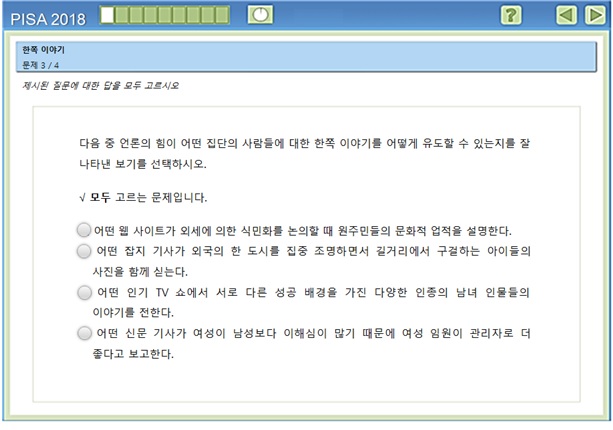
In PISA 2018, in addition to assessing the literacy, mathematics, and science skills of 15-year-old students, global competence was added as an innovative assessment domain and evaluated for the first time. Global competence is a multidimensional ability that includes explaining global and intercultural issues, understanding different perspectives and viewpoints, effectively interacting with people from diverse backgrounds, and acting for collective well-being and sustainable development.
It was measured through surveys and cognitive assessments. Among the 79 countries participating in PISA 2018, 66 countries participated in the student survey, and 27 countries participated in the cognitive assessment.
As a result, the average score for the cognitive assessment of global competence was 509 points for Korean students, which was 35 points higher than the overall average of 474 points across the 27 participating countries. The international headquarters conducting this study explained, "Because global competence is multidimensional and complex, only the average scores by country were calculated and presented without ranking."
The average score for female students was 518 points, higher than the 500 points for male students, and except for one country among the 27, female students’ average scores were significantly higher than those of male students. The average score difference was 26 points.
Ability to Understand Others’ Perspectives Higher than Average
Interest in Learning About Other Cultures is Low
This survey was conducted across four dimensions: ▲ explaining regional, global, and intercultural issues ▲ understanding and acknowledging others’ perspectives and worldviews ▲ participating openly, appropriately, and effectively in intercultural interactions ▲ acting for collective well-being and sustainable development. The third item was conducted only through surveys without cognitive assessment.
Specifically, Korean students’ self-efficacy index regarding global issues was higher than the OECD average. Self-efficacy refers to confidence in one’s ability to achieve desired outcomes through actions. Conversely, the awareness index of global issues was lower than average.
In the evaluation of understanding and acknowledging others’ perspectives and worldviews, survey results showed that the ability to understand others’ perspectives, respect for people from other cultures, and attitudes toward immigrants were higher than average, but interest in learning about other cultures and cognitive adaptability were lower than average.
The 'awareness of intercultural communication' index was 0.4, higher than the OECD average. In the survey results related to collective well-being, the agency index regarding global issues was 0.5, showing a high level.
The Ministry of Education and the Korea Institute for Curriculum and Evaluation plan to continue in-depth research based on this data.
© The Asia Business Daily(www.asiae.co.kr). All rights reserved.

















