Federation of Korean Industries Analyzes Impact of Strengthened Fair Trade Act Regulations
56 Listed Companies Newly Subject to Regulations Included
[Asia Economy Reporter Dongwoo Lee] Concerns have been raised that if the government's amendment to the Fair Trade Act is passed, shares worth 10.8 trillion won could be released, potentially causing turmoil in the domestic stock market.
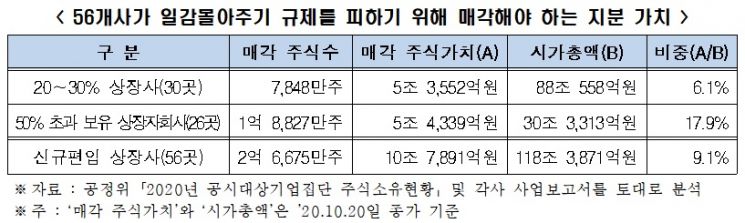
The Federation of Korean Industries (FKI) announced on the 22nd that an analysis of 56 newly regulated listed companies among 388 companies newly included under the amendment revealed that the value of shares they would need to sell to avoid regulation amounts to 10.8 trillion won, which corresponds to 9.1% of the market capitalization of the analyzed companies.
Among the 56 companies, 30 listed companies have a controlling family shareholding ratio of 20-30%, and 26 listed companies have subsidiaries where the regulated company holds more than 50% of shares.
The amendment targets listed companies where the controlling family holds 20-30% of shares and subsidiaries where the regulated company holds more than 50% of shares as new regulation subjects. Therefore, these companies must reduce the controlling family's shareholding in the listed company to below 20% or reduce the parent company's shareholding in the subsidiary to 50% or less to avoid regulation.
The FKI argued that if a large volume of shares is sold at once, there are concerns about stock price fluctuations and resulting damage to minority shareholders. For example, Company A must dispose of shares equivalent to 25% of its market capitalization, with the value of the shares to be sold exceeding 3 trillion won. In fact, when Hyundai Glovis attempted to sell controlling family shares after becoming subject to the Fair Trade Act amendment in 2013 targeting internal transactions, its stock price plunged 15%, from 300,000 won to 255,000 won.
The FKI pointed out that transactions between affiliated companies often involve essential matters such as maintaining confidentiality, making reduction difficult. Transactions between affiliated companies account for only 8.7% of the total sales of the 56 listed companies. Most transactions occur between non-affiliated companies, and companies engage in transactions between affiliates only when necessary for efficient production and sales, securing stable supply chains, and maintaining confidentiality. The FKI also claims that it is realistically difficult to change business partners within the one-year grace period after the amendment's enforcement.
Yoo Hwan-ik, head of the Corporate Policy Office at the FKI, said, “Since transactions between affiliates account for a small portion of sales, it is difficult to reduce them further. If regulations are strengthened, companies are likely to sell shares to escape regulation, and the resulting damage will fall on minority shareholders. The necessity of regulating internal transactions should be reconsidered.”
© The Asia Business Daily(www.asiae.co.kr). All rights reserved.
![Clutching a Stolen Dior Bag, Saying "I Hate Being Poor but Real"... The Grotesque Con of a "Human Knockoff" [Slate]](https://cwcontent.asiae.co.kr/asiaresize/183/2026021902243444107_1771435474.jpg)
















