Last-Minute Obstacle in Bangbae Samik Reconstruction
Property Valuation of Complex Shops '0 Won'
Greater Burden Than Apartment Union Members
Ministry of Land Responds 'Resolve Within Union'
Gangnam Reconstruction Residents Foresee Conflict
Experts Say "Improvement Measures Needed"
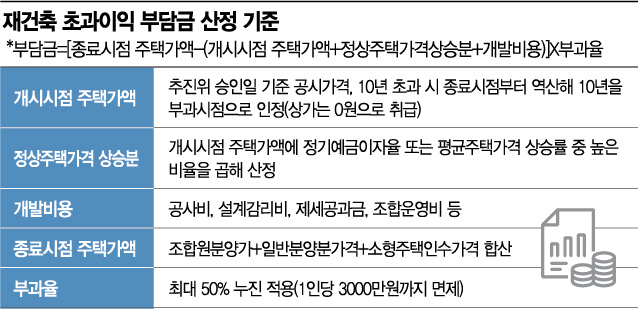
[Asia Economy Reporter Choi Dong-hyun] Since its reimplementation in 2018, the Reconstruction Excess Profit Recovery System (재초환) has continued to cause side effects in various places despite the Constitutional Court's ruling of constitutionality and subsequent legal adjustments. In particular, a legal loophole that causes commercial unit association members to bear a heavy burden of charges when they receive apartment allocations is intensifying internal conflicts within the associations.
According to industry sources on the 22nd, the Bangbae Samik Reconstruction Association in Bangbae-dong, Seocho-gu, Seoul, is currently undergoing an appraisal to submit data for members' application for allocation and to estimate the expected reconstruction excess profit charges after recently signing the main construction contract with Daelim Industrial. This complex, also well known as the home of former Minister of Justice Cho Kuk, is a mid-rise complex of 408 households built in 1981. Through reconstruction, it will be transformed into 'Acro Ritz County' with 721 households.
However, an unexpected obstacle has emerged at the final stage of the reconstruction project. The current 재초환 law only assumes situations where houses are demolished and rebuilt, so there is no proper basis to evaluate the commercial properties within the complex and reflect them in the charge collection. This is clearly reflected in the method of calculating the 재초환 charges. According to the formula in the Ministry of Land, Infrastructure and Transport manual, the charge is calculated by subtracting the sum of the normal housing price increase and development costs from the housing price at the end point, then multiplying by the charge rate. In other words, when calculating development profits, only 'housing' is considered, and commercial properties are excluded. Therefore, commercial properties, which clearly have market prices, are excluded from the starting point price.
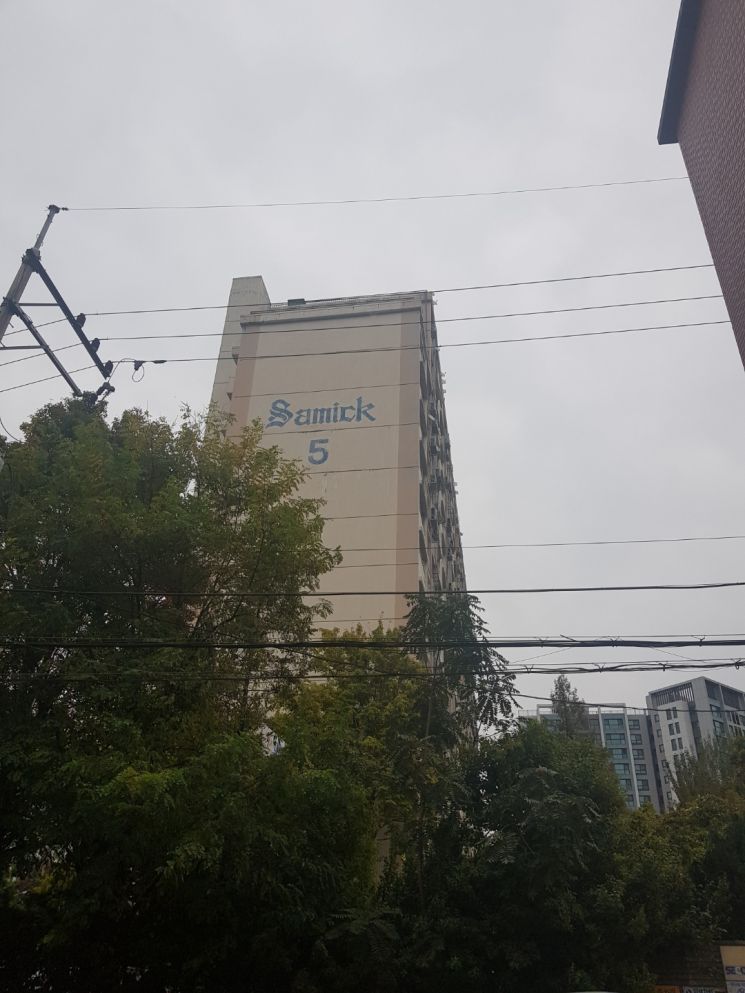
The problem is that in such a situation, if commercial unit association members want to obtain apartment occupancy rights instead of commercial units, they may face a heavy charge burden. Bangbae Samik consists of 408 apartment association members and 61 commercial unit association members, and it is reported that most commercial unit members currently hope to obtain apartment occupancy rights. Assuming that the prices of apartments and commercial units before reconstruction are both 100 million KRW, apartment association members would be deducted 40.8 billion KRW from the development profits after reconstruction, but commercial unit members would have to bear 6.1 billion KRW. As a result, even if they receive occupancy rights at the same market price, their charges inevitably become higher.
The association filed a complaint with the Ministry of Land, Infrastructure and Transport to improve this unfairness, but the ministry only gave a general response. In a recent reply to the association, the ministry stated, "According to Article 4 of the 재초환 law, the standard for burden sharing among members is determined based on the proportion of net profits each member holds," and added, "The association should decide a reasonable sharing ratio so that commercial unit members do not suffer relative disadvantages compared to apartment members." The ministry explained that it only notifies the total charge amount to the association, and it is up to the association to divide it. An association official said, "They made a law that cannot keep up with reality, and when conflicts arise among residents, they just say solve it yourselves," emphasizing, "This issue is like a time bomb that will explode in many reconstruction complexes in Gangnam in the future."
Experts also demanded prompt measures, pointing out that the government is violating the principle of fair taxation itself. Appraiser A pointed out, "In the case of commercial properties, unlike apartments, the official price system is institutionally insufficient, so making them pay more charges unfairly violates tax justice." He proposed an alternative, saying that by broadly interpreting Article 9, Paragraph 2, newly established by the revised 재초환 law in August, this issue can be resolved without legislative procedures. This clause aims to apply the same official price ratio when calculating housing prices at the start and end points, considering the difference caused by the realization of official prices. Appraiser A said, "If the realization reflection rate at the end point is applied equally to the appropriate market price of commercial properties at the start point, it can compensate for the lack of official prices for commercial properties at the start point," adding, "By calculating charges with the adjusted amount, the current law can also solve the problem."
© The Asia Business Daily(www.asiae.co.kr). All rights reserved.


















