China Foreign Ministry Denies BTS Merchandise Import Ban Rumors: "No Such Policy"
Ambassador Jang Ha-sung Apologizes for Corporate Card Use... If Not for COVID-19, Xi Jinping Would Have Already Visited Korea
[Asia Economy Beijing=Special Correspondent Jo Young-shin] On the 10th day of the national audit, the video national audit of the National Assembly Foreign Affairs and Unification Committee held at the Korean Embassy in Beijing on the 21st focused on Ambassador Jang Ha-sung's controversy over the misuse of corporate cards during his tenure as a professor at Korea University and the BTS controversy.
There was also interest in questions about the possibility of Chinese President Xi Jinping visiting Korea within the year and China's economic growth.
Ambassador Jang publicly apologized for the controversy over the improper use of corporate cards during his time as a Korea University professor, stating that although the cards were used at restaurants rather than entertainment establishments, it was inappropriate.
In response to Rep. Park Jin (People Power Party)'s question about the use of corporate cards, Ambassador Jang explained, "I used them for meals and wine costs when having dinners with research institute staff at restaurants."
He stated that he spent a total of 2.79 million won over six occasions and explained, "Since multiple people ordered meals and side dishes, about 400,000 won was additionally charged, so the payment was split between the research institute operation card and the research fund support card."
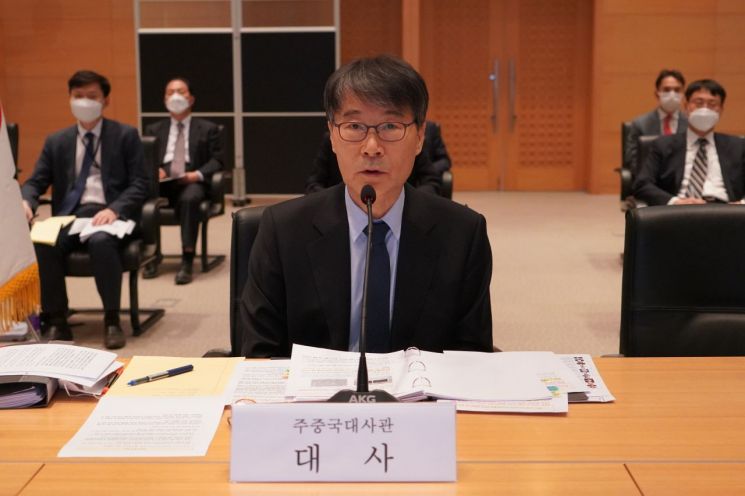 On the 21st, the 10th day of the National Assembly inspection, Ambassador Jang Ha-sung to China is giving a work report at the Foreign Affairs and Unification Committee's inspection at the National Assembly. (Beijing Correspondents)
Ambassador Jang further explained that the Korea University audit pointed out that the payments were inappropriate, and he refunded the full amount.
He said, "Although it was during my time as the head of the research institute, I sincerely apologize to the members of Korea University and the public for the inappropriate use."
Questions about the ban on BTS product deliveries also followed.
Rep. Jung Jin-seok (People Power Party) criticized the government's response as passive and helpless.
Rep. Lee Yong-seon of the Democratic Party of Korea expressed concern that the BTS controversy might worsen like the THAAD (Terminal High Altitude Area Defense) incident, causing Chinese authorities to reimpose non-tariff barriers in areas such as economy, culture, and tourism.
Ambassador Jang responded, "After the related situation was first reported, I directly communicated with high-level Chinese government officials the next day," adding, "We are taking the situation very seriously and will respond accordingly."
He continued, "After a company called Yunda (韻達) posted a notice, there were reports that two companies had stopped, so I checked directly, and there was no suspension of delivery at that time," but added, "However, since there was clearly a delivery suspension issue, we are responding very actively, and after the audit, I will raise the issue directly with senior Chinese officials."
Regarding media reports that the number of companies suspending BTS product deliveries is increasing, Ambassador Jang said, "Initially, it was only one company called Yunda, but there have been reports that other companies such as Zhongtong have been added, so we are communicating directly with the companies," adding, "Because this is a very sensitive issue that could affect the sentiments of both countries' citizens, we are responding strictly."
The Chinese Ministry of Foreign Affairs stated at a regular briefing that "China wants to actively work with Korea to promote friendship between the two countries," and "Chinese customs and other government agencies have not issued policies such as banning the clearance of (BTS) products."
In response to Rep. Kim Seok-ki (People Power Party)'s question about President Xi's visit to Korea, Ambassador Jang said, "The embassy has been continuously communicating with the Chinese side that Korea is the priority country to visit once the COVID-19 situation stabilizes," adding, "Hypothetically speaking, if it were not for COVID-19, I believe the visit would have already taken place."
He added, "Chinese authorities have also clearly expressed their intention to visit Korea first once the COVID-19 situation stabilizes."
Rep. Kim Young-ho (Democratic Party of Korea) asked about the background of China's rapid economic recovery.
Ambassador Jang explained, "At the Chinese National People's Congress, a large-scale fiscal expansion policy was implemented, which was unprecedented," adding, "The COVID-19 situation recovered earlier than in other countries, and the fiscal policy helped the economic recovery."
Regarding the damage to Korean companies caused by the US-China trade war, Ambassador Jang said, "There is no damage in advanced industries such as semiconductors, but consumer goods like air conditioners and refrigerators are affected," adding, "We are assessing the situation and consulting to minimize damage to small and medium-sized enterprises."
© The Asia Business Daily(www.asiae.co.kr). All rights reserved.

















