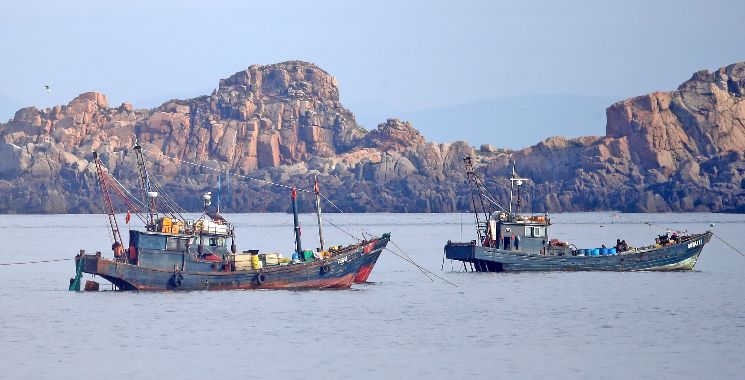
 Chinese fishing vessel in operation / Not related to the article content. [Image source=Yonhap News]
[Asia Economy Reporter Jeong Hyunjin] According to the Asahi Shimbun on the 21st, the number of Chinese fishing vessels illegally operating near Daehwatae, a fishing ground in the East Sea between Korea and Japan, has surged, while North Korean vessels have disappeared.
According to the report, the Japanese Fisheries Agency demanded the removal of a total of 4,000 North Korean vessels from Japan's Exclusive Economic Zone (EEZ) near Daehwatae last year, but this year, only one vessel was subject to such a demand. On the other hand, the number of Chinese vessels that received removal requests from Japan reached 2,586 by the end of September this year, about 3.6 times the number during the same period last year.
This trend was also confirmed by statistics from the Japan Coast Guard. The Coast Guard has demanded the removal of more than 1,000 North Korean vessels annually from Japan's EEZ near Daehwatae, but so far this year, there have been no removal requests against North Korean vessels. In the case of Chinese vessels, there were 89 and 12 removal requests in 2018 and 2019 respectively, but this year, as of the 16th, a total of 102 requests have been recorded, setting a record high.
The Daehwatae fishing ground is located in the central East Sea, where warm and cold currents intersect, making it rich in marine resources such as squid, earning it the nickname "golden fishing ground." Accordingly, nearby fishing vessels often enter the area to fish. In October last year, a North Korean vessel collided with a Japanese Fisheries Agency patrol boat in this area and sank.
Asahi introduced an expert's opinion that the disappearance of North Korean vessels and the surge of Chinese vessels in Daehwatae are likely due to the novel coronavirus disease (COVID-19). Professor Satoru Miyamoto of Seigakuin University, specializing in North Korean political diplomacy, said, "According to local reports from North Korea, they seem to be restricting fishing activities because they believe there is a risk of COVID-19 infection even from collecting marine drift objects," analyzing that Chinese vessels have taken advantage of the gap left by the disappearance of competing North Korean vessels.
The Japanese Fisheries Agency recently requested its domestic vessels to refrain from fishing in certain waters starting from the end of last month, fearing the possibility of collisions due to the surge of Chinese vessels illegally fishing in Daehwatae. Chief Cabinet Secretary Katsunobu Kato explained yesterday that this was an unavoidable measure to ensure the safety of Japanese vessels.
However, Japanese fishermen expressed dissatisfaction, saying, "It is a reversal of priorities to crack down on our own vessels while leaving Chinese vessels operating in waters under Japanese sovereignty." Asahi reported that the most affected are Japanese squid fishing vessels, quoting a representative from the Ishikawa Prefecture Fisheries Cooperative Association in central Japan who lamented, "I don't understand why Chinese vessels, which do not even border the East Sea, are fishing in Japan's EEZ."
© The Asia Business Daily(www.asiae.co.kr). All rights reserved.