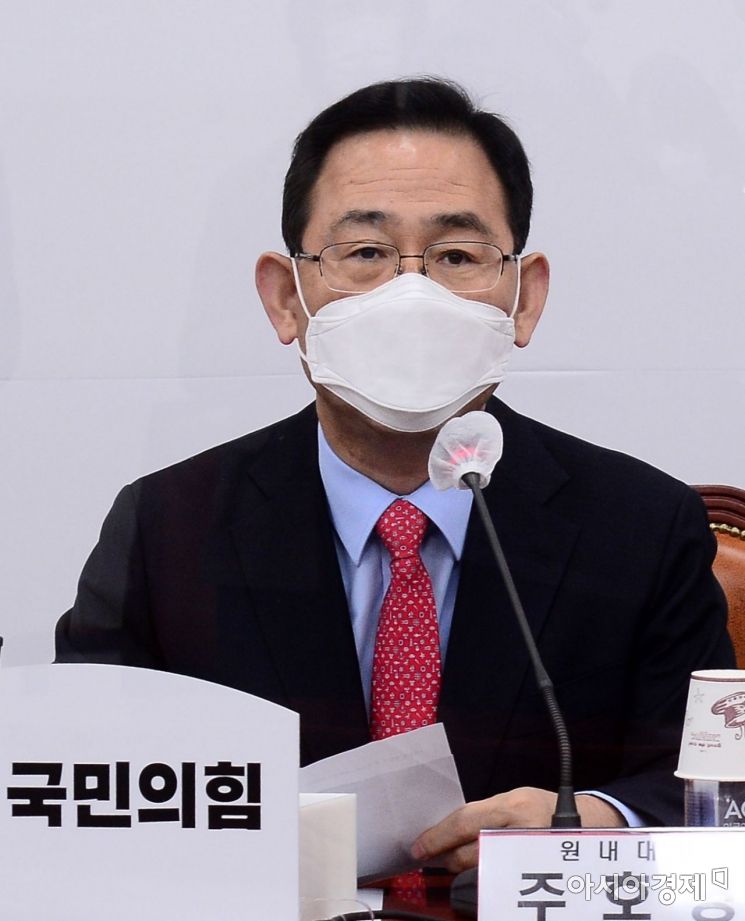
 Joo Ho-young, floor leader of the People Power Party, is attending the emergency response committee and senior lawmakers joint meeting held at the National Assembly on the 21st, delivering an opening remark. Photo by Yoon Dong-joo doso7@
[Asia Economy reporters Lee Ji-eun and Won Dara] The opposition party has launched an offensive targeting the Blue House as the 'head' in connection with the Board of Audit and Inspection's (BAI) audit results on the early shutdown of Wolsong Unit 1, vowing to hold President Moon Jae-in legally accountable even after his term ends. On the other hand, the ruling party defended the audit, saying it only evaluated economic feasibility and cannot be seen as a comprehensive judgment, accusing the opposition of trying to turn it into a political conflict.
On the 21st, Joo Ho-young, floor leader of the People Power Party, said in his opening remarks at the emergency countermeasure committee and senior lawmakers joint meeting, "The 370 billion won was lost due to the president's single remark asking 'When will Wolsong Unit 1 stop?', which was the starting point of the illegal and improper shutdown," adding, "President Moon is still in office, and although there are signs that the BAI did not conduct a proper audit, if there is legal responsibility after his retirement, he will not be able to avoid it."
He also stated, "The fact that former Minister of Trade, Industry and Energy Baek Woon-kyu and other public officials destroyed 444 nuclear power-related documents the day before the audit symbolically reveals that the early shutdown was wrong," emphasizing, "We will criminally prosecute all those responsible for obstructing the audit, abusing authority, and damaging official documents during the improper shutdown process." He added, "The audit committee members of the BAI, an independent constitutional institution, who acted as puppets of the regime to obstruct the conclusion of the audit and undermined the independence and neutrality of the BAI will remain a disgrace to their families forever."
In an interview with KBS Radio's 'Kim Kyung-rae's Strongest Current Affairs,' Floor Leader Joo said, "To judge the right or wrong of the early shutdown, we need to look at economic feasibility first, then safety, and then the acceptance of local residents, among which economic feasibility is the most important factor," adding, "If the economic feasibility evaluation was wrong, it is natural to conclude that the early shutdown was also wrong," interpreting the audit results.
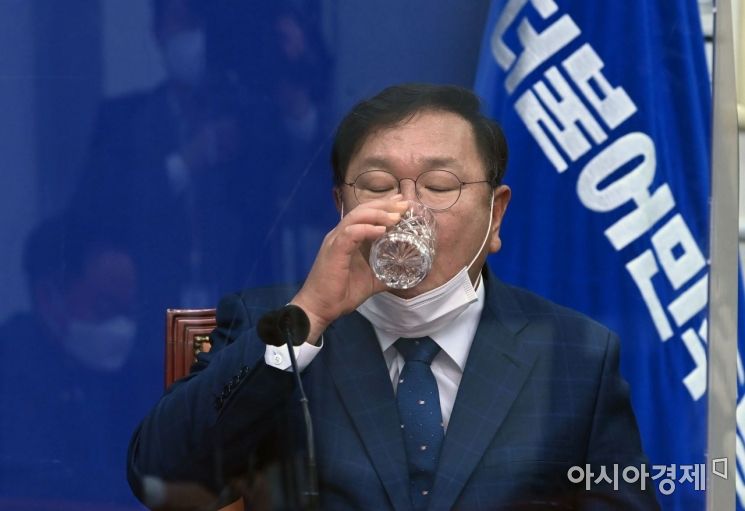 Kim Tae-nyeon, floor leader of the Democratic Party of Korea, is attending the Supreme Council meeting held at the National Assembly on the 21st and is drinking water during the meeting. Photo by Yoon Dong-joo doso7@
On the other hand, Kim Tae-nyeon, floor leader of the Democratic Party of Korea, said at the party's highest council meeting held at the National Assembly that morning, "The BAI's audit only examined the economic feasibility evaluation, which is one of several judgment factors related to the shutdown of Wolsong Unit 1," and urged, "The People Power Party should stop trying to twist the BAI's audit for political conflict."
He emphasized, "The BAI clearly stated that the audit results cannot be seen as a comprehensive judgment on Wolsong Unit 1," adding, "The early shutdown of Wolsong Unit 1 was a result of a comprehensive judgment including not only economic feasibility but also safety and local residents' acceptance."
Yang Yi-won-young, chairperson of the Democratic Party's Special Committee on Environment, also appeared on KBS Radio that day, saying, "The problem is turning what is just a routine audit into a controversy as if it were a judgment on energy transition policy," adding, "The head of the BAI also bears responsibility, and the opposition and certain conservative media have continuously urged supervision as if something is going on inside the BAI." Song Gap-seok, a member of the same party, said on MBC Radio's 'Kim Jong-bae's Focus,' "The audit was problematic from the start," adding, "Focusing only on economic feasibility and excluding the other two factors (safety and local residents' acceptance) means the audit was misguided from the beginning."
© The Asia Business Daily(www.asiae.co.kr). All rights reserved.


















