[Asia Economy Reporter Seulgina Jo] "Korea is special."
Reed Hastings, the founder and CEO of Netflix, which is building a global content kingdom, has never hidden his special affection for Korea in official settings. He named 'Kingdom,' which sparked the 'K-zombie' craze, and 'Crash Landing on You' as "the most entertaining dramas" he has watched, while also emphasizing the importance of Hallyu content that is loved worldwide. He also finds it remarkable that Korea was largely unaffected even as content production in major countries came to a halt due to the COVID-19 pandemic.
Korea has played a significant role not only in Netflix's subscriber growth in the third quarter but also as a key production hub for Netflix's 'original content strategy.' Domestically, despite massive traffic, Netflix has continuously faced controversy over avoiding network usage fees, known as 'free riding.' This background explains why many believe Korea has greatly contributed to Netflix's rise as a streaming giant with 200 million paid subscribers worldwide.
Netflix 3Q Performance Led by Korea and Asia
On the 20th (local time), Netflix revealed in an investor letter along with its earnings report that the Asia-Pacific region, centered on Korea and Japan, contributed the most to the increase in paid subscribers in the third quarter. It was reported that 46% of the global net increase in paid subscribers in Q3 came from the Asia-Pacific region, a 66% increase compared to the previous year.
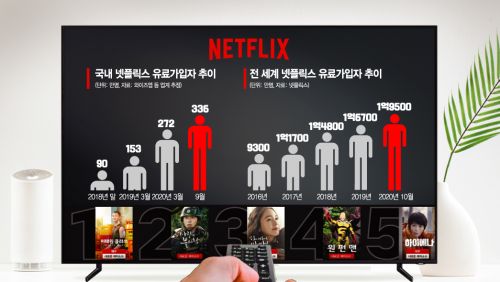
Netflix expressed satisfaction with the progress in the Asia-Pacific region, stating, "Especially in Korea and Japan, we achieved double-digit market share in households using broadband." Netflix's paid subscribers in Korea are estimated at 3.36 million as of last month, nearly double the 1.84 million recorded in the same month last year.
Netflix's Q3 revenue disclosed that day was $6.44 billion, roughly in line with market expectations, but earnings per share ($1.74) and the number of new global paid subscribers (2.2 million) fell far short of market forecasts. Foreign media reports suggest that without the Asia-Pacific region, including Korea and Japan, which accounted for about half of the new subscribers, Netflix's results would have been much worse.
There is also analysis that Korean popular culture, such as K-pop and K-dramas, which have recently gained global popularity, played a significant role. A source mentioned Netflix's investments in 'Kingdom' and 'The School Nurse Files,' saying, "Korea has become Netflix's biggest growth engine in the global market."
Focusing on the growth of the Asian market, Netflix early on designated Korea as a content hub. The scale of investment in Korean content, which was only 15 billion KRW in 2016, has now expanded more than 20 times to about 300 billion KRW annually. The source said, "Since 2015, Netflix has invested $700 million (approximately 797 billion KRW)." Based on this, over 70 works produced in Korea have been released globally as 'Netflix Originals,' available with subtitles in 31 languages and dubbing in more than 20 languages.
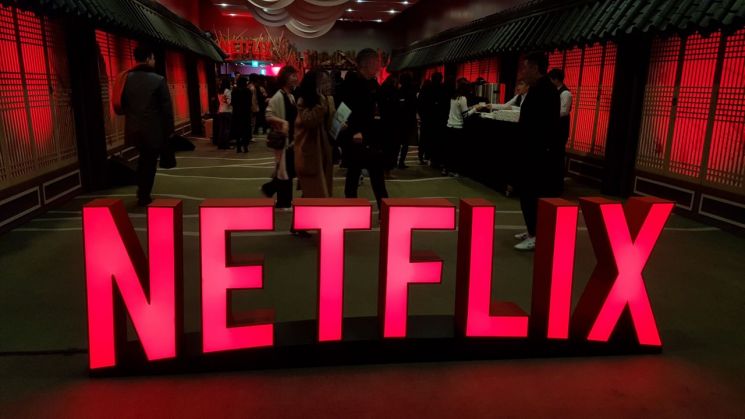 In January last year, the production presentation of the Netflix original drama 'Kingdom'. It is decorated like a theme park.
 [Image source=Yonhap News]
Ongoing 'Free Riding' Controversy
This figure draws even more attention as it comes amid ongoing controversy over Netflix's free riding ahead of the comprehensive audit of the Ministry of Science and ICT and the Korea Communications Commission by the National Assembly's Science, Technology, Information and Broadcasting Committee scheduled for June 22-23.
Initially, the committee requested Reginald Sean Thompson, head of Netflix Services Korea, as a witness for the audit, but he submitted a letter of absence citing overseas stay. On the 23rd, Netflix's operational staff are expected to attend the audit and emphasize Netflix's significant investment in Korean content production and its important role as a global platform.
However, criticism is inevitable that Netflix, which earns huge profits using K-content as a major weapon, is free riding domestically by ignoring network quality obligations. Currently, overseas content providers (CPs) such as Netflix and YouTube account for over 70% of domestic traffic. An industry insider pointed out, "Despite causing a heavy burden on domestic network maintenance due to massive traffic, they ignore their obligations." The government has also announced legislation, known as the 'Netflix Free Riding Prevention Act' (an amendment to the Telecommunications Business Act), to impose network quality maintenance obligations on global CPs.
There is also ongoing controversy over tax blind spots. According to data received by Park Hong-geun, a member of the Democratic Party, from the National Tax Service, 134 foreign IT companies including Netflix, Google, Facebook, and Amazon paid 236.7 billion KRW in value-added tax annually, which is less than the corporate tax (450 billion KRW) paid by a single company, Naver.
Meanwhile, Netflix's card payments confirmed in Korea last month approached 50 billion KRW, making it a central player in the subscription economy market. The industry expects the actual payment amount to be even higher when combined with payments through telecom companies. An industry insider criticized, "Global IT platforms earning trillions of won in revenue are avoiding their tax obligations, causing reverse discrimination controversy."
© The Asia Business Daily(www.asiae.co.kr). All rights reserved.
![Clutching a Stolen Dior Bag, Saying "I Hate Being Poor but Real"... The Grotesque Con of a "Human Knockoff" [Slate]](https://cwcontent.asiae.co.kr/asiaresize/183/2026021902243444107_1771435474.jpg)












