Questioning the Board of Audit and Inspection's Economic Feasibility Evaluation
Government Intervention, Policy Legitimacy & Trust Decline
Controversy Over Old Nuclear Plant Shutdown Provides Pretext
Industry Demands Resumption of Shin Hanul Construction
Government, Aware of Backlash, Files "Reconsideration Request"
Energy Transition Policy's Fate Likely Hinges on New Old Nuclear Economic Indicators
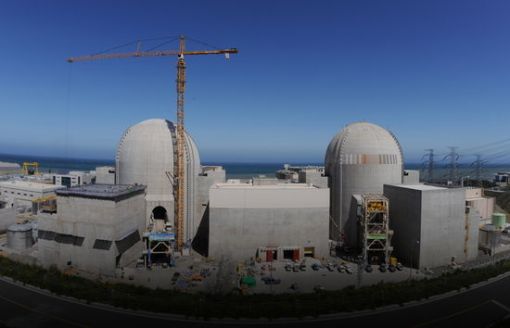 Panoramic view of Wolseong Nuclear Power Plant. (Photo by Korea Hydro & Nuclear Power)
[Asia Economy Reporter Moon Chaeseok] On the 20th, the Board of Audit and Inspection (BAI) announced the results of its audit on the validity of the early shutdown decision of Wolseong Nuclear Power Plant Unit 1, stating that "the economic feasibility was unreasonably undervalued," but deferred judgment on whether the early shutdown decision was unjust.
Accordingly, there is an analysis that the government has secured justification to continue its nuclear phase-out policy. However, since it was revealed that the government forcibly intervened in the economic evaluation to push forward the nuclear phase-out, there is also strong opposition arguing that it will be difficult to proceed with momentum as before. This is because the trust and transparency of government decision-making are being questioned.
Already, the nuclear industry is demanding the withdrawal of the early shutdown of Wolseong Unit 1 and the resumption of construction of Shin Hanul Units 3 and 4. It is also analyzed that the government's decision to request a re-examination from the BAI, despite the evaluation of the audit as "government-favorable," is in response to such backlash.
Procedural Legitimacy Tarnished, Burden on Future Nuclear Phase-Out Policy
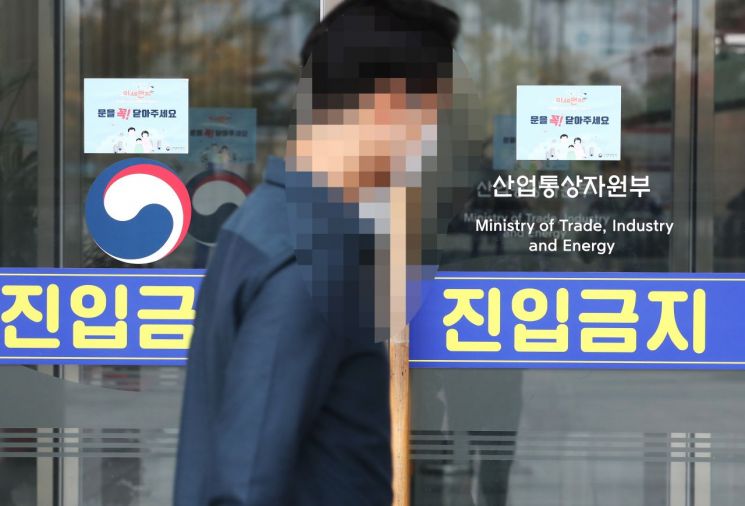 On the morning of the 21st, officials from the Ministry of Trade, Industry and Energy are seen arriving at work. (Image source=Yonhap News)
“The Ministry of Trade, Industry and Energy (MOTIE) stated immediately after the BAI announcement the previous day, 'We will announce our position on whether to request a re-examination of the audit after additional review of detailed issues,' and added, 'Since no problems have been confirmed regarding the early shutdown decision of Wolseong Unit 1, we will continue to pursue the energy transition policy without wavering.'
MOTIE strongly refuted the BAI’s view that the ministry inappropriately intervened in the economic feasibility analysis process, saying, 'We find it difficult to agree with the BAI’s perspective that MOTIE was improperly involved in the opinion exchanges during the economic analysis process.' This contrasts with Korea Hydro & Nuclear Power’s (KHNP) position of 'principally accepting the audit results.' For the government, since doubts have been raised about the procedural legitimacy of policy implementation, it appears concerned that this will become a burden when establishing future nuclear phase-out policies.
According to Article 36, Paragraph 2 of the Board of Audit and Inspection Act, MOTIE can request a re-examination of the BAI’s disposition demands (notification of personnel data for former Minister Baek, disciplinary requests for two officials in the Nuclear Industry Policy Division). The request must be submitted to the BAI by November 20, one month after the disposition date (the previous day). A MOTIE official said, 'We need to look into the details. It is not yet decided whether to submit a re-examination request, and we will review it after the National Assembly audit ends.' The comprehensive MOTIE audit ends on the 22nd.
The government plans to maintain its policy direction of reducing rather than adding nuclear power (resuming construction of Shin Hanul Units 3 and 4), but is aware of social conflicts surrounding the extension or early shutdown of aging nuclear plants. The plan is to close aging nuclear plants without extending their lifespan when their design life ends, but each time there may be controversy over validity. After Wolseong Unit 1, Gori Unit 2 will reach the end of its lifespan in 2023, followed by Gori Unit 3 (2024), and Gori Unit 4 and Hanbit Unit 1 (2025).
In fact, immediately after the BAI audit announcement, the nuclear industry demanded not only the withdrawal of the early shutdown of Wolseong Unit 1 but also the resumption of construction of Shin Hanul Units 3 and 4 in Uljin, Gyeongbuk. The 'Professors’ Council for Rational Energy Policy (Egyopyeop)' stated, 'KHNP’s board decision to early shut down Wolseong Unit 1 is null and void and must be immediately withdrawn,' and urged, 'KHNP should express its intention to build Shin Hanul Units 3 and 4 in the 9th Basic Plan for Electricity Supply and Demand (9th Electricity Plan), and the government should accept this and properly restore the halted construction.'
"Transparency and Independence Must Be Secured for New Economic Feasibility Indicators"
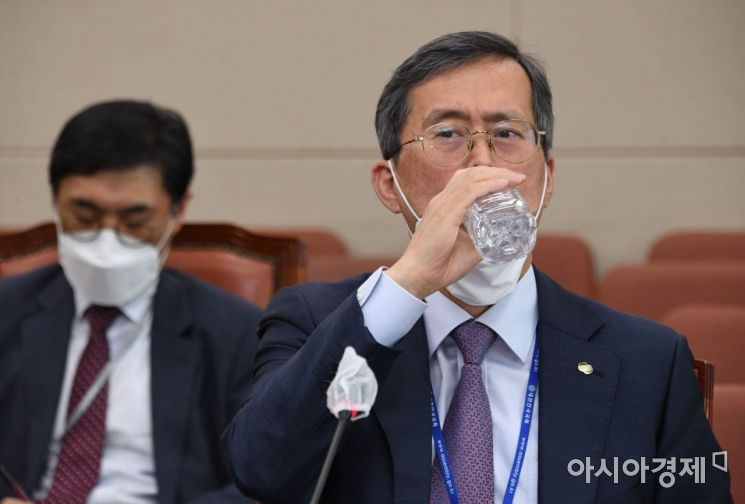 Jung Jae-hoon, President of Korea Hydro & Nuclear Power, appeared at the National Assembly's Science, Technology, Information and Broadcasting Communications Committee on the 12th for a government audit of the Nuclear Safety and Security Commission and others, drinking water as if feeling anxious. Photo by Yoon Dong-joo doso7@
The impact of the new economic feasibility evaluation indicators for aging nuclear plants, which KHNP plans to develop together with the government, on future nuclear policies is also drawing attention. Depending on how the economic indicators are created, they could either justify the government’s energy transition policy or become a new obstacle. KHNP announced two hours after the BAI announcement that it would faithfully implement follow-up measures by preparing guidelines related to economic feasibility evaluations concerning continued operation of nuclear plants through consultation and review with MOTIE and related ministries.
Experts point out that the new economic feasibility indicators must be established transparently and independently. They call for ▲involving experts and guaranteeing their independence in the process of creating the new economic evaluation indicators, not just consulting with the government ▲review of the indicator creation process by a third independent institution besides KHNP and MOTIE ▲ensuring the independence of accounting auditors during actual nuclear economic feasibility evaluations. In the recent Wolseong Unit 1 audit alone, it was revealed that the independence of Samdeok Accounting Corporation, the auditor responsible for key economic evaluation factors such as 'capacity factor' and 'sales price,' was not properly secured.
Professor Jung Yong-hoon of KAIST’s Department of Nuclear Engineering emphasized, “In the indicator creation process, the criteria for estimating sales costs and capacity factors for each economic evaluation scenario should be clearly disclosed, including whether nuclear power is cheaper or more expensive than other power sources.”
© The Asia Business Daily(www.asiae.co.kr). All rights reserved.


















