Jeonnam Forest Resources Research Institute Successfully Extracts and Separates Fiber from Kudzu Vine
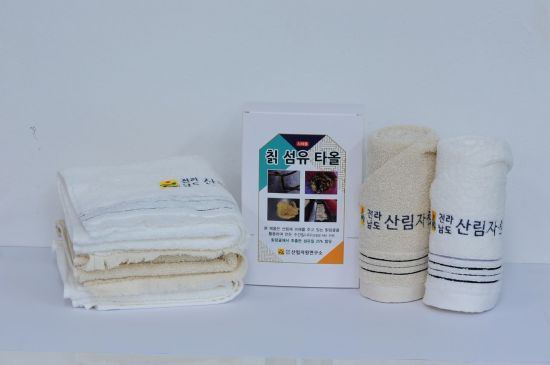
[Asia Economy Honam Reporting Headquarters, Reporter Yoon Jamin] The kudzu vine, known as the main culprit of forest damage, has been transformed into a ‘natural material towel’.
The Jeonnam Forest Resources Research Institute announced on the 21st that it has developed a natural material kudzu vine fiber towel by extracting and separating fibers from the kudzu vine, which is causing damage to the forest ecosystem.
The kudzu vine fiber towel was developed as part of a Korea Forest Service R&D project, utilizing the moisture absorption function of the kudzu vine. In particular, the cellulose content of the kudzu vine is 47%, slightly lower than that of general wood (60%), but it is easier to process.
The towel is made by extracting fibers through pretreatment processes such as hot water treatment and impurity removal, then spinning the extracted fibers into yarn and knitting them.
The kudzu vine grows rapidly with strong growth power, reaching over 100 meters in length per year.
It also has strong reproductive ability through seed propagation and secondary growth, making its removal very difficult. Most of the kudzu vines generated during removal projects are left on site, damaging the landscape.
Currently, 33,000 hectares of kudzu vine are distributed in the Jeonnam region. Various studies on kudzu vine removal (physical and chemical treatments) and equipment development have been conducted so far, and this year, a kudzu vine removal project covering 12,000 hectares is underway with a budget of 12.1 billion KRW.
In this regard, the institute is conducting tests for kudzu vine removal and is also promoting the development of kudzu walking mats using discarded kudzu vines.
Additionally, when kudzu vines were pelletized and their thermal efficiency measured, a thermal efficiency of 4600 kcal, similar to wood, was confirmed, proving its high value as an unused forest biomass resource material.
Kim Jaegwang, director of the Forest Resources Research Institute, said, “We will conduct research to enable various industrial uses of the kudzu vine, which is a headache for the forest ecosystem, and devote ourselves to optimizing kudzu vine control research.”
© The Asia Business Daily(www.asiae.co.kr). All rights reserved.
![Clutching a Stolen Dior Bag, Saying "I Hate Being Poor but Real"... The Grotesque Con of a "Human Knockoff" [Slate]](https://cwcontent.asiae.co.kr/asiaresize/183/2026021902243444107_1771435474.jpg)











