Focus on Actual Residence Over Investment... Half of Home Buyers in the First Half Are in Their 30s and 40s
The 30s and 40s generation is emerging as the main player in the housing market. According to data from the Korea Real Estate Board, the 30s and 40s generation purchased 227,256 apartments in the first half of this year. This accounts for 50.2% of the total transaction volume of 452,123 units.
The influence of the 30s and 40s generation is also strong in the pre-sale market. According to data released by the Ministry of Land, Infrastructure and Transport in January this year, among the winners of private housing supplied in the metropolitan area in 2019, those in their 30s accounted for 41.2%, and those in their 40s accounted for 27.7%, making up 68.9% of all winners. In other words, 7 out of 10 winners are in their 30s to 40s.
The industry analyzes that due to regulatory impacts, investment demand has decreased, the proportion of those aged 50 and above has declined, and the increase in mid- to low-priced sales led by actual demand has resulted in a higher proportion of apartment transactions by the 30s and 40s generation.
As the 30s and 40s generation rises as the main force in the market, apartment trends are also changing. Apartments near elementary schools (Chopuma, meaning "apartments embracing elementary schools") are gaining high popularity, while natural environments such as parks, mountains, and forests have become essential factors. This is interpreted as a change in residential choice factors as the Baby Boomer generation (1946?1964) is replaced by their children’s generation, the Eco Generation (1979?1992).
A real estate expert explained, “Most of the 30s and 40s generation are parents with young children, so they prioritize their children’s safety and prefer locations close to schools. Recently, health issues such as fine dust and COVID-19 have emerged, making residential comfort important. Furthermore, considering soaring housing prices and daily life, they show interest mainly in small to medium-sized units.”
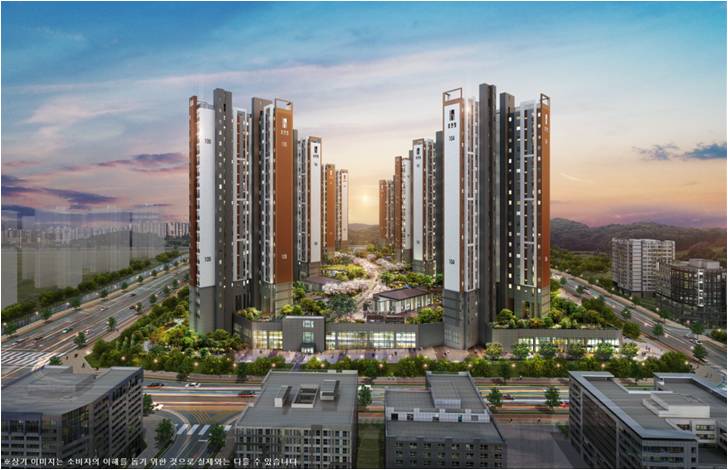
Amid the accelerating movement of the 30s and 40s generation to secure their own homes, market attention is focused on ‘Yeoju Station Humanville,’ scheduled to be supplied this month in the Yeoju Station area urban development district. This is because all units are small to medium-sized, and the location conditions such as school zones, forest zones, and station zones are excellent.
First, right in front of Yeoju Station Humanville, Yeoju Elementary School, boasting 110 years of history, is planned to be relocated and newly established. On the site of Yeoju Elementary School, a school facility complex project is progressing rapidly, which includes an elementary school facility sports center, library, cultural center, and experiential learning rooms, so students are expected to receive education in an improved environment in the future. In addition, Sejong Elementary, Sejong Middle School, Yeoju High School, and Yeoju University are located within commuting distance.
Also, a cluster of academies is formed near the complex, and a national/public daycare center and kindergarten are planned within the complex, providing excellent childcare and educational environments. Moreover, instead of parking spaces on the ground, themed landscaping like parks will be created, allowing children to play freely and safely, and making it a pleasant eco-friendly apartment where people of all ages can enjoy. Community facilities such as a premium library, children’s playground, and resident exercise facilities will also be established.
From the south side of the complex, some units offer views of Yeonhasan Mountain, and nearby are Hwanghaksan Arboretum and various parks. Numerous golf courses, water leisure facilities, and Sun Valley Water Park are also close by, allowing residents to enjoy leisure activities in a pleasant environment without going far.
The fact that it is a super-station zone apartment located only 220 meters from Yeoju Station on the Gyeonggang Line also draws attention. Using Yeoju Station on the Gyeonggang Line, it takes about 40 minutes to Pangyo and less than an hour to Seoul Gangnam. Yeoju General Terminal is nearby, and access to major cities is easy via the metropolitan transportation network including Bukyeoju IC and Yeoju JC. Yeoju Station is also planned to be part of the Yeoju-Wonju double-track electrification project, so once opened, Yeoju Station is expected to play a significant role as a transfer station.
Meanwhile, Yeoju Station Humanville will be built in Block 1 of the Yeoju Station area in Yeoju-si, Gyeonggi-do (around 418-1, Gyodong). It will consist of 8 buildings, 2 basement floors to 19 floors above ground, with a total of 640 units ranging from 59 to 84 square meters in exclusive area. By size, there are 216 units of 59㎡ and 424 units of 84㎡. The model house is located at 403-2, Gyodong, Yeoju-si, Gyeonggi-do (in front of Yeoju Station on the Gyeonggang Line) and is scheduled to open in October. Move-in is expected in April 2023.
© The Asia Business Daily(www.asiae.co.kr). All rights reserved.
![Clutching a Stolen Dior Bag, Saying "I Hate Being Poor but Real"... The Grotesque Con of a "Human Knockoff" [Slate]](https://cwcontent.asiae.co.kr/asiaresize/183/2026021902243444107_1771435474.jpg)
















