Ryu Ho-jeong Receives 'Oi' Informal Speech at National Assembly Audit
"An Incident Revealing the True Faces of Established Middle-Aged and Older Men"
952 Part-Time Workers: 90.2% Hurt by Rude Customer Behavior During Work
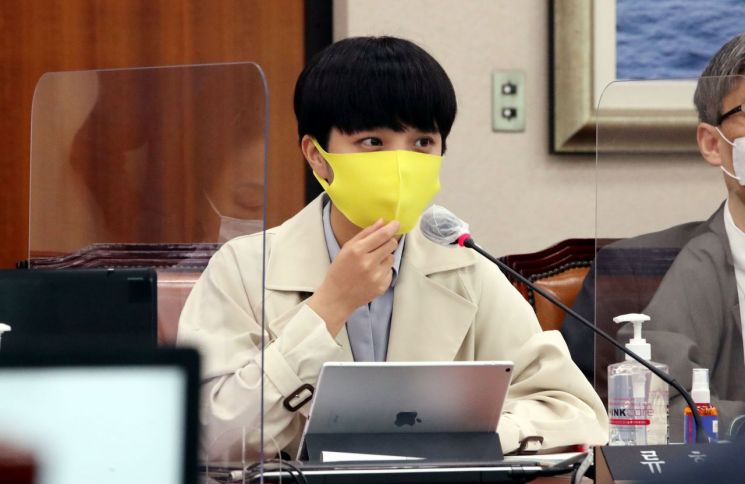 Ryu Ho-jeong, a member of the Justice Party, is questioning during the National Assembly's inspection of the Korea Trade-Investment Promotion Agency and the Korea Trade Insurance Corporation at the Industry, Trade, Energy, Small and Medium Business Committee held on the morning of the 13th. Photo by Yonhap News
[Asia Economy reporters Seunggon Han and Yeongeun Kim] "My name is not 'Eoi' (Hey).", "There are many customers who call me informally and shout."
On the 19th, during the National Assembly's Industry, Trade, Energy, Small and Medium Enterprises Committee's audit, controversy arose over whether Choi Chang-hee, CEO of Public Home Shopping, used informal language by calling Justice Party lawmaker Ryu Ho-jeong 'Eoi' (Hey). CEO Choi denied the claim, but separately, there are criticisms that middle-aged men’s power harassment against young people, such as calling women in their 20s like lawmaker Ryu 'Eoi' or speaking informally to part-time workers, is widespread.
During the audit, lawmaker Ryu raised suspicions of irregular hiring by pointing out false career entries in the recruitment process for a Public Home Shopping specialist (head of marketing division). CEO Choi responded, "They had equivalent qualifications," adding, "I think there were no contract or regular positions 20 years ago, so I did not consider it false information."
When lawmaker Ryu interrupted, saying, "That does not mean false entries are acceptable," CEO Choi said "Eoi." Ryu responded with "Eoi?" and continued her questioning. After controversy grew that CEO Choi ignored Ryu by speaking informally due to her young age, CEO Choi explained that the "Eoi" remark was not a form of address but an exclamatory expression spoken to himself.
In a follow-up question, lawmaker Ryu asked, "Is it true that you instructed employees to issue a correction to the media claiming it was just a simple exclamation?" CEO Choi replied, "I think I just said 'false,' but I’m not sure. I was wearing a mask, so judging by context, I think I said 'false.' If there was any misunderstanding, I apologize."
CEO Choi is an advertising expert who created the phrase "People First" and previously joined Moon Jae-in’s presidential campaign as a PR advisor. Lawmaker Ryu, born in 1992 and the youngest member of the 21st National Assembly, is 43 years younger than CEO Choi, who was born in 1949.
Given the situation, young politicians of similar age to lawmaker Ryu criticized the incident as exposing "the true face of entrenched middle-aged and older men in power who routinely belittle others simply because they are younger or female."
Kang Min-jin, preparatory committee chair of the Youth Justice Party, said, "It is even more absurd that the rude behavior was not acknowledged and was brushed off as a simple exclamation," adding, "Regardless of age, young lawmakers including Ryu are elected representatives of the people," criticizing the incident.

The so-called 'informal language controversy' that lawmaker Ryu experienced in the National Assembly is also a common situation faced by other women in their 20s.
A university student A (23), who works part-time at a bakery cafe in the metropolitan area, complained that she hears informal language from customers at least two or three times every workday.
A said, "Many customers ask about different types of bread, and I often hear informal language then," adding, "Especially male customers about my father's age call me 'Agassi' (young lady), 'Eoi' (Hey), and often say things like 'What’s in this? Recommend something tasty,' or 'You should give me more forks' in an informal tone." She also said, "During busy times, some customers shout informally, 'When will it be ready?' It happens every time, but it always upsets me."
Even outside part-time work, there are many cases of hearing informal language. Office worker B (26) said, "I often take taxis, and many drivers suddenly say 'Where to?' or 'Cash payment?' informally," adding, "Of course, the drivers are older than me, but just because of that, speaking informally feels belittling." He continued, "It feels bad, but since it’s a one-time encounter, I just endure it," lamenting, "Some people take informal speech for granted, but it’s a matter of manners that is often not observed."
These complaints from part-time workers are reflected in a survey result. Last year, part-time job portal AlbaMon surveyed 952 part-time workers, and 90.2% responded that they had been hurt by customers’ bad manners during work.

They cited moments when they were hurt as △dealing with customers who speak informally (51.5%) △being asked for things beyond their authority like 'discounts' or 'extra service' (27.5%) △customers throwing or scattering money or cards (26.9%) △customers making mistakes but demanding unconditional apologies from workers (24.8%) △being scolded with complaints like 'It tastes bad' or 'The service is terrible' (16.3%).
Other bad manners included △ignoring greetings from part-time workers (12.1%) △constantly calling workers for even minor issues including self-service (9.3%) △demanding the boss come out immediately (7.7%).
Experts suggest the need to break away from outdated patriarchal culture and improve awareness.
Kim Min-moon-jung, co-representative of the Korean Women’s Associations United, pointed out, "Our society has been based on a patriarchal culture where women are not recognized as public agents, so such perceptions continue and cause these problems."
Kim added, "It’s truly a difficult issue," criticizing, "In the National Assembly and society, young women are often not seen as lawmakers with equal legislative rights or equal members of society, but rather as someone who should be taught by someone older or higher in hierarchy."
She emphasized, "A common example is taxi drivers speaking informally to young-looking passengers, especially female passengers. Even though they are all passengers, the attitude toward female and male passengers differs. We need to improve awareness to treat everyone equally regardless of age or gender and work together on this."
© The Asia Business Daily(www.asiae.co.kr). All rights reserved.
![Clutching a Stolen Dior Bag, Saying "I Hate Being Poor but Real"... The Grotesque Con of a "Human Knockoff" [Slate]](https://cwcontent.asiae.co.kr/asiaresize/183/2026021902243444107_1771435474.jpg)


















