South Korean Government Struggles to Find Means and Justification... "Seeking Measures in Cooperation with the International Community"
Won Hee-ryong, Governor of Jeju, States "Not a Single Drop Can Be Tolerated"... If Japan Proceeds, "Including Civil and Criminal Lawsuits and International Court Litigation"
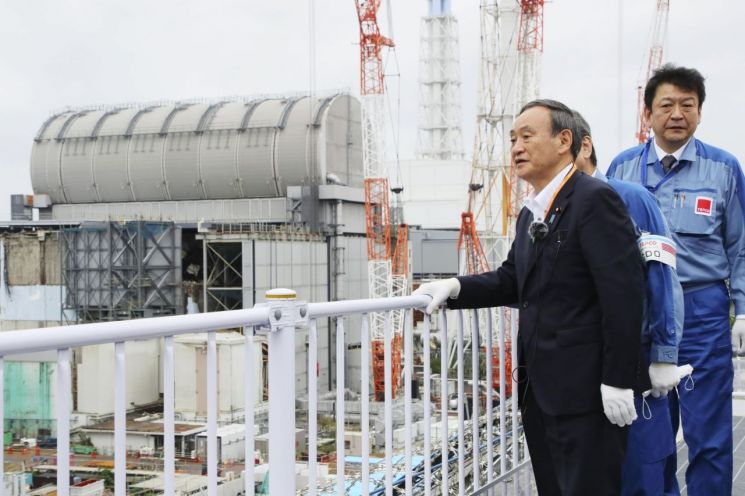
[Asia Economy Reporter Lim Cheol-young] As the Japanese government’s decision to discharge contaminated water from the Fukushima Daiichi Nuclear Power Plant approaches in one week, the South Korean government’s concerns are deepening. Amid worsening public opinion both domestically and among neighboring countries, the government has stated its intention to coordinate with the international community to devise countermeasures, but no clear plan has yet been established. Meanwhile, Jeju Governor Won Hee-ryong announced plans to pursue joint actions with local governments and civic groups within Japan, as well as to proceed with international court litigation, including civil and criminal lawsuits.
Japan appears to be pushing forward with the discharge decision based on its own investigation data titled “Tokyo Electric Power Company Fukushima Daiichi Nuclear Power Plant Treated Water Status” and the review report from the International Atomic Energy Agency (IAEA). The Japanese government plans to officially decide on the policy to purify and discharge radioactive contaminated water from Fukushima Daiichi at the “Decommissioning and Contaminated Water Measures Ministerial Meeting” scheduled for the 27th. Once the policy is officially decided, the discharge facility design and safety review will follow, with discharge expected to begin around October next year. At Fukushima Daiichi, contaminated water is generated daily at a rate of 160 to 170 tons due to the mixing of rainwater and groundwater.
The South Korean government is responding mainly through the Office for Government Policy Coordination but has yet to announce specific countermeasures. The government’s stance is to respond at a whole-of-government level in solidarity with the international community, emphasizing “transparent information disclosure and safe discharge in accordance with international standards.” In this regard, the Ministry of Foreign Affairs stated, “The government prioritizes the protection of the health and safety of its citizens and will continuously monitor Japan’s contaminated water disposal activities closely, coordinating with the international community to take necessary measures.”
Voices opposing the Japanese government’s policy are growing louder. Governor Won held a press conference at the National Assembly Communication Office, stating, “We cannot tolerate even a single drop of contaminated water from Fukushima,” and announced plans to promote joint actions with the “Council of Governors of Coastal Cities and Prefectures along the Korea-Japan Strait” (8 cities) and the “Trans-Pacific Peace Park Cities Association” (7 cities). He also said he would recruit resident plaintiffs representing Korean and Korea-Japan coastal residents to file a lawsuit against the Japanese government at the International Court of Justice.
The Chinese government and public opinion within Japan share similar concerns. Zhao Lijian, spokesperson for the Chinese Ministry of Foreign Affairs, said the day before, “We hope the Japanese government will carefully decide on measures after sufficient consultation with neighboring countries,” and “We hope the government will announce its plans in an open and transparent manner.” Furthermore, according to a public opinion poll by Japan’s Yomiuri Shimbun, opposition to the Japanese government’s plan to discharge Fukushima contaminated water into the ocean stood at 50%, higher than the 41% in favor. Considering that 68% of Japanese citizens had withheld their response in a March survey, this represents a dramatic shift. Yoshihiro Murai, governor of Miyagi Prefecture, expressed at a regular press conference the day before, “We are very surprised by the sudden reports without any information provided by the government,” emphasizing, “It cannot be said that there has been a national discussion.”
However, it is not easy to fully block the Japanese government’s policy. Apart from South Korea, no major countries have actively expressed opposition to Japan’s plan, and China has already discharged contaminated water into the Yellow Sea, making it difficult to oppose the plan outright. In fact, China repeatedly maintains a fundamental position urging the Japanese government to handle the contaminated water through transparent and safe procedures.
The IAEA review report, which holds significant influence over international public opinion, also evaluated that Japan’s proposed contaminated water treatment plan is technically feasible if transparent communication with the international community is maintained. The Japanese government is actively using this report in international public relations efforts. In the report released in April, the IAEA recommended, “Ocean discharge is a method routinely used at nuclear power plants and nuclear fuel processing facilities worldwide,” and “A communication plan should be established to actively provide information to all stakeholders and the general public.”
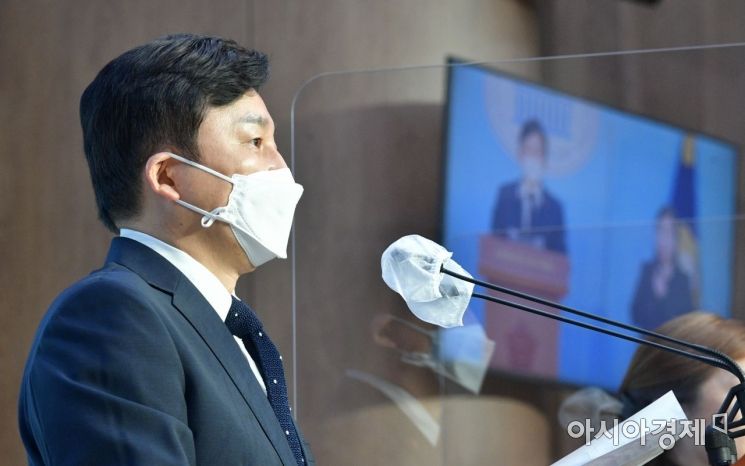 Jeju Governor Won Hee-ryong held a press conference at the National Assembly on the 20th regarding preparations for the discharge of contaminated water from Fukushima, Japan. At the event, Governor Won said, "I urge Prime Minister Suga Yoshihide to immediately halt preparations related to the discharge of Fukushima contaminated water." Photo by Yoon Dong-joo doso7@
© The Asia Business Daily(www.asiae.co.kr). All rights reserved.


















