World's No.1 Semiconductor Until 2016
Business Decline in Recent Years
Stock Price Also Fell Over 15% This Year
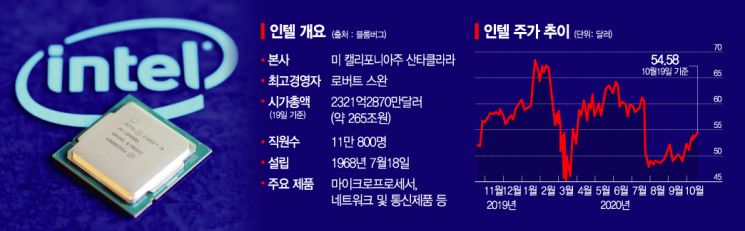
[Asia Economy Reporter Kwon Jae-hee] Intel, once the dominant force in the global semiconductor industry, is now faltering. Since its founding in 1968, Intel had never lost its position as the world's number one semiconductor company until 2016. However, in recent years, the company has fallen into business stagnation and has been repeatedly overtaken by latecomers. Especially after losing ground in memory chips, Intel is now also falling behind in the crucial non-memory sector, leading to assessments that the "fall of the Intel empire" is becoming a reality.
Intel's slump is evident across the board. In January, it sold its stake in a joint venture developing new memory semiconductor technologies for $1.5 billion (about 1.7 trillion KRW). In the non-memory sector, while the latecomer American company AMD rapidly increased its market share, Intel faced setbacks in mass production of next-generation central processing units (CPUs). The PHLX Semiconductor Index, which reflects the stock prices of 30 semiconductor companies on Nasdaq, has risen 30% this year, but Intel's stock price has dropped by more than 15%. Its market capitalization stands at $232.1287 billion (about 265 trillion KRW), significantly trailing Nvidia’s $333.1245 billion (about 380 trillion KRW), which recently acquired the UK semiconductor company ARM.
The downfall of once-thriving Intel is attributed to its failure to adequately respond to the rapid changes in the semiconductor industry. Intel maintained global semiconductor dominance for over 50 years with its unrivaled position in the CPU sector, an essential component in all PCs worldwide. However, Intel failed to anticipate the shift to mobile. The American telecommunications chip specialist Qualcomm developed the application processor (AP), known as the smartphone CPU, capturing global smartphone manufacturers such as Samsung Electronics and Huawei, breaking the formula of "CPU = Intel." This is closely related to Samsung Electronics overtaking Intel as the top semiconductor market revenue leader.
Intel's decline became more visible this year. Due to the US-China trade dispute, Intel faced difficulties exporting to China. Last year, 78% of Intel’s sales came from overseas markets, with 28% dependent on China. The trade conflict exposed the vulnerabilities of Intel’s fragile global supply chain. Additionally, the US government's crackdown on Huawei, Intel’s major customer, resulted in a ban on supplying parts to Huawei, delivering a direct blow.
Internally, Intel has faced multiple setbacks this year. Jim Keller, a legend in the CPU industry, left Intel, and Apple declared its "post-Intel" strategy. Apple's sudden announcement carries significant meaning. Although Apple accounts for less than 5% of Intel’s sales, its symbolic presence in the PC market is substantial. Apple’s move away from Intel signals a major shift in the PC semiconductor environment and is seen as evidence that Intel has failed to keep pace.
Intel’s long-standing reign as the semiconductor industry king has led to bureaucratic and rigid organizational culture, which is also considered to have weakened its competitiveness. Bloomberg analyzed, "The departure of key internal personnel due to poor leadership raises doubts about Intel’s technological capabilities," adding, "Many analysts are concerned about Intel’s future."
© The Asia Business Daily(www.asiae.co.kr). All rights reserved.
![Clutching a Stolen Dior Bag, Saying "I Hate Being Poor but Real"... The Grotesque Con of a "Human Knockoff" [Slate]](https://cwcontent.asiae.co.kr/asiaresize/183/2026021902243444107_1771435474.jpg)











