September Employment Trends
Newly Employed Aged 15-29 Down by 218,000
30s Down by 284,000
Employment in 40s Declines for 59 Consecutive Months
Only Those Aged 60 and Over Increased by 419,000
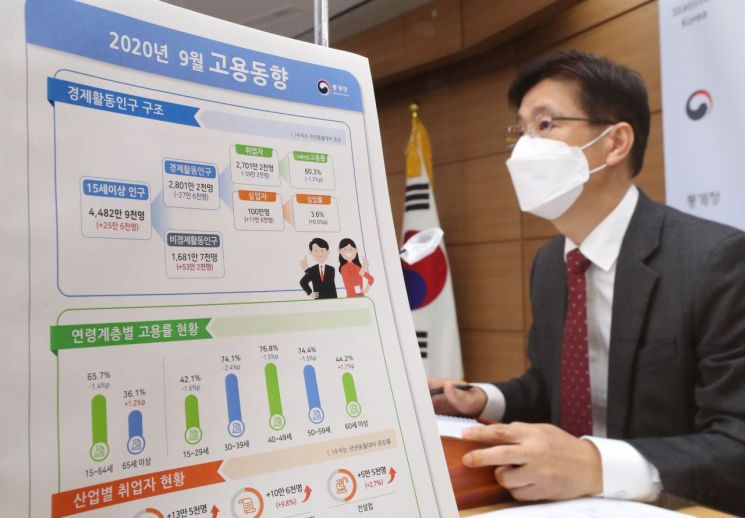
[Sejong=Asia Economy Reporters Kim Hyunjung and Joo Sangdon] The resurgence of COVID-19 in mid-August this year mainly affected the youth (aged 15-29) and those in their 30s. In September, the number of employed people decreased by 392,000, with over 500,000 job losses occurring solely among the youth and those in their 30s. Consequently, the decline in employment was more pronounced in industries where the youth and 30s predominantly work, such as accommodation and food services, wholesale and retail trade, and education services.
◆ COVID-19 Resurgence Impact Concentrated on Youth and 30s = According to Statistics Korea's 'September Employment Trends' released on the 16th, newly employed individuals aged 15-29 decreased by 218,000, and those in their 30s decreased by 284,000. The trend of only those aged 60 and over finding jobs continued in September. The number of employed people aged 60 and over increased by 419,000, of which those aged 65 and over increased by 256,000. In contrast, employment decreased across the board in the 30s and 20s (-198,000), 40s (-176,000), and 50s (-133,000). Employment among those in their 40s has been declining for 59 consecutive months since November 2015. Employment among the youth (aged 15-29) also decreased by 218,000, marking eight consecutive months of decline since February. The scale of the decrease in youth employment was the largest in five months since April this year (-245,000).
The overall employment rate, which is the proportion of employed people among the population aged 15 and over, was 60.3%, down 1.2 percentage points from a year earlier. This is the lowest for the same month in eight years since 2012 (60.2%). The employment rate for those aged 15-64, the OECD comparison standard, fell 1.4 percentage points from the previous year to 65.7%, the lowest for the same month since September 2013 (65.2%).
Looking at the decrease in employment by industry, the impact of employment decline among the youth and those in their 30s is clearly evident. The largest decreases were in accommodation and food services (-225,000, -9.8%), wholesale and retail trade (-207,000, -5.7%), and education services (-151,000, -7.9%). By occupation, sales workers (-172,000, -5.7%) and service workers (-136,000, -4.4%) showed notable declines.
Unemployed Also Increased Significantly in 30s
Up 21.9%, Largest Increase Among All Age Groups
Economically Inactive Population at 16.817 Million
2.413 Million 'Rested' Despite Ability to Work... Highest for September on Record
The number of unemployed reached 1 million, an increase of 116,000 (13.1%) from the same period last year, the highest in two years since September 2018 (1.024 million). Unemployment increased across all age groups: 20s (46,000, 15.4%), 30s (35,000, 21.9%), 40s (15,000, 10.3%), and 60 and over (10,000, 9.0%).
Jung Dongmyung, Director of the Social Statistics Bureau at Statistics Korea, explained, "Unemployment increased mainly among the youth and those in their 30s because they have been unable to find jobs due to the resurgence of COVID-19 and are continuously waiting in unemployment." He added, "The increase in unemployed and unemployment rate can be seen as a result of unemployed individuals actively engaging in job-seeking activities."
The employment auxiliary indicator 3 (expanded unemployment rate), which reflects perceived unemployment, also showed a significant rise among the youth. Overall, it rose by 2.7%, with the youth alone increasing by 4.3 percentage points.
The economically inactive population, those neither employed nor unemployed during the survey period, was 16.817 million, an increase of 532,000 from the same period last year. Among them, those classified as 'rested' within the economically inactive population numbered 2.413 million, the highest for September since statistics began in 2003. The increase was particularly large among those in their 20s (83,000, 23.9%) and 30s (66,300, 28.8%). Additionally, discouraged job seekers also rose to 645,000, an increase of 113,000 over one year.
Deputy Prime Minister Hong Namgi: "Employment Recovery Will Resume in October... Consumer Coupons and Fiscal Job Projects to Be Promoted"
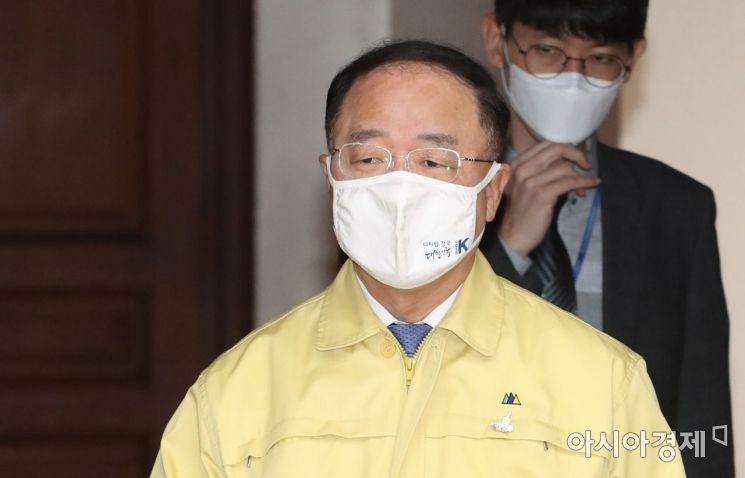
◆ Government Reintroduces Consumer Coupons and Fiscal Job Measures = Regarding the deterioration of employment indicators in September due to the resurgence of COVID-19, the government expects a recovery trend to appear in October. With the slowdown in COVID-19 spread and the easing of social distancing, the number of employed people is expected to increase again. The government announced plans to resume issuing eight types of consumer coupons and to supplement the decline in market jobs through a fiscal job project creating 600,000 jobs to stabilize the employment market.
Deputy Prime Minister and Minister of Economy and Finance Hong Namgi held a meeting of related ministers (Green Room Meeting) at the Government Seoul Office this morning and announced these measures. The meeting, chaired by Deputy Prime Minister Hong, was attended by the Minister of Employment and Labor, Director of the Office for Government Policy Coordination, Commissioner of Statistics Korea, Chief Presidential Secretary for Economic Affairs, and Chief Presidential Secretary for Jobs.
Hong Namgi stated, "Participants shared recognition of the severity of the employment market situation in September, where the employment recovery trend from May to August was interrupted and worsened due to the resurgence of COVID-19." He added, "There is particular concern about the continued and deepening difficulties faced by vulnerable employment groups such as youth, temporary and daily workers, self-employed, and COVID-19 vulnerable industries such as accommodation and food services." However, he noted, "Compared to the first employment shock in March and April, the degree of employment contraction is not as severe," and predicted, "With the recent slowdown in the spread and easing of social distancing, employment recovery is expected to resume in October." Indeed, the average daily number of new confirmed cases decreased from 180 in the first to tenth of last month, to 123 in the 11th to 20th, 84 in the 21st to 30th, and 74 up to the 10th of this month.
The government plans to promptly execute the 4th supplementary budget projects targeting employment-damaged groups such as small business owners' New Hope Fund, emergency employment stabilization subsidies, and special youth job-seeking support funds, while implementing measures to stabilize the employment market including ▲ extension of employment retention subsidy support period ▲ resumption of issuing eight types of consumer coupons and Korea Sale Festa ▲ amendment of the Employment Insurance Act and implementation of the National Employment Support System ▲ fiscal job projects creating 600,000 jobs.
The government stated that the resumption of the eight consumer coupons, which were suspended due to the COVID-19 resurgence, will be carried out after comprehensive review of timing, event promotion, and supplementary quarantine measures in close consultation with health authorities. Additionally, they plan to promote various domestic demand revitalization packages by sector (dining, tourism, culture, etc.) such as Korea Sale Festa (November 1-15) and consumption events for small and medium enterprises and traditional markets during Christmas.
© The Asia Business Daily(www.asiae.co.kr). All rights reserved.


















