Resolution at the 2nd Hydrogen Economy Committee
Establishment of Commercial Vehicle Hydrogen Charging Stations and Creation of 25 Trillion KRW Investment Over 20 Years
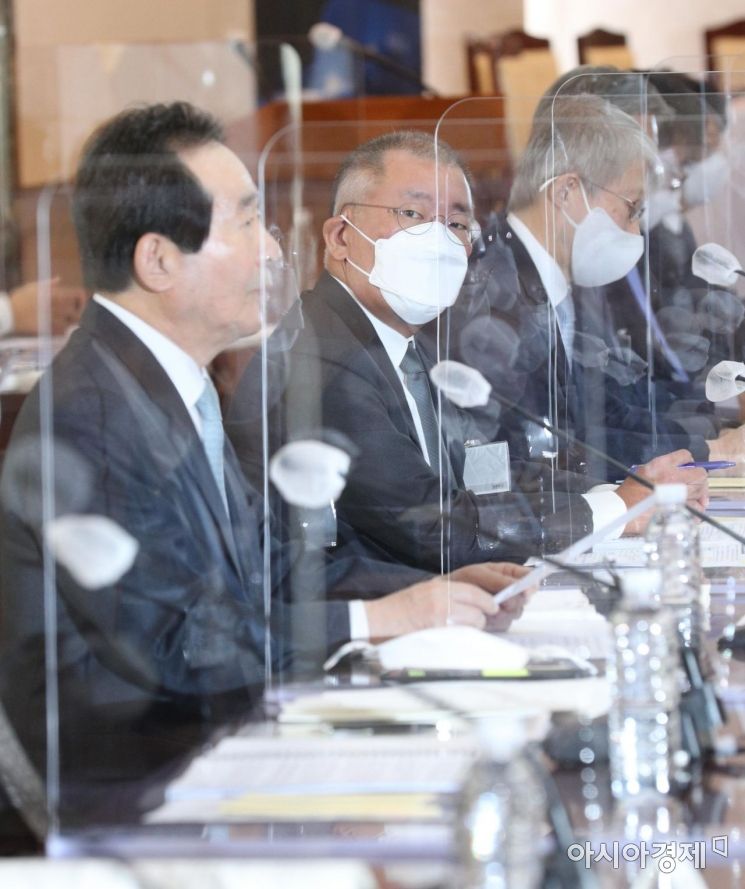 Prime Minister Chung Sye-kyun is delivering a welcoming speech at the '2nd Hydrogen Economy Committee' held on the 15th at the Government Seoul Office in Jongno-gu, Seoul. Photo by Jin-hyung Kang aymsdream@
[Asia Economy Reporter Moon Chaeseok] The government will introduce a system from 2022 that mandates the purchase of a certain amount of electricity generated by hydrogen fuel cells in the power market. Additionally, it will improve the natural gas supply system for hydrogen production to reduce prices by up to 43%, and establish a special purpose corporation (SPC) through public-private partnership to actively build hydrogen refueling stations for commercial vehicles.
On the 15th, the government held the '2nd Hydrogen Economy Committee' at the Government Seoul Office, chaired by Prime Minister Chung Sye-kyun, where it deliberated and approved two agenda items containing these measures and reported on three other items.
First, the government will introduce the 'Hydrogen Power Obligation System (HPS)' by 2022. This policy separates hydrogen fuel cells from the existing Renewable Portfolio Standard (RPS) system, which includes solar and wind power, creating a separate mandatory supply market for hydrogen fuel cells. To this end, the government plans to amend the 'Act on the Promotion of Hydrogen Economy and Hydrogen Safety Management (Hydrogen Act)' by next year to include mid- to long-term supply obligations in the basic hydrogen plan under the Hydrogen Act.
The government aims to increase hydrogen supply to achieve 8GW by 2040 and generate investments of 25 trillion KRW over the next 20 years. A government official stated, "As far as we know, there are no cases overseas where hydrogen power generation has been made mandatory."
The government plans to change the existing natural gas supply system, which only allowed city gas companies to supply, to permit Korea Gas Corporation (KOGAS) to directly supply natural gas to large-scale hydrogen producers. Furthermore, KOGAS's individual tariff system, previously limited to power generation, will be expanded to include hydrogen production. This will allow hydrogen producers to import natural gas separately at recently lowered prices, resulting in about a 30% reduction in raw material costs. For natural gas used in hydrogen production for vehicle refueling, temporary exemptions on taxes and fees (import duties and safety management fees) will be pursued.
The government, local governments, and companies have agreed to establish the SPC 'Kohygen' to build hydrogen refueling stations for urban commercial vehicles and signed a memorandum of understanding (MOU) on the same day. Kohygen will receive a total project budget of 330 billion KRW, including 167 billion KRW in government subsidies and 163 billion KRW in investments. The public-private partnership will finalize participating companies by November this year and officially launch Kohygen by February next year. The goal is to build and operate 35 hydrogen refueling stations for commercial vehicles such as buses and trucks.
© The Asia Business Daily(www.asiae.co.kr). All rights reserved.

















