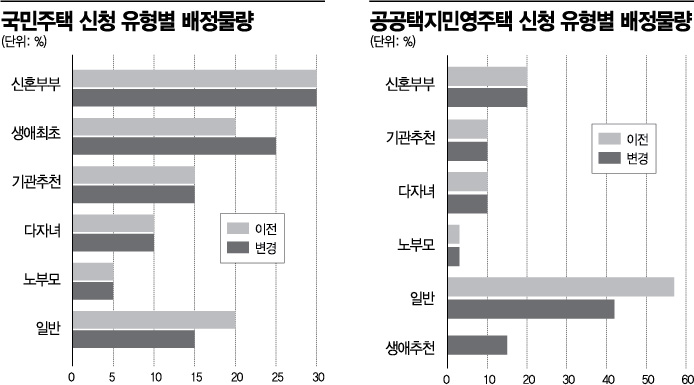
[Asia Economy Reporter Yuri Kim] The government's adjustments to the subscription system appear to be triggering conflicts not only between generations but also within generations. By easing the income requirements for the special supply for newlyweds without changing the supply volume, even households with a dual-income annual salary of 100 million won are benefiting from the 'special supply,' leading to complaints that the benefits for those who truly need them have decreased. Among middle-aged and older groups, whose share of general supply has decreased due to the expansion of special supply ratios such as for first-time homebuyers under the July 7-10 measures, dissatisfaction such as "Is being older a crime?" is not easily subsiding.
On the 15th, sharp conflicts erupted across various online communities regarding the government's announcement the previous day about easing income criteria for special supply for newlyweds and first-time homebuyers. A person in their 30s, Mr. A, said, "The reason for the existence of special supply is becoming meaningless due to the generalized criteria," and criticized, "It would be better to fairly select residents by lottery among all non-homeowners." On the other hand, Mr. B, also in his 30s, welcomed the government's plan, saying, "Excluding people from special supply just because their income is slightly higher is reverse discrimination."
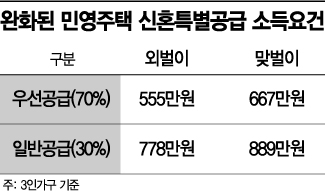
The reason for such conflicts over easing income criteria is that 30% of the special supply for newlyweds in private housing can now be applied for by households with up to 140% (160% for dual-income) of the average monthly urban worker income. For a three-person household, this includes households with a single income of 93.36 million won (pre-tax) or dual incomes totaling 106.68 million won annually.
In particular, dissatisfaction is greater regarding this plan. It is not just that the income criteria were eased, but the share of households with a monthly average income of 100% (120% for dual-income), who have priority, was reduced from 75% to 70%, and the general supply volume (30%) was increased. There are claims that the share for those 'who need benefits more' has been taken away.
Complaints are also high about setting eligibility criteria based solely on income without considering assets. The criteria are said to favor 'gold spoon' individuals who have substantial assets but low income. Most newlyweds working in medium and large companies, who live on their own income without parental support, exceed even the eased pre-tax income criteria, but since they lack enough points for general subscription, they end up being excluded from the subscription market.
In the subscription market, the sense of deprivation among middle-aged non-homeowners and one-homeowners who have struggled to buy homes on the outskirts with loans has already grown significantly due to the excessive proportion of special supply. Mr. C, in his 50s, said, "These days, I wonder if only the youth are considered citizens," and added, "Instead of increasing the volume to accommodate those in their 20s and 30s, taking away the share from high-score applicants and redistributing it inevitably causes dissatisfaction among those who fail to meet the criteria."
Industry insiders point out that such conflicts between and within generations are triggered by the government's attempt to appease the younger generation's dissatisfaction through the subscription system without increasing the overall supply. An industry official said, "When the same volume is divided and distributed according to preferences, conflicts are inevitable," and added, "Ultimately, the fundamental solution is to expand supply through deregulation."
Fundamental criticisms of the subscription system are also emerging. There are voices calling for a change in the structure where winning a subscription results in tens of millions of won in profits for the winner. Senior Researcher Seong-gyu Doo of the Korea Research Institute for Construction Industry said, "The 'lottery sale,' where the price difference goes entirely to the winner, intensifies subscription overheating," and suggested, "While refining the distorted subscription criteria through multiple revisions, measures such as introducing a bond bidding system should also be considered."
© The Asia Business Daily(www.asiae.co.kr). All rights reserved.


















