Increase in Delivery Orders Due to COVID-19 Spread
Business Owners Struggling with 'Black Consumers' Abusing Delivery App Reviews
Experts Say "App System Must Be Improved to Enhance Review Culture"
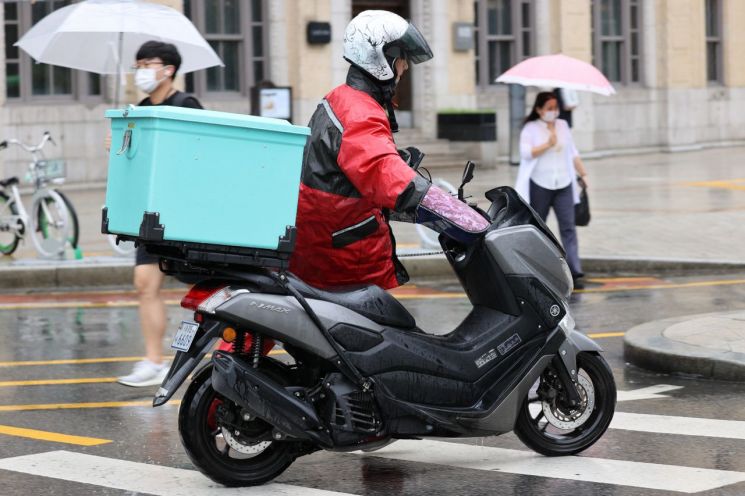 On September 2nd, a delivery rider was walking with a motorcycle near the crosswalk by Gwanghwamun Station in Jongno-gu, Seoul. [Image source=Yonhap News]
[Asia Economy Reporter Heo Midam] "It's so bad I just can't eat it. I'll just throw it away.", "If you give me a service, I'll write a good review."
Recently, some consumers have been repeatedly posting malicious slanders about food ordered through delivery apps, causing a social problem. They exploit the fact that delivery app reviews greatly influence consumers' choice of stores, using so-called 'rating terrorism' and malicious reviews as bait to demand unreasonable services from store owners.
In particular, some consumers go beyond simple criticism of the food's taste and even post photos of throwing food into the sink drain or trash bags, deepening the worries of business owners. Experts say that malicious reviews have a significant impact on consumers' choices and recommend that delivery apps take firm measures themselves.
As the time spent at home increased due to the spread of the novel coronavirus infection (COVID-19), the demand for delivery food has also increased.
According to the 'Online Shopping Trends' announced by Statistics Korea on the 5th, online shopping transaction amount in August was 14.3833 trillion won, a 27.5% increase from one year ago (11.2786 trillion won). By product category, the transaction amount for delivery food services such as pizza and chicken surged by 83.0% to 1.673 trillion won. This is the largest transaction amount since statistics began to be compiled in January 2017.
The number of delivery app users is also increasing accordingly. As of the first half of this year, 'Baedal Minjok' and 'Yogiyo' secured a total of 14 million users and more than 170,000 registered stores.
The problem is that as the number of consumers using delivery apps has increased, the influence of malicious reviews has also grown. There are reports of so-called 'black consumers' who pick faults even when the restaurant is not at fault, demand refunds, and threaten to write malicious reviews if services are not provided.
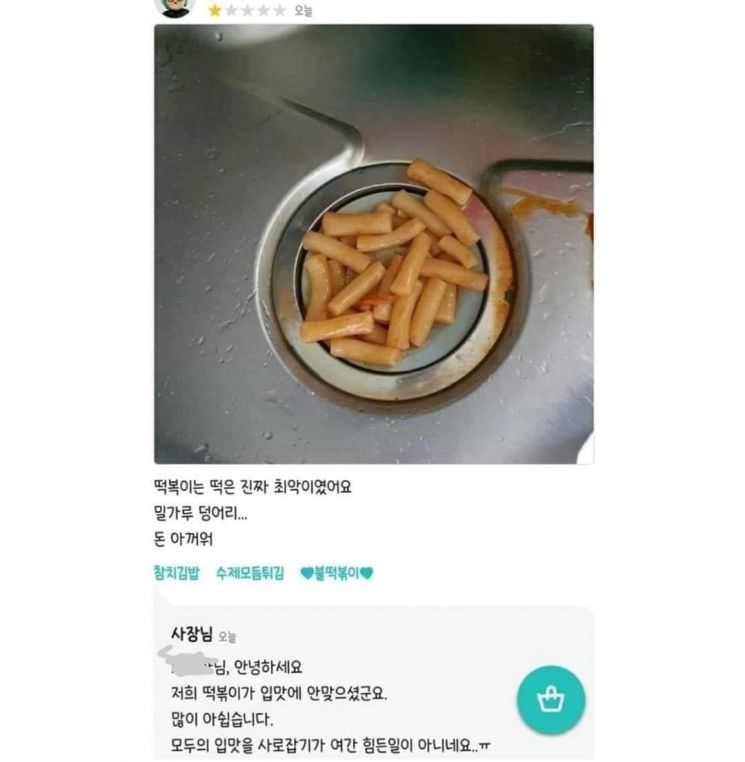 A review posted by a consumer on 'Baedal Minjok'. Photo by Baedal Minjok delivery app screen capture.
Such grievances can be easily found in 'Apeunikka Sajangida,' the largest online community for self-employed people in Korea.
A poster who identified themselves as a restaurant owner said, "We give drinks as a gift only to customers who order more than 10,000 won, but a customer who did not order more than 10,000 won carried out a 'rating terrorism,'" adding, "I usually don't care much about ratings, but I get angry when I am criticized for absurd reasons."
In particular, some consumers go beyond criticism of the food and even post photos of throwing food into the sink drain or trash bags. A business owner in their 50s who saw such a review expressed through a delivery app comment, "I retired from work in my late 50s and run this store with my wife as a matter of life and death," and said, "There have been various incidents, but seeing photos of food being thrown away as garbage breaks my heart and makes me feel as if I could die from the pain today."
The problem is that consumers are directly influenced by malicious reviews. Consumers usually decide their orders by looking at reviews about food and service.
Kim (30), an office worker who frequently uses delivery apps, said, "In cases where I cannot visit the store directly, I mostly order by looking at reviews," adding, "I trust stores with high ratings more, so I try to avoid stores with low ratings. Ordering food from places with bad reviews makes me feel like I'm losing out."
As a result, some people have expressed opinions that reviews should be abolished altogether. On the Blue House's public petition board, a post titled 'Please listen to the stories of self-employed people' was uploaded on the 13th.
The petitioner, who identified themselves as self-employed, said, "A customer ordered without checking the delivery fee, but carried out review terrorism saying, 'Why is the delivery fee so expensive?'" and added, "The delivery fee received from the customer is not kept by the self-employed person but given to the courier."
They continued, "It was the customer's fault, but they acted as if it was our fault and carried out review terrorism. I suggested this to the delivery app customer center, but there was no response," they lamented.
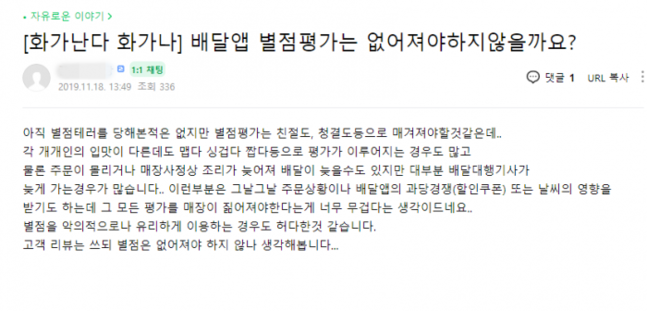 A business owner is expressing dissatisfaction with the review feature of a delivery app. Photo by Naver Cafe 'Apeunikka Sajangida' capture.
In response to this situation, delivery apps are also actively managing reviews. 'Baedal Minjok' has deleted a total of 62,000 illegal reviews from the start of service in 2010 until April 2019.
'Yogiyo' is also filtering out fake and abusive reviews using AI technology and has strengthened sanctions such as warnings and expulsions upon detection. However, with over 10 million delivery app users, it is pointed out that it is difficult to filter out malicious reviews by enforcement alone.
Experts suggest that the delivery app system should be improved to enhance the review culture.
Professor Lee Eunhee of Inha University's Department of Consumer Studies said, "Consumers refer to reviews and photos to choose one among many options they have not experienced. In such cases, malicious reviews inevitably have a significant impact on consumers' choices," adding, "This is also why self-employed people inevitably suffer from malicious reviews."
She added, "If false reviews about a store are posted, it is necessary for delivery apps to take firm measures."
© The Asia Business Daily(www.asiae.co.kr). All rights reserved.



















